
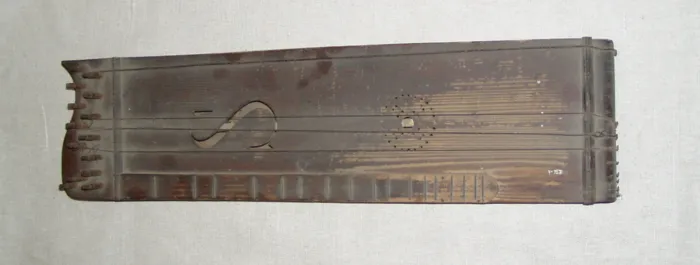
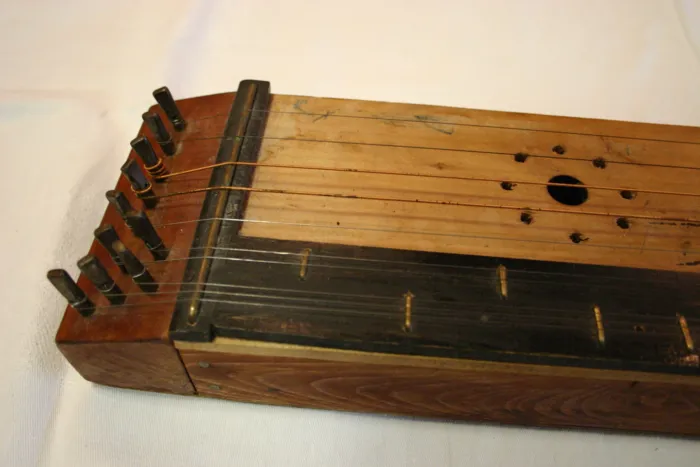
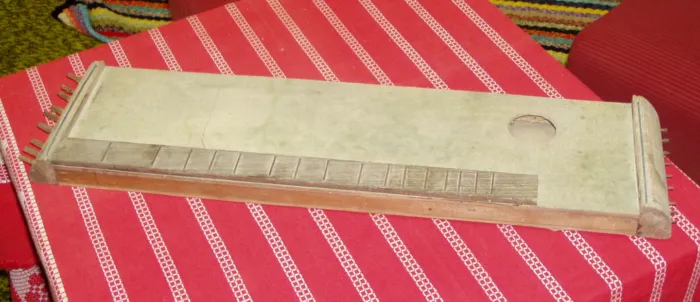
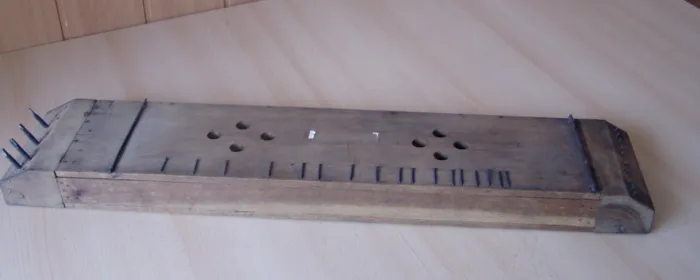
Flat-wide box zithers from the Highlands
Foreign national part value
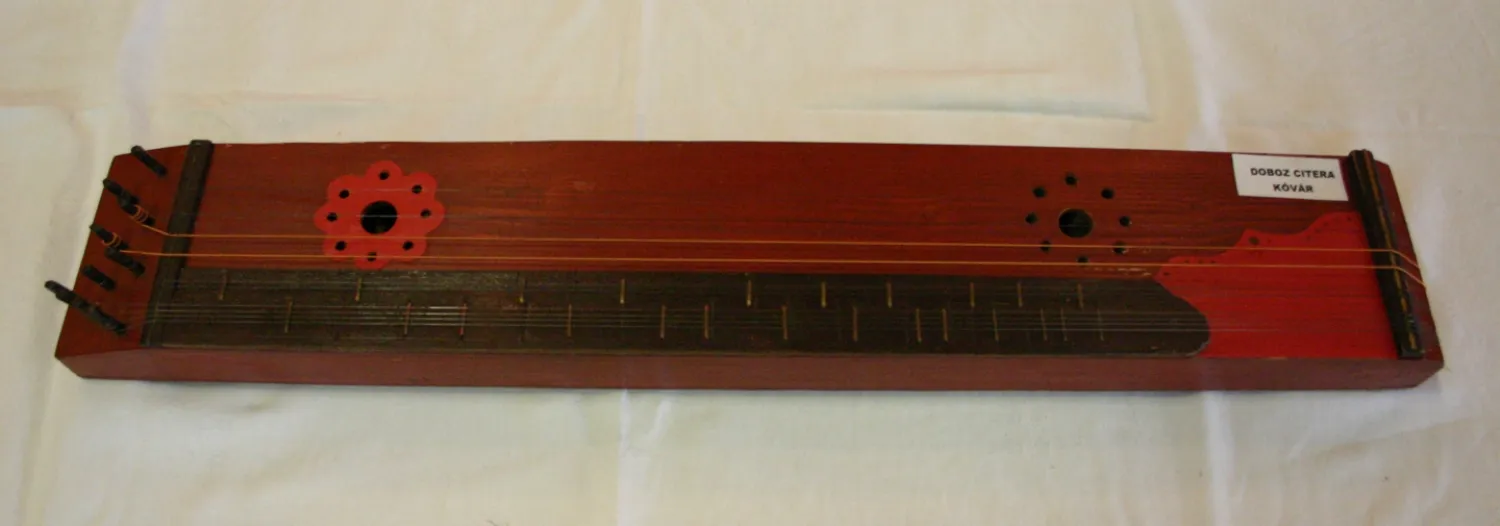
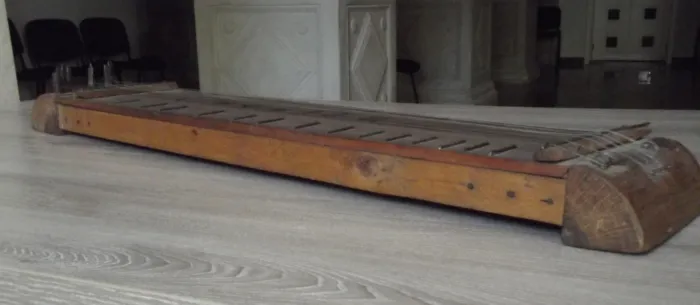
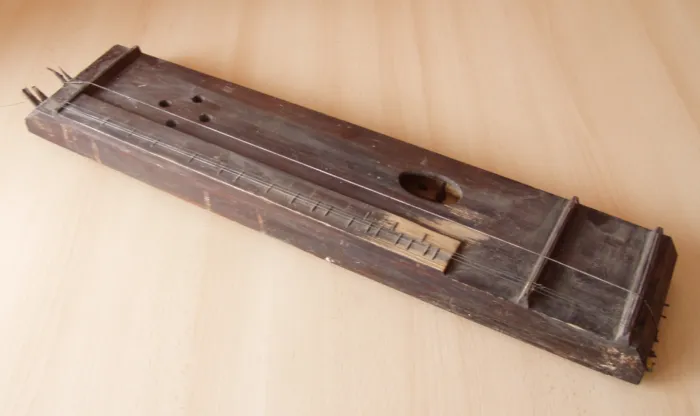
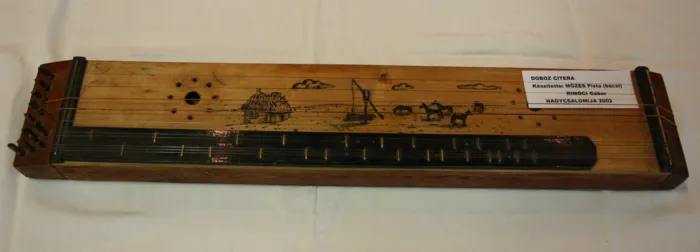
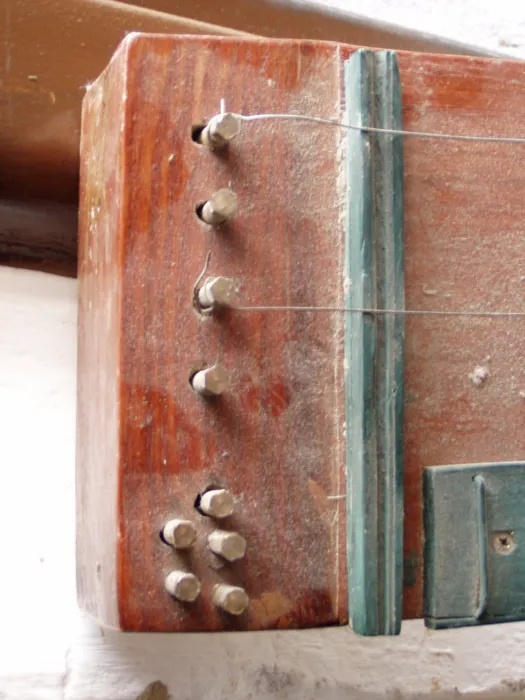
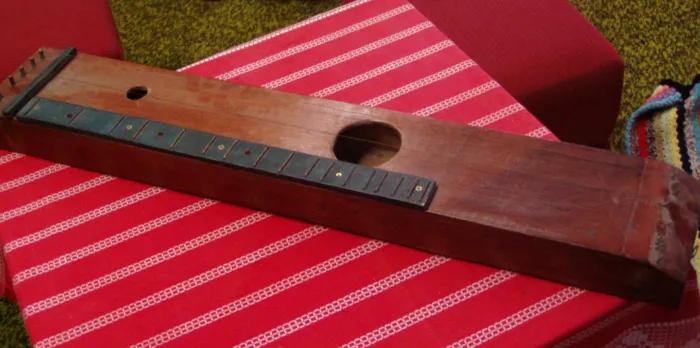
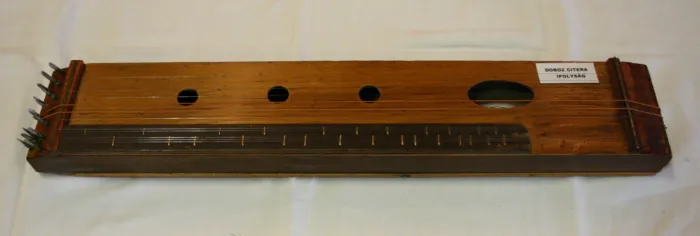
In Europe, the zither is sporadically recorded from many places. The Belgian (Flemish) researcher Wim BOSMANS explains why it spread so explosively at the beginning of the 20th century. According to him, it was because World War I moved the poor strata (as soldiers) of different cultures (countries) so far that they were able to adopt people from each other, and they were able to adopt the zither from each other. This is confirmed by Bálint Sárosi, who refers to old Székelys, according to whom the zither was brought to Transylvania by soldiers from the Great Plain at the end of World War I (Sárosi 1998. 40.); Few folk instruments can rival the Hungarian table zither in popularity. At the end of the 19th century and the beginning of the 20th century, many houses in villages inhabited by Hungarians had such an instrument, or a person who could play it. The zither, or table tambura, is the embodiment of family music in this era, in the countryside. In the time before radio, television, and hi-fi towers, it was almost the only source of instrumental musical entertainment in simple village homes. Of course, shepherds, farmers, and manual workers had flutes, bagpipes, wind instruments, and tambourines, but orders of magnitude fewer than the zither. This is proven by museum collections and unique historical pieces that can still be found today. ; Regarding the basic type of the instrument, the trough zither carved from a single piece, researchers have different opinions about when and where the first Hungarian zithers were made. ; However, it can be convincingly proven that from this basic type, in each region, in the Hungarian cultural environment, the formal and structural variants develop, which are decisively characteristic of the individual ethno-cultural areas. ; As a result of Ferenc Borsi's research into the form and structure of about 500 zithers, which has been ongoing for more than ten years, the geographical distribution of several zither types has been outlined, with the documentation of photos and data sheets. ; Not only Ferenc Borsi, but also contemporary experts in folk instruments (individuals who can play the instrument), who also conduct research, agree that the two-row chromatic scale of the Great Plain zithers is a distinctly Hungarian characteristic, since Flemish and Walloon zithers are mostly single-row diatonic, while instruments from German-speaking areas mostly have single-row chromatic tangent scales. The fact that the two-row chromatic tangent scale is deeply embedded in our musical tradition is proven by the fact that we also find this system on early tambourines with bourdon accompaniment and on Hungarian reed lutes. ; There were researchers who were unable to establish a logical regularity from the extremely diverse sizes of zithers. The large number of samples showed that it is not the individual sizes that should be compared, but the dimensional ratios. In the case of the zithers, we find longitudinal, lanky, high-sounding boxes (5-11 cm), narrow, long-headed zithers in the Great Plain, while in Southern and Western Transdanubia and in the Highlands (in Csallóköz, Mátyusföld and along the Ipoly River) zithers with wide, flat sounding boxes (3-6 cm), short-headed zithers were made. The wide-flat type of zithers, almost all have closed boxes (bottomed out at the bottom), are therefore box-like, while the longitudinal type of zithers from the Great Plain are usually open at the bottom. ; The dimensional ratios of the wide-flat type of zithers, box zithers are strongly correlated. If we divide their string length by the width of the foot, and the quotient is less than 5, then the soundboard is flat, the width of the head is greater than its length (they have a short head, their length is 3-5 cm), and the tuning pegs in the short head are typically arranged transversely. These proportions clearly define the block-shaped zither typical of the Highlands. Which is why we can consider it a national treasure of the Highlands.