
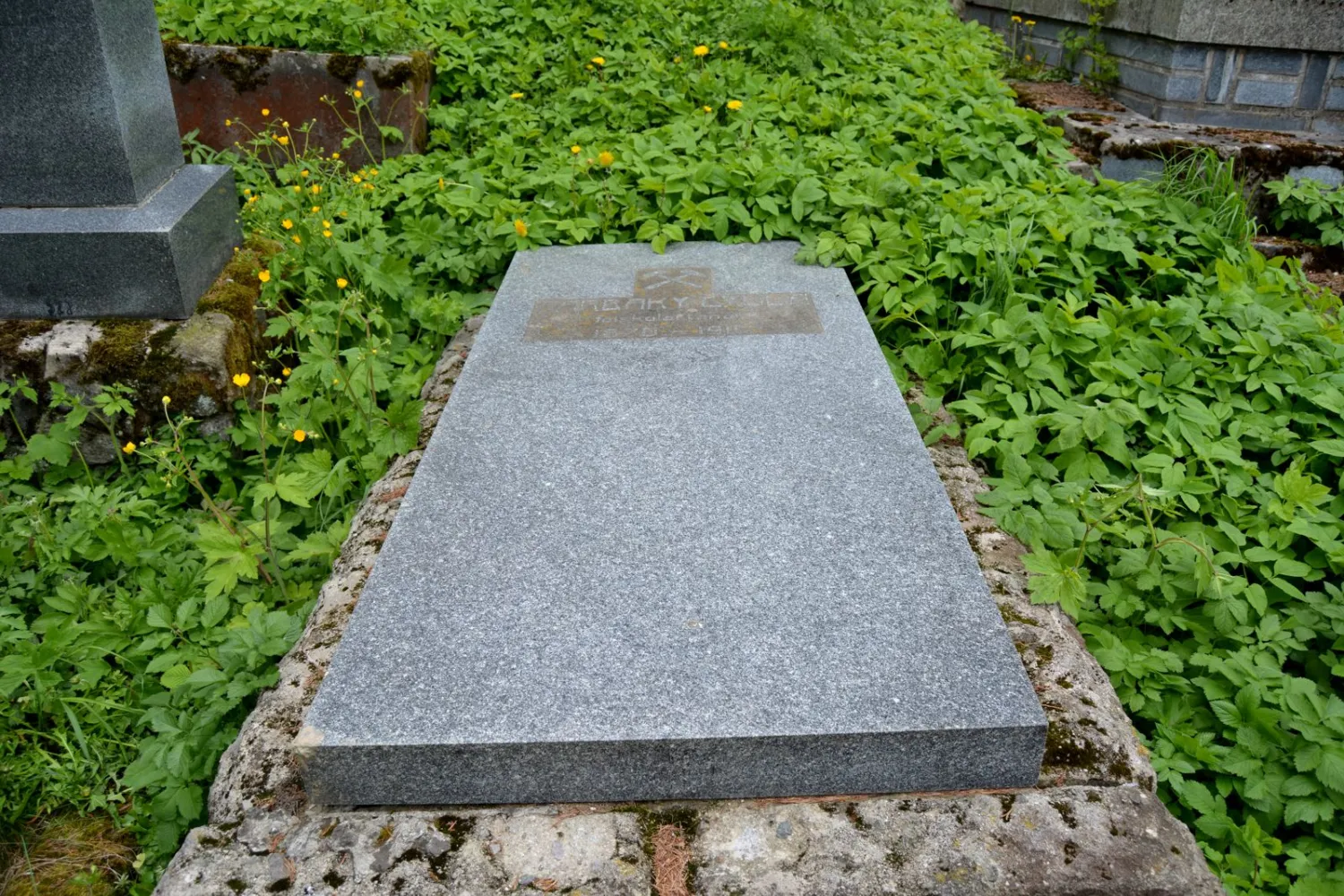
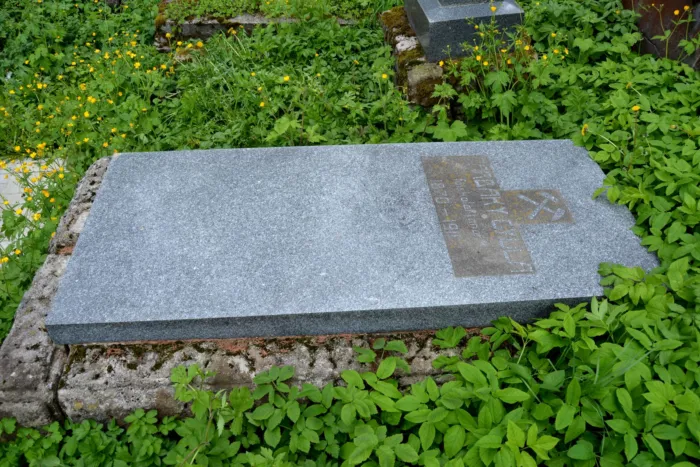
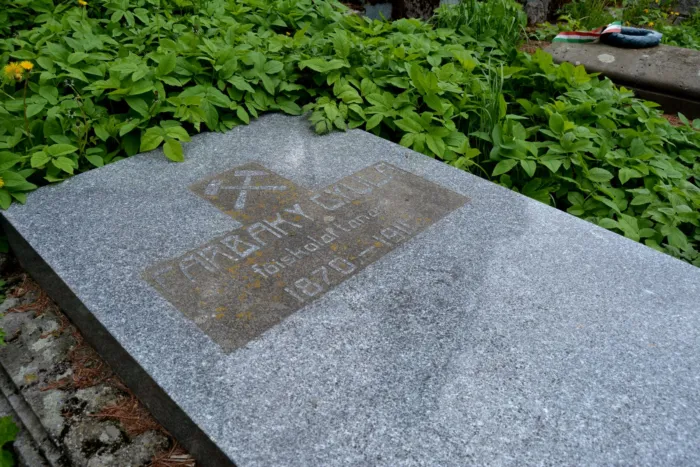
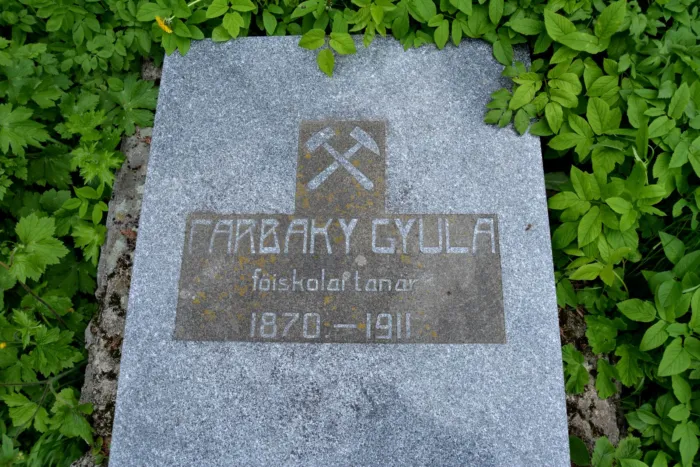
The resting place of Gyula Farbaky
Cemeteries, tombstones, graves
Gyula Farbaky (Munkács, April 18, 1870 - Selmecbánya, October 1911) was a smelting and mining engineer, academic teacher, and was a student at the Selmec Academy from 1888 to 1891. He graduated in metallurgy, and later also graduated in mining. In 1892, he became an assistant at Selmecbánya, and in 1894-95, he was an assistant professor at the metallurgy department of the Aachen University of Technology. In 1895, he studied metallurgy in Westphalia and Belgium, and then in Sweden. From 1895, he worked as an engineer at the Selmec smelting office. From 1905 until his death, he was a full professor and head of the II. Department of Mechanical Engineering at the Selmec College. He published numerous publications. He was unable to finish his monograph on non-ferrous metallurgy due to his early death. He had a fatal accident while working. His gravestone can be found in the Lower Evangelical Cemetery in Selmec. ; ; The weekly newspaper A Bánya reported on the circumstances of the accident in its November 5, 1911 issue: ; "A young life, a hopeful drive for such a significant family in the field of mining, for one of the most important colleges in the country, was cut in two at the waist. Gyula Farbaky, a college professor in Selmec, died, the thread of his life was cut in two by a truly unpredictable decision of fate. ; If there is a tragedy on earth, it is certainly his. A miner who has been walking the depths of the mine all his life. He is used to facing the most secret and most terrifying, because indescribable, horrors of the depths of the earth, who cannot fear or tremble, because - when, tempting God with His holy name, he descends there to fulfill his noblest and most devoted duty to humanity, who is brave and strong, young and generous, a miner who is a friend of mother earth: he stands on the roof of a cellar and a moment later his wife and two children sob after him for a lifetime. The mines The depth did not harm him, but he was buried in an ordinary cellar. ; He had barely exceeded his tenth year of teaching service when he was taken away by a harsh fate. The sincere mourning of the teaching staff and youth of Selmec, the entire society of the town of Selmec, accompanied him on his last journey through the streets of Selmec. But the entire Hungarian mining community participated in this mourning, whose sincere condolences we express. ; In front of the laboratory pavilion of the new palace of the mining college, there is an old building that has just been demolished. College professor Gyula Farbaky was standing on the terrace of the laboratory at two in the afternoon and watching the demolition work. In the meantime, the terrace, under which the cellar is located, suddenly collapsed with a huge bang. When the big cloud of dust cleared, the workers involved in the demolition and the passers-by gathered at the scene of the accident. The teachers and the servants who were staying at the college also arrived there, but even then no one thought that there was a person buried under the ruins. ; — Have you seen Professor Farbaky, please? — the laboratory servant suddenly asked worriedly. ; No one knew about it. Then the servant said that Professor Farbaky was probably on the terrace at the time of the collapse. László Fodor, the rector of the college, who had also arrived in the meantime, instructed the servants to search for Professor Farbaky in his apartment, or if he was not there, in the city. ; An exciting half hour passed, then the servants returned one after another and reported that they had not found the teacher anywhere. Gyula Farbaky's wife and two children also arrived at the scene of the accident, who sobbed and urged them to dig up the earth. They were consoled that if Farbaky were to be found or if the earth had really buried him, they might still be able to save him. ; Since the The basement was eight meters deep, and such a thick layer of earth had to be dug out. The workers who were working nearby started this work right at the first minute of the accident, because one of them claimed that he thought he heard a sharp cry at the time of the collapse. The rescue was led by Jenő Sobó, chief mining advisor, and Géza Réz, college professor. ; The whole town gathered at the scene of the accident. The college youth, who loved the missing teacher very much, also took up shovels and helped remove the mass of earth. Since this work was progressing slowly, a hole was drilled from above, which went down to a depth of eight meters. In this way, they wanted to introduce air into the depths of the basement so that Farbaky would not suffocate if the earth did not press down on him. ; When evening fell, they continued the feverish work by torchlight. The whole town was in a state of excitement, the women were crying and begging the work leaders to hurry. No grown man in the city could find peace, everyone was waiting there at the scene of the disaster. ; Ten hours after the collapse, at a quarter to one at night, a worker finally exclaimed in shock: ; — He lies here! ; One leg was visible from the ground. Soon the whole body was dug up. A terrible silence fell and the rector spoke in a grave voice: ; — He is dead. ; The dug up body was that of Gyula Farbaky. The doctors there determined that his death was caused by suffocation. There were no external injuries on him. The dead body was taken away and the public of the city was filled with sympathy. The police launched an investigation into who was responsible for the accident. ; Gyula Farbaky, who had met with an unfortunate end, had been a regular teacher at the for the mining and forestry college. He lectured on mining and general mechanical engineering. He was a very talented man who also took an active part in professional literature. ; The funeral of the tragically deceased teacher, according to mining custom, will probably take place on Sunday evening."