
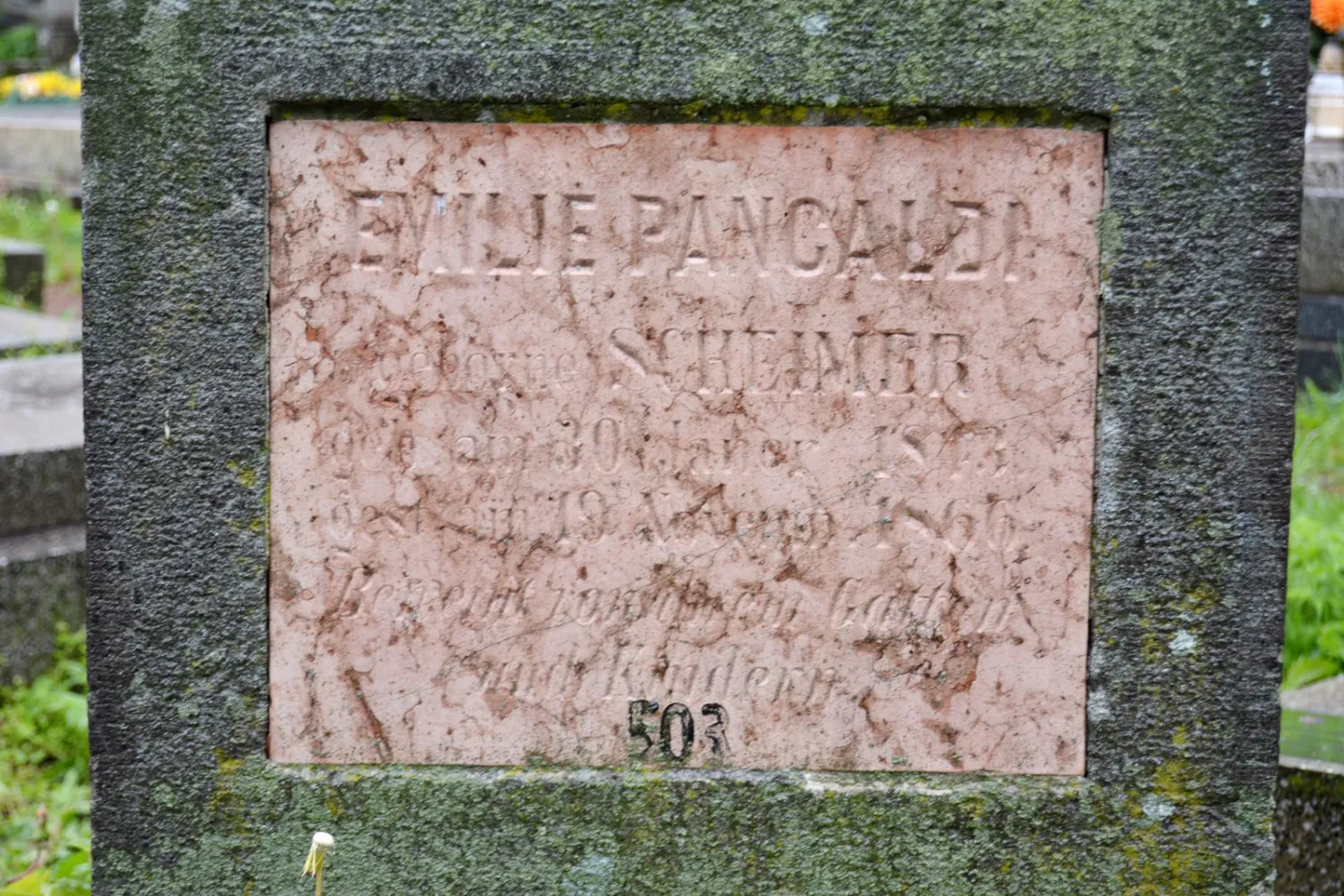
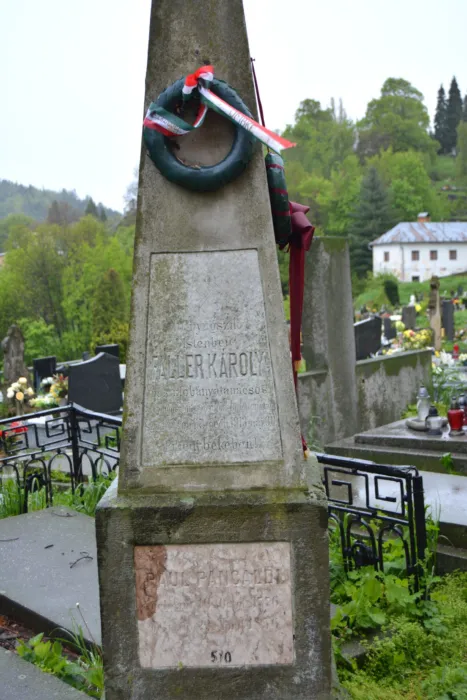
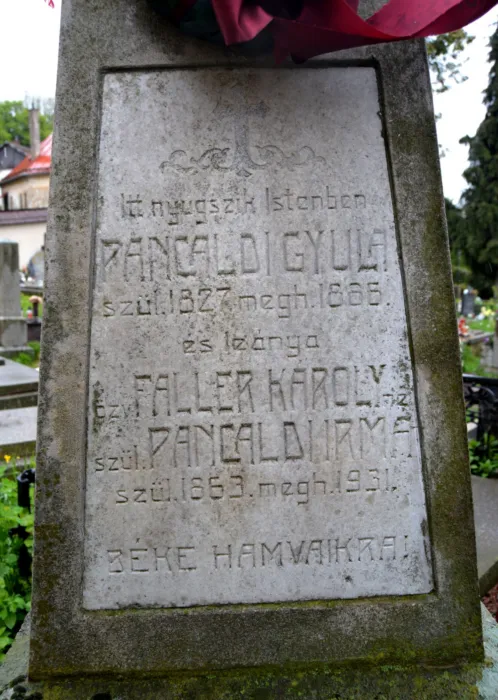
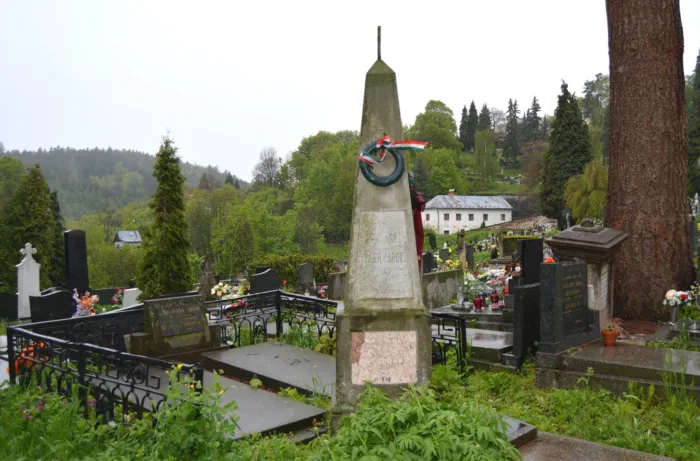
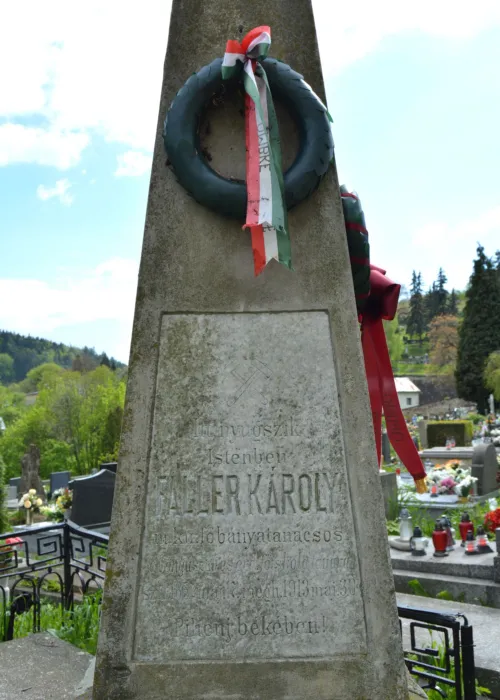
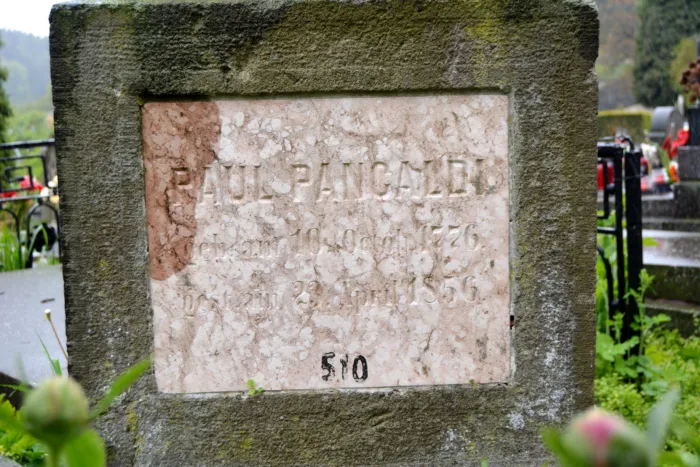
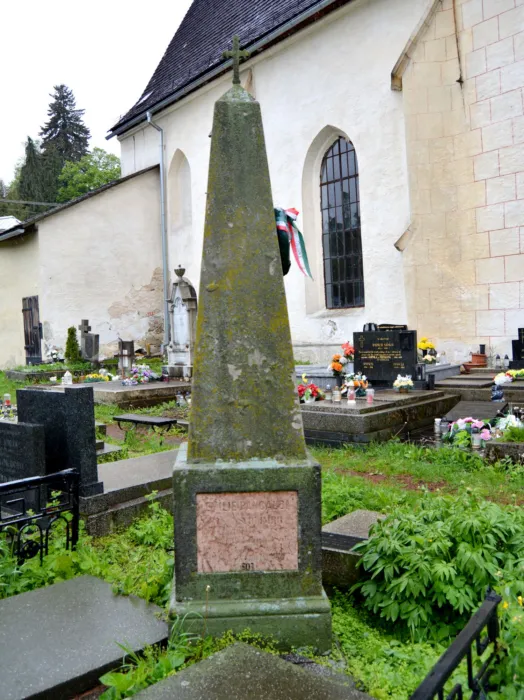
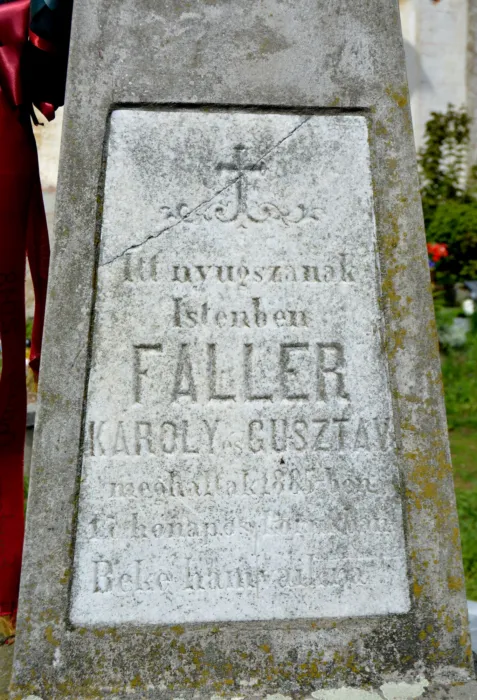
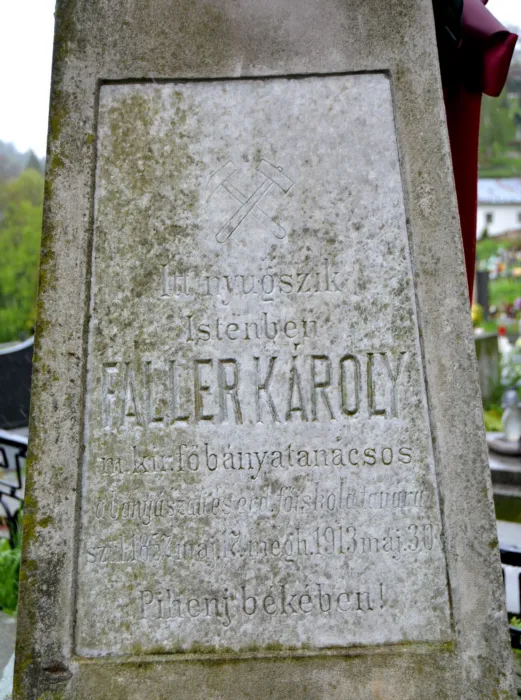
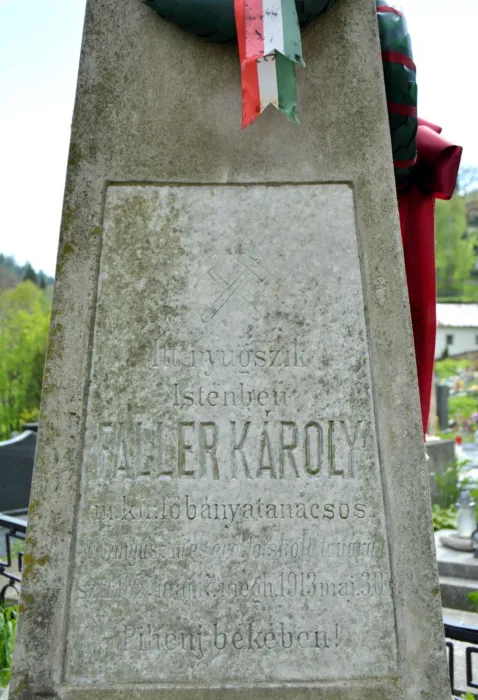
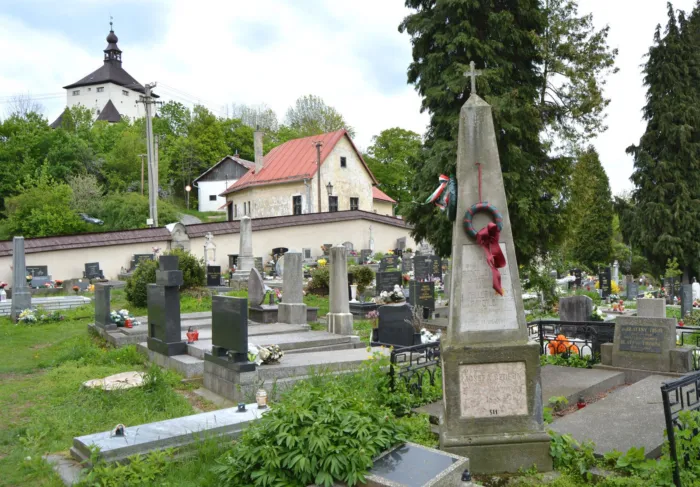
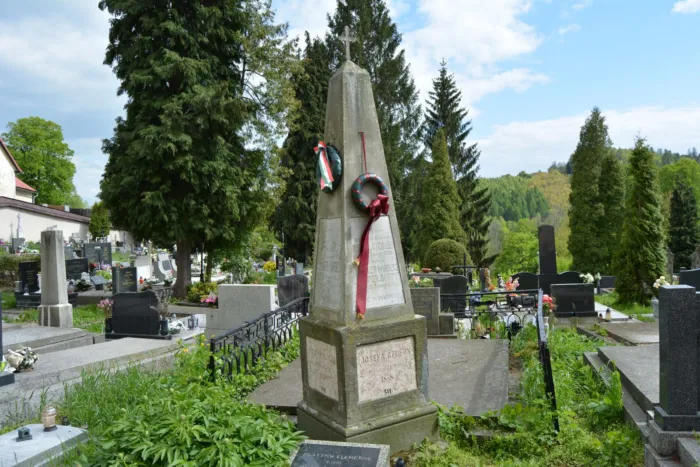
Tomb of Charles Faller
Cemeteries, tombstones, graves
Károly Faller was a metallurgical engineer, college professor, president of the Selmecbánya Mining and Metallurgical Literature Support Association (1889–1892), and a founding member of the National Hungarian Mining and Metallurgical Association. He was born on May 17, 1857, in the ancient mining town of Selmec, where his father was already a mining academy teacher. According to other sources, his date of birth is May 21, 1857. (Csath B., 1992. p. 130.) He completed his secondary school studies in Selmecbánya and Košice, and from 1875 he was a student of the mining academy. After completing his college studies, he worked in Košice, Nagybánya and Budapest, and in 1882 he was appointed a metallurgy teacher in Selmec. After minor professional detours, he was assigned to the metallurgy department in 1894, where he was a professor until 1913. In the meantime, the government sent him abroad to study the more famous smelters. The outlook was useful: he wrote original studies about his experiences and travelogues about his experiences. He visited, among others, such developed industrial countries as Germany, Italy, Switzerland, France, England, Belgium, the Netherlands and Sweden. ; In Selmecbánya, the academic teachers of the academy were also textbook writers. Károly Faller also wrote his greatest work here, his monograph entitled A fémkohásztan készészésékészek. The four-volume work was published in Selmecbánya in 1896, 1898, 1902 and 1904. According to experts, “This book was a reference book for metallurgists for a long time. It is characteristic of its value that our older metallurgists still use it with profit today. For a long time, this was the only work on metallurgy in the Hungarian language.” (Horváth Z., 1959. p. 556–561) Károly Faller carried out a whole series of pioneering works in his field. For example, in Hungary, he was the first to try to “use metallographic methods to explain the phenomena taking place in metallurgy.” (Horváth Z., 1959. p. 559) In 1903, he published his work entitled Tanulmányok a metallógrafá teren in Budapest, and in 1905, his work entitled A kedmény ólom mikrostrukturja was published there. He also wrote studies on newer explosives and the colloidal state of metals. ; He did not isolate himself from public life either. He prepared the chapter entitled Metallurgy for the county monograph. From this we can learn that the oldest age of metallurgy in Selmec is “covered in darkness”, but it can be proven that smelters existed here as early as the 14th century. Around this time, every miner had his own smelter or metal smelting workshop. The smelters processed the mineral resources of the mines of the Selmec district: silver and lead ore, as well as lead copper ore. The pedagogical methods of the teacher, who had rich subject knowledge and traveled the world, were also characterized by the fact that he successfully combined theoretical education with practice. Selmec had the opportunity to do this, because the town enjoyed its heyday with its “rich mining treasures” for centuries. It is no coincidence that when the 18th century At the beginning of the 19th century, the Viennese government had to decide where to set up the mining school, and Selmec came to the fore, compared to Vienna and Prague. After all, as the justification stated: “The town is small, but it has an intelligent character, where the true mining spirit has long been rooted in homely and warm soil...” (Sobó J., 1906. p. 199) Our distinguished native, our Hungarian teacher predecessor, who died in Budapest on May 30, 1913, undoubtedly contributed significantly to the enrichment of traditions in his area. ; From his marriage to Irma Pancaldi, four children were born: two sons who died in infancy, Gusztáv and Károly, and Gizella and Irén. ; Károly Faller’s tombstone can be found in the Frauenberg cemetery. ; ; His main works: ; • On the melting of metals by electricity. Mining and Metallurgical Papers, 18(1885) 58–59. ; • Tellurium. Mining and Metallurgical Papers, 22(1889), 140–143. ; • Aluminum. Mining and Metallurgical Papers, 29(1896), 20–23, 36–38, 54–56, 71–73, 87–90. ; • Handbook of Metallurgy, 1-4. Selmecbánya, 1896–1904. ; • Studies in the field of metallography. Athenaeum, Budapest, 1903. ; • The microstructure of hard lead. Mining and Metallurgical Papers, 38/2(1905), 265–277. ; • Synthesis of metal compounds by dissolution and crystallization in metals. Mining and Metallurgy Papers, 39/1(1906), 145–160. ; • Metallurgy. Mining and Metallurgy Yearbook, 1(1909), 173–178.