
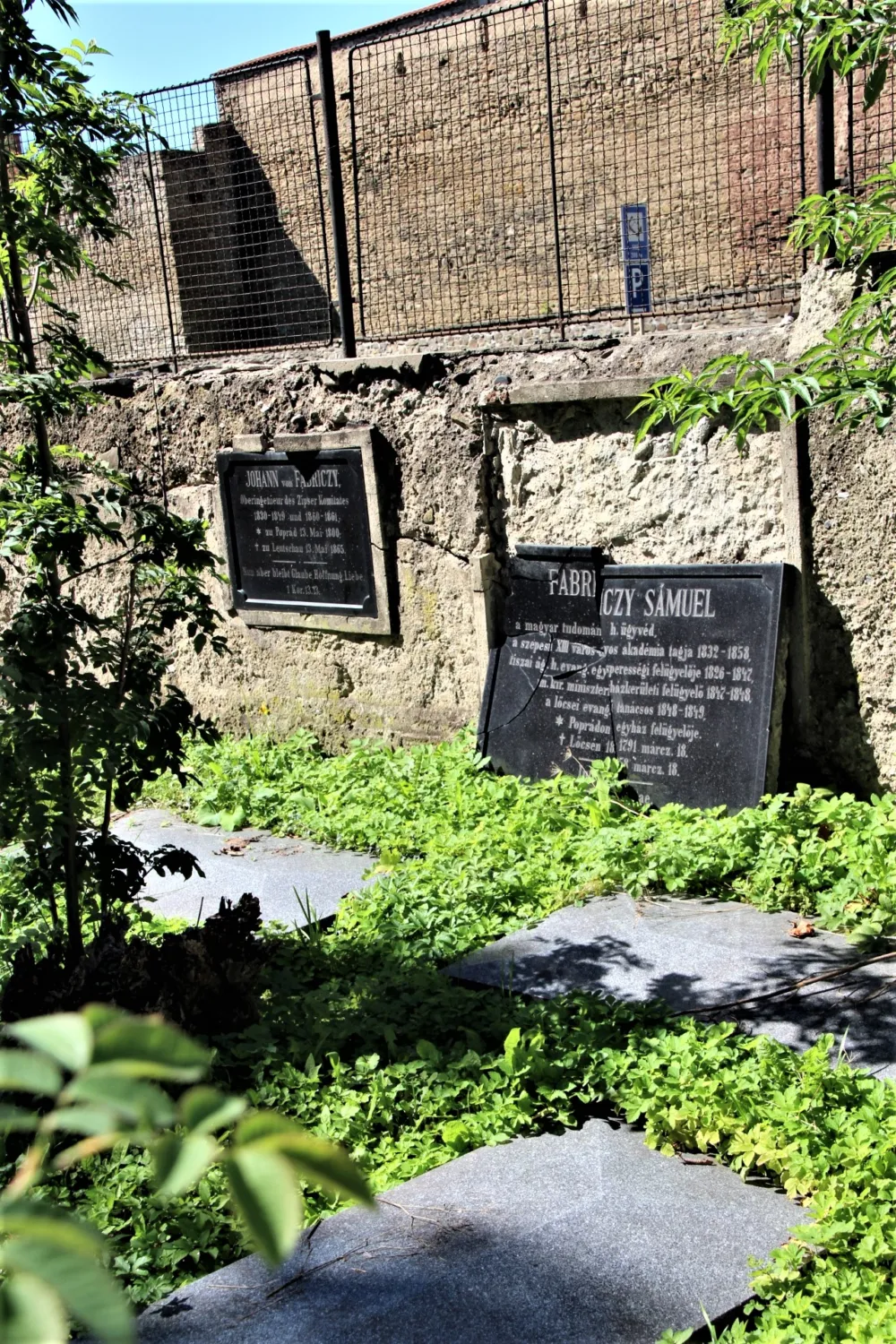
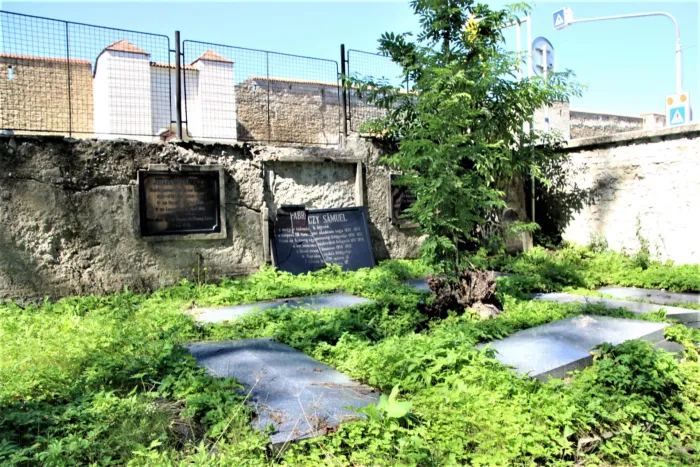
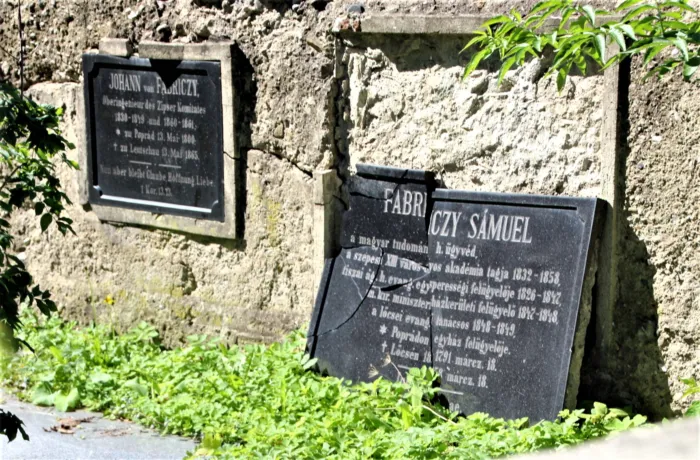
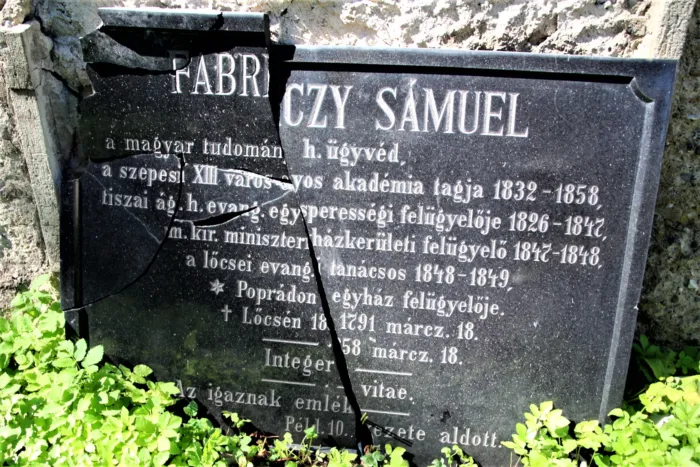
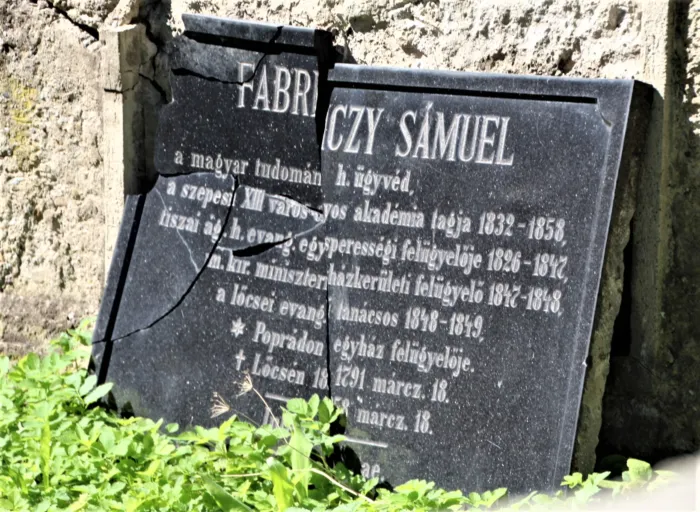
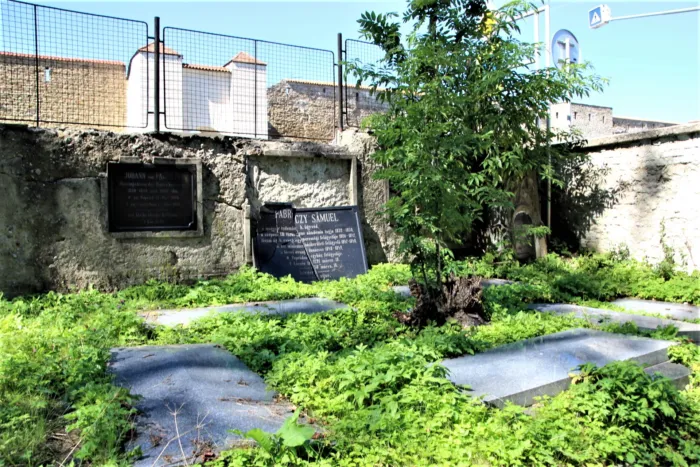
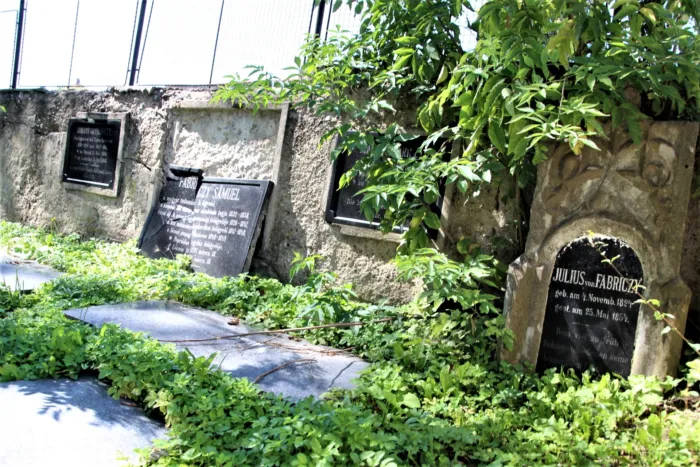
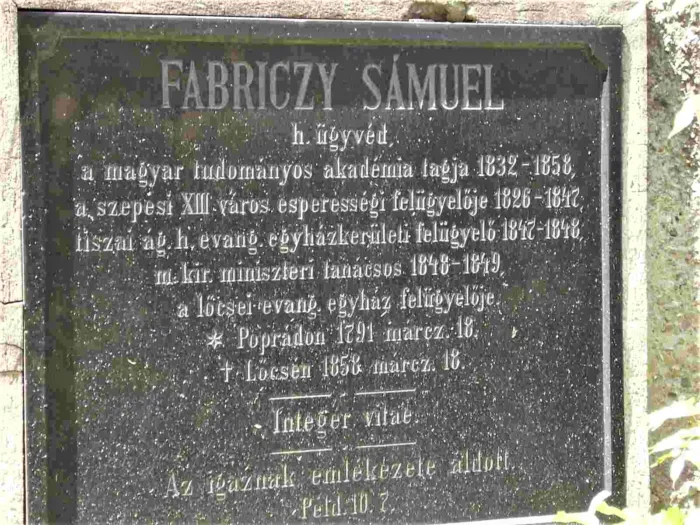
Resting place of lawyer Sámuel Fabriczy
Cemeteries, tombstones, grave sites
Sámuel Fabriczy (Poprád, March 18, 1791 – Levoča, March 18, 1858) was a lawyer, corresponding member of the Hungarian Academy of Sciences, and Lutheran church district supervisor. He was the father of the art historian Kornél Fabriczy. ; He was the son of the Lutheran pastor András Fabriczy and Klára Ab hortis Augustini. He received his first education at the Lutheran school in Poprád, where he learned Latin and Hungarian, leaving syntax in 1803 and completing rhetoric in addition to being home-schooled by Wittchen. In 1805–1806, he studied theology, church history and aesthetics at the Lutheran lyceum in Levoča from teacher Márton Liedemann, philosophy from János Fuchs, anthropology and physics from János Sámuel Hauser, and also practiced French. In 1807, at the Keszmárk Lyceum, he studied Hungarian law from István Aderján, with whom he remained a close friend, political science and diplomacy from Ádám Podkoniczky, and economics from Dániel Mihályik. András Thaisz was his dearest friend here, who had a great influence on his later literary work. In 1808, he went to Miskolc for legal practice and worked for Miklós Eötvös, the county chief prosecutor, and in 1809, for Dániel Várady, the county chief prosecutor. On November 29, 1810, he was sworn in as a lawyer and spent several months dealing with the affairs of a family in Sáros County. In September 1811, the chieftain of Torna County, János Okolicsányi, appointed him as his secretary. He attended the Diet of Bratislava in this and the following years and informed Count Henrik van der Nath, who was a Diet envoy, about the events of the Diet. After the Diet, he stayed in Őrmező, Zemplén County, at the residence of chieftain János Okolicsányi, for two more years and was elected as a magistrate of this county. He spent his free time studying French and Italian works. In 1814, Gergely Berzeviczy, one of the most distinguished and highly cultured publicists of the time, invited him to be his lawyer, before moving to Szepeslomnica, where he met the famous French geologist François Sulpice Beudant, whom he accompanied on his exploration of the Carpathians. In 1816, Count Emmánuel Csáky appointed him as the sub-notary of Szepes County, in 1818 as the judge of the court, in 1828, when his legal activities increased greatly, he resigned from the notary position, but he participated in the public affairs of the county and, having been elected a member of the committees, he also contributed to the development of instructions given to the deputies of the Diet from 1825 to 1847. In 1820, he was elected as the chief notary of the Tisza Lutheran church district, in 1826 as the inspector of the 13th town of Szepes and on March 9, 1832, as a corresponding member of the Hungarian Academy of Sciences. On August 17, 1841, he resigned from the position of chief notary and became the bar judge of Abaúj County, and in 1847 the chief bar judge of Szepes County. His word had a decisive influence on even the most delicate issues at the county assemblies, and several important proposals addressed to the court chancellery, for example on the occasion of the peasant uprising, came from his pen. On July 5, 1847, he was elected as the supervisor of the Tisza church district, and on April 24, 1848, he was appointed as the Ministerial Councilor for Religion and Public Education. He moved to the capital and during his stay in Buda, he had frequent contact with László Bártfay, Gusztáv Szontagh, Ferenc Toldy, Mihály Vörösmarty, Mihály Helmeczy, Gábor Klauzál, József Bajza, Pál Szemere and especially Count István Széchenyi, with whom he later corresponded. After the War of Independence, he returned to Levoca, where he worked as a lawyer and in literature. In 1854, the Levoca Evangelical Church elected him as its supervisor. ; His wife, Mária Izabella Scultéty, whom he married on June 19, 1821, died of cholera on September 1, 1855, having buried his son, Gyula Fabriczy, a year earlier. László Szalay wrote about him (Pesti Hirlap, 1844): he is as thoroughly knowledgeable as he is modest, his elements of criminal law are characterized by constitutional views and sound principles, there are those whose fame is greater than their merits, and there are others again who deserve greater glory than what they have received, Fabriczy is among the latter. ; The graves of Sámuel Fabriczy and his family members are in the upper right corner of the cemetery (IX. sector). ; ; Works: ; Elementa juris criminalis hungarici. Leutschoviae, 1819. (Used as a guideline in the Kézsmárk lyceum and elsewhere.) ; Manuale procuratorum. Pestini, 1828. (2nd edition 1835. 3rd edition, 1841. Pestini. He wrote this work in 1820, several people copied it and someone published it anonymously without his knowledge.) ; ; Among his manuscript works, which are in the family's possession, the most notable are: ; Reflections on the power trials, State, Church and Science, On the Solstice, Proposal for a Law on Antiquity, Über das Recht der Selbstvertheidigung, Über Selbstständigkeit des Charakters, Über den Nutzen des heiligen Abendmahls in Rücksicht auf das Ganze der christlichen Kirche, Über den Umgang mit Leuten von schlechtem Rufe, Über die Befriedigung gerechter Erwantige, Über den Misbrauch der Satyre, Über die Pflicht nicht unter seinem Stand zu heirathen, Über den Geist des Protestantismus, Charakterbilder von dem ungarischen Landtage zu Pressburg 1811 und 1812, Tagebuch von Szinye-Lipócz 14. Juli bis 31: August 1813. Gemischte Ehen. Über die Freiheit des Willens, Über die griechische, katholische und protestantische Kirche in ihrem Verhältniss zum Fortschritt, Über den Zehent, Der Protestantismus in Ungarn, de recolenda memoria Christi in sacra coena, Systema legislationis criminalis, Compendium historiae civilis, Juramentum episcoporum catholicorum, Sur la déstination de l'Avocat, Sur l'union perpetuelle du bonheur et de la vertu, Sur le devoir de contenterles justes altentes ďautroui, Sur l'explication naturelle des miracles, Sur le but de la mort de Jesus, Sur la fermeté de caractére, list of Hungarian-German words in m. can. from the bequest of the Academy, Tagebuch einer Reise von der Zips nach Wien im J. 1825., Book reviews: Tanulmány count to István Széchenyi Világ c. about his work (Censura did not allow it to be printed), Örtel, Was glauben die Juden? Theses: Zerstreute Gedanken über die Ilias, Über die Aeneis. Über das bereftte Jerusalem von Tasso, Über die Henriade von Voltaire, Über den Oberon von Wieland, Über Campe's Seelenlehre sat. ; ; He began his literary career in 1819, when, in addition to book reviews, he also wrote several larger articles of public interest in his friend András Thaisz's Scientific Collection, mostly anonymously or under the initials F. S. (1819. VIII. The history of the Berzeviczy family, 1820. II. Carpathian migrations, VII. Lipócz spa and its surroundings, Thoughts on some of the most famous heroic poems of old and new nations, VIII. Questions in law, 1822. V. The biography of Gergely Berzeviczy, VIII. Thoughts on some statements found in the philosophical works of Professor Krug, 1823. I. On the jury's seat, VIII. Statistical review of Szepes county from the point of view of national economy, 1824. V. The Ág. religion. Evangelicals of Tiszamellék a short review of the superintendency, 1825. II. On the reszentő and related concepts, 1829. X. Aesthetic and philological heresies), smaller stories in the Társalkodób (1834. Ibrahim and Roxolane, 1835. Charité, after Lucius Apuleius, 1837. Charicléa, after Heliodor in excerpt, 1832. The warming power of firewood, and also Füzér under the section on Law, mostly anonymously: 1833. On bankruptcy lawsuits, On forests. On trial fees, 1834. On customs, On judicial pledge, On capital punishment, On antiquity, On the responsibility of judges, 1835. On historical law, On the prohibition of judgment, On the parliamentary recess, 1836. On deportation, 1839. On elevation, On natural law, 1840. On the freedom of human will, On the crimes of drunkards, On the organization of free royal cities, On the influence of cities in the legislature, On Hungarian first names, On the eternal Aaronic redemption of the urbér burdens, 1841. On the permissive and obligatory law applied to the urbér redemptions, On the property of the clergy, On the payment of the house tax by the nobility, On the elevation of the official prosecutor in criminal trials, On public education, 1842. On teachers and parents, On villages and the salary of teachers, 1848. On the election of county court judges), in Figyelmező (1837. On the Hungarian law of the punitive court to Pál Szlemenics, judgment, 1839. On some works published in the case of the new urbér), in the Athenaeum (1840. A look on the two-chamber system, 1842. A few words on the German universities), in the Budapest Hirado (1846. 399. 400. 402. review of Mittermaier's work, Die Mündlichkeit), in Jelenkor (1844–46. many distinguished treatises and bills: On the subject of city designation and elections, private system, peerage, two-chamber system, antiquity, religious reversals, 1847. 464. p. Judicial arbitrariness, 43. Undemanding views on the proposal of the Augustinian general assembly committee discussing church regulation, 1848. Famine-preventing laws), in the New Hungarian Museum (1852. The punishment for tyranny against rural communities.)