
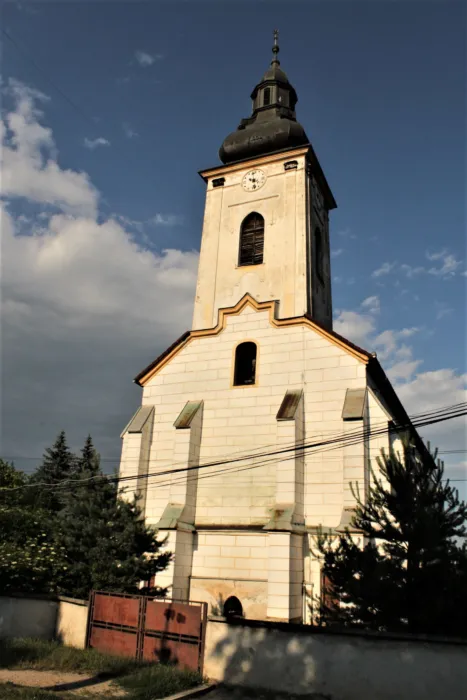
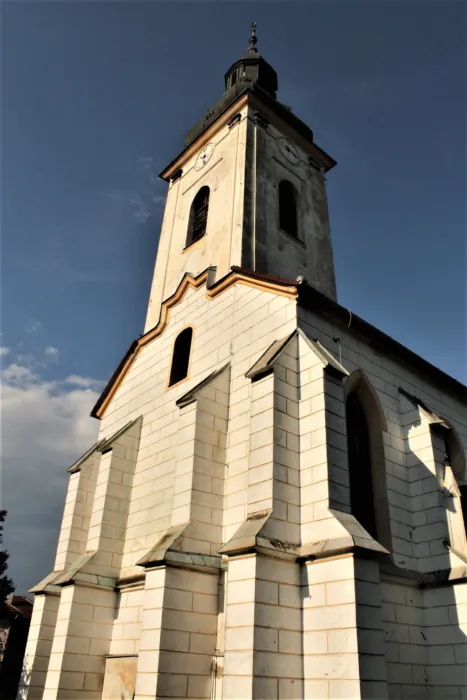
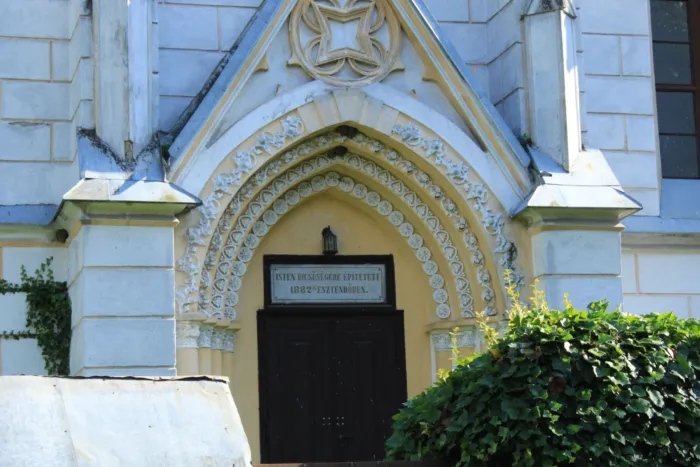
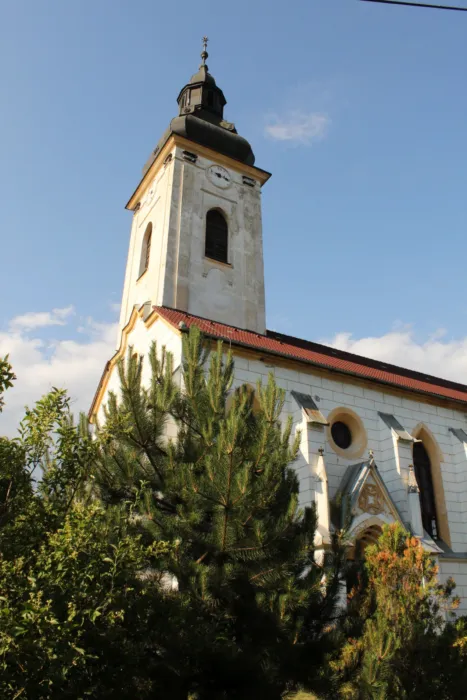
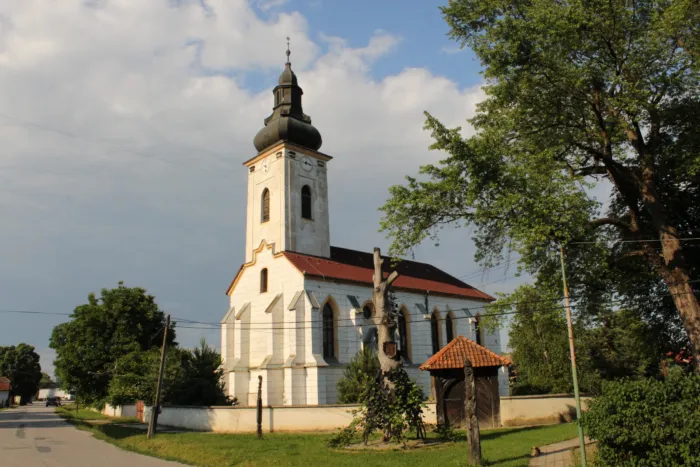
Evangelical church in Sajógömör, exterior
Building, structure
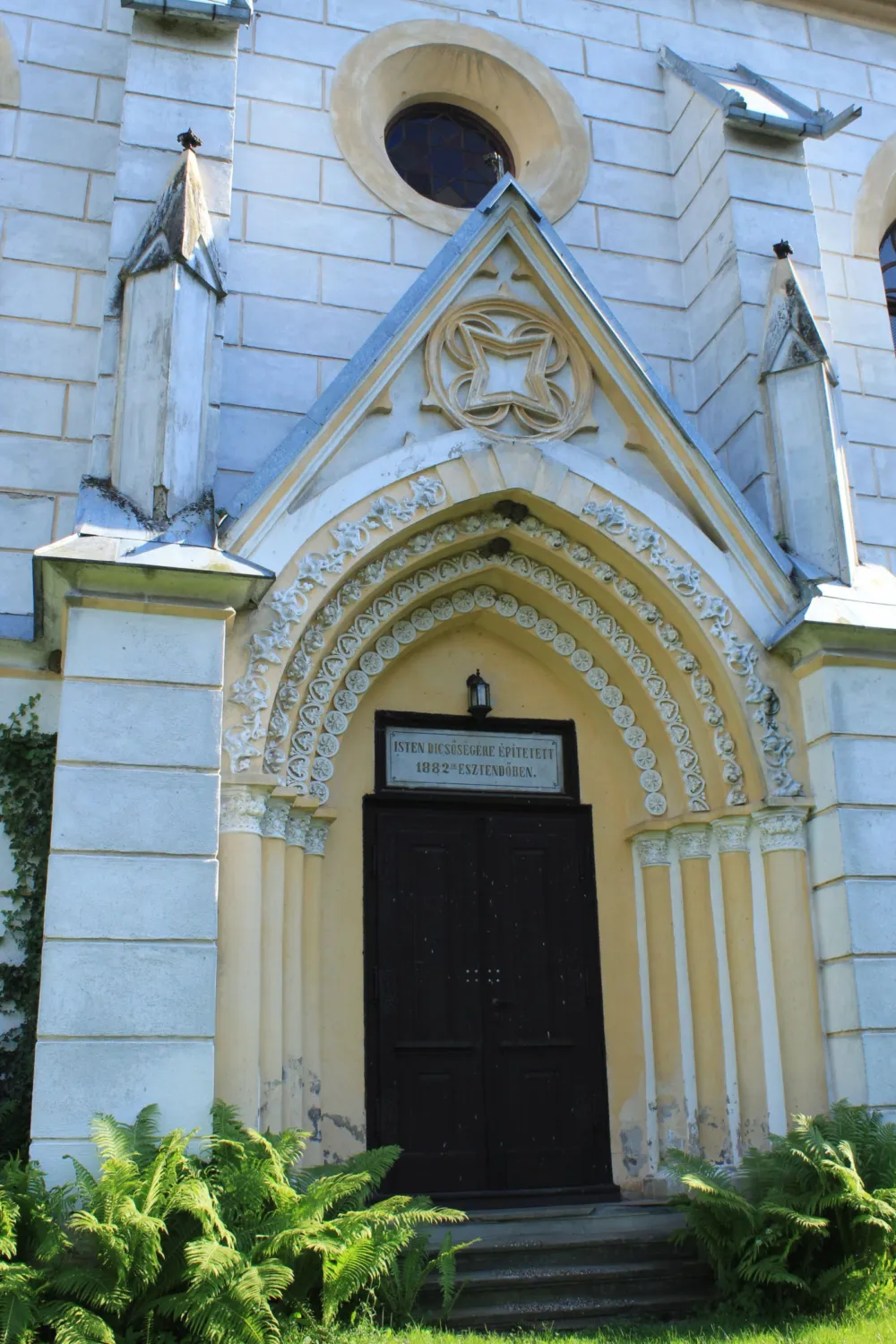
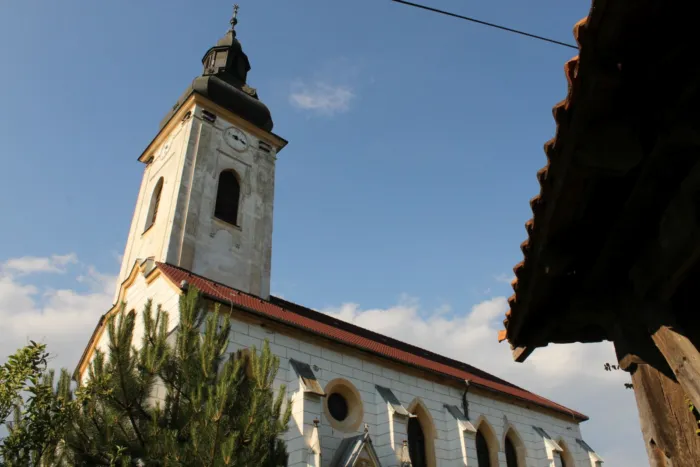
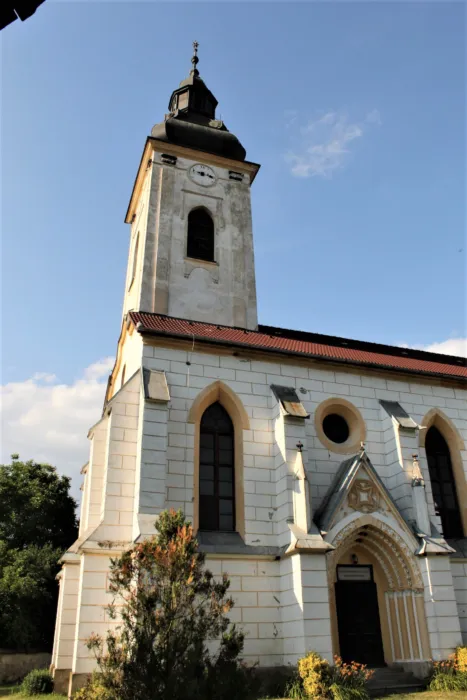
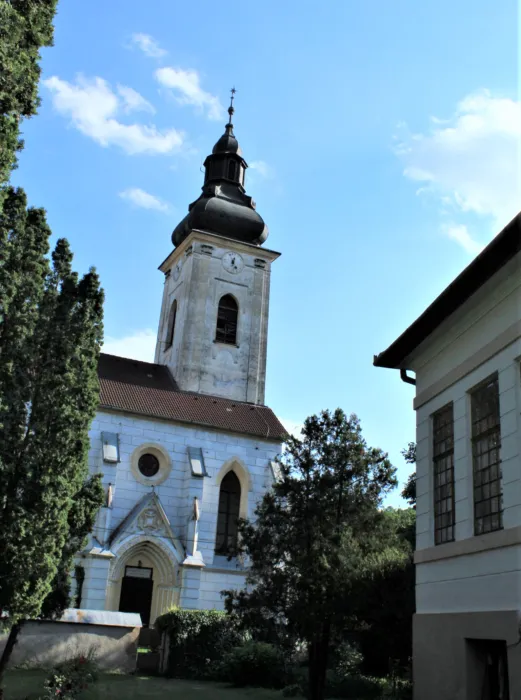
The church, built in the neo-Gothic style, survived the two world wars, but during the communist party state its condition deteriorated so much that it has been under constant renovation from the nineties to the present day. The current pastor of the church, Dezső Rusznyák, who has been serving as a pastor in Sajógömör for about twenty years, played a major role in organizing the renovation. After the change of regime, the congregation received financial assistance from the faithful, various foundations, the Hungarian Lutheran congregation, and even the Stuttgart Lutheran congregation. As a result of many years of hard work, this patina-like church shines in its full glory again today. The interior renovation in particular required expertise. This work was carried out by painter-restorer Marian Švec and his assistants, Jana Gromanová and Róbert Bakó. The church held a thanksgiving service on June 4 of this year. ; According to contemporary writings, the “organized” church life in Sajógömör is almost as old as the village with its rich historical past. A 1263 charter already mentions the priest of the “Gömör castle people”. They converted en masse to the Protestant faith in 1595, but at first they adhered to the views of Calvin. Their first pastor was Illés Doby (Elias Doby), who preached the word according to the Reformed religion. Great changes occurred in 1615, when the priest teachers banned from Rozsnyó found refuge in Sajógömör with their students. At that time, the people of Gömör also joined Luther’s followers. The most famous of the 17th century pastors was Miklós Bugányi, who suffered a sad fate in Naples in 1675 for his faith. ; He served his grateful and loyal followers until the demolition of the old church. Even the fire of 1853 could not destroy it. Sándor Petőfi wrote about this church when he visited it: “On the top of the tower there is a cross, a star and a crescent. What is this supposed to be?” – the poet wondered. The explanation may be that the cross was placed on it at the time by the Roman Catholic Church, the crescent dates back to the Turkish times, and then the star was added during the Reformation. There was a cemetery around the old church – in accordance with the customs of the time – as evidenced by the “cartload” of skeletons found while digging the foundation of the new church. They were later reburied with due respect. When the new church was built, the stone fence, originally equipped with loopholes, was still left, which testifies to the fact that the old church could also have served as a fortified church. The wooden fence gate still stands today, on which the text “ANNO 1710”, carved into wood, is still clearly visible. ; The tower of the new church – which is approx. 50 m high – its foundation was still the old one, but in 1868 the architect József Nagy from Gömörpanyti raised the stone wall by four ells. This marked the beginning of the period of construction of the new church. Pastor István Czékus, later the bishop of the Lutheran church district of Tisza Mellék, worked for 28 years to raise the capital. The money needed for the construction of the church was collected from small and large donations, almost pennies. The construction of the church – based on the plans of Károly Bakó, an architect from Budapest – was undertaken by the architects András Peck and János Gothard from Dobsina “with such consultation” ... “the construction of all the stone, wood, iron and glass parts of the new church” ... “as the church provided sufficient stone, brick, sand and transport for the construction”. ; The church’s followers assisted with great zeal in the construction of the church. According to the old records: “more carts always went out to work than were assigned.” They did about 500 forints worth of work. The name of the city hajdú György Rákosi is also mentioned here, “who showed tireless activity when assigning work.” However, the burden of the work fell on the shoulders of György Mikola – who now sleeps his eternal sleep in the Sajógömör cemetery. The services on Sundays and other holidays did not stop during the construction of the church. The elementary school yard was used for this purpose, but the Lord’s Supper was served in the classroom. On Pentecost, the school yard was decorated with white birch trees with bright green leaves, and the service took place here. On weekdays, however, the faithful prayed at home. ; Great care was also taken to furnish and decorate the new church – which was only completed in 1886. ; János Bakos, an organ builder, built a new organ. János Erősi, a sculptor from Rozsnyó – who also worked in London for 7 years – created the pulpit and the baptismal font with a “simple but real artistic exhibition”. The work of Ferenc Plachy, a painter from Rimaszombat, is the large altarpiece depicting the resurrection of Jesus. The small altarpiece below it is also his work, on which he painted the Last Supper and donated it to the church in Sajógömör in 1884 in memory of his deceased wife, Polexia Hevessy. There are two gilded statuettes on the two wings of the altar. One depicts Martin Luther, the initiator and one of the leading figures of the 16th-century Reformation, and the other his close colleague, Philip Melanchthon. The southern wall of the church interior is decorated with a large mural, which shows Martin Luther before his judges at the Imperial Diet of Worms on April 18, 1521, and below the picture is his saying that has become a household word: "Here I stand, I cannot do otherwise! God help me! Amen." On the northern wall is a memorial plaque for the citizens of Sajógömör who died a heroic death in the First World War. On both walls there are five smaller white and black marble memorial plaques. One commemorates Pastor Béla Mayer, who served the Lord and his followers unwaveringly for 38 years during the difficult years of the 20th century in this village. Even in the fifties of the last century, at Christmas, at midnight, the beautiful singing of the church's male cantor sounded in the high tower of the church, announcing the birth of baby Jesus every year. The singing of the cantus has long since fallen silent, as has the proud tower clock, which was damaged during World War II – during the front. The oldest bell in the church dates back to 1754. The large bell, worth 24 thousand crowns, which was taken for military purposes during World War II, was donated to the church by Márton Deákpál, the middle bell was donated to the church by András Cs. Csala for 14 thousand crowns, and the small bell was donated to the church by Péter Adorján for 3,000 crowns. The bells are no longer rung by a bell-ringer, but are powered by electricity. The tower has been renovated several times. Major renovations took place in 1992 and a few years ago, when it was covered with new copper plates and the original reddish color was changed to dark brown. ; Finally, returning to the period of the construction of the new church, immediately before the consecration of the church, on September 25, 1882, a memorial was placed in the altar, one foot deep, in the place towards which the holy chalices are placed during the distribution of the Lord's Supper. The memorial was wrapped in thick paper and placed between two glass panes, in a zinc case, the lid of which was sealed airtight. This was again installed between two dry wooden boards and dry bricks so that moisture could not easily reach it. ; The memorial states, among other things: "The Sajó-Gömöri branch. evangelical. church, having thoroughly demolished its dilapidated church, which was in the process of collapsing, had a completely new one built in its place in 1881 and 1882." ... "Since no sign or document was found in the old church about the time of its construction, this brief description of the past and present moments of the city and church, if time does not consume it, is placed on the altar as an eternal memory." ; The new, still beautiful Lutheran church was finally consecrated on November 11, 1882, on St. Martin's Day, and has served the Augustinian Lutheran congregation of Sajógömör ever since.