
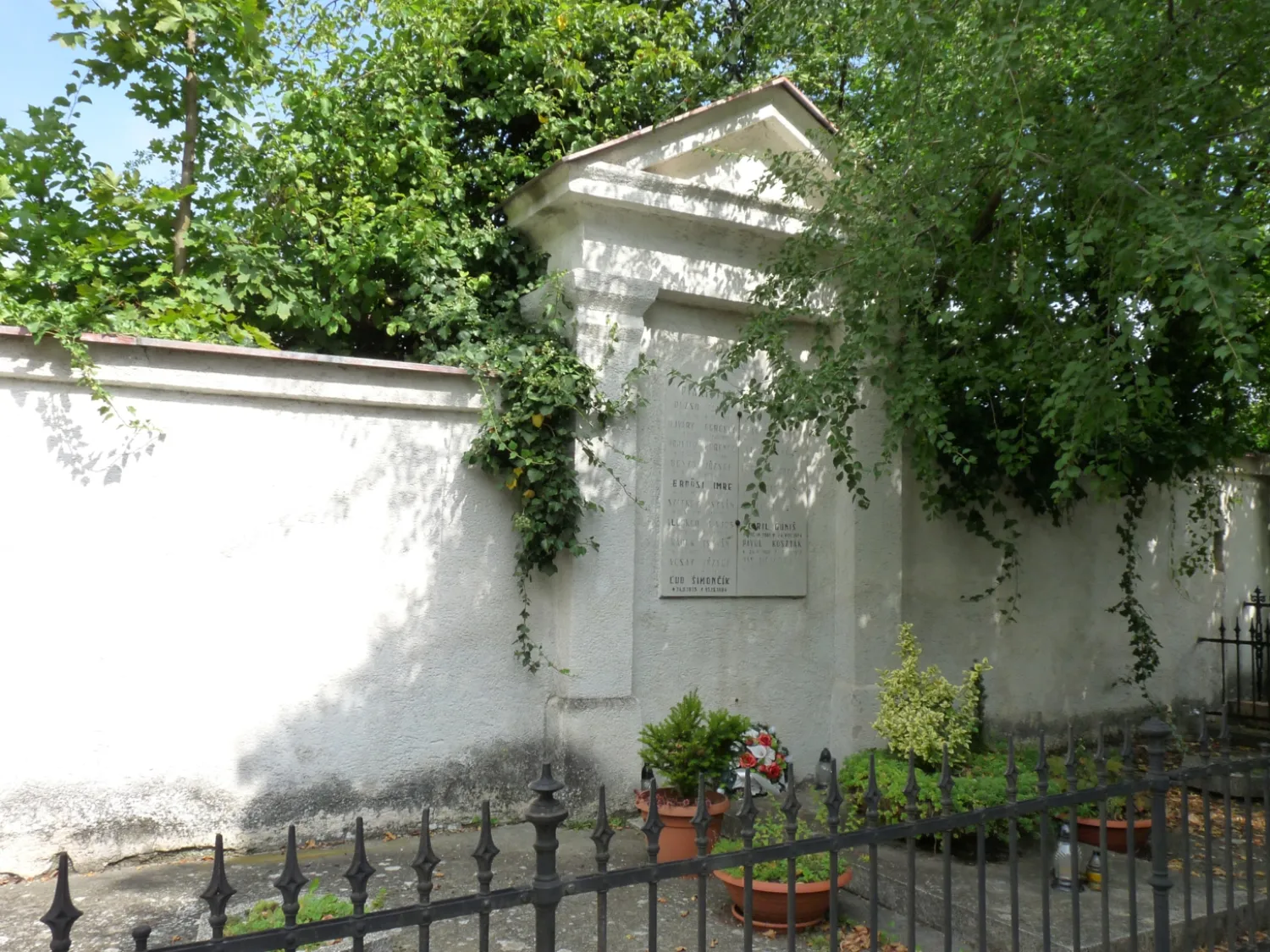
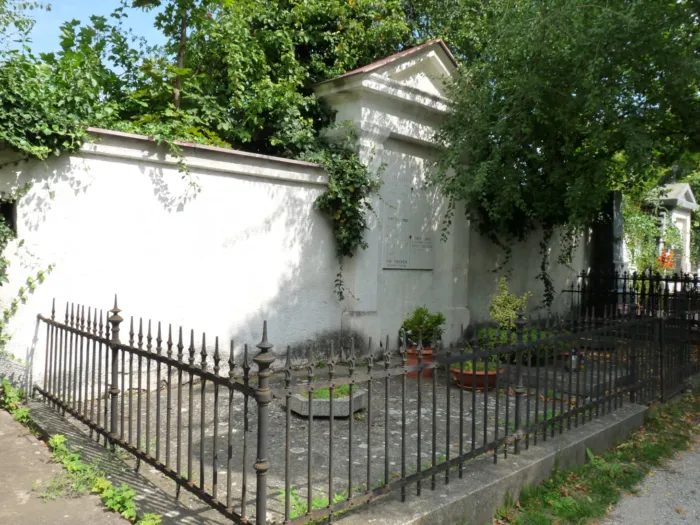
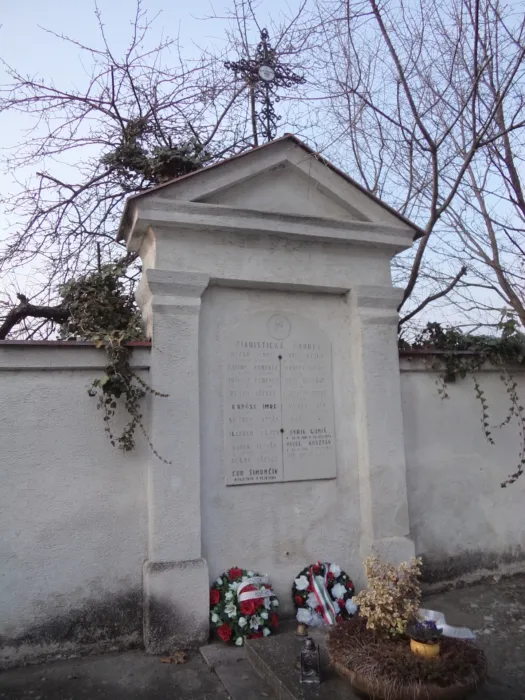
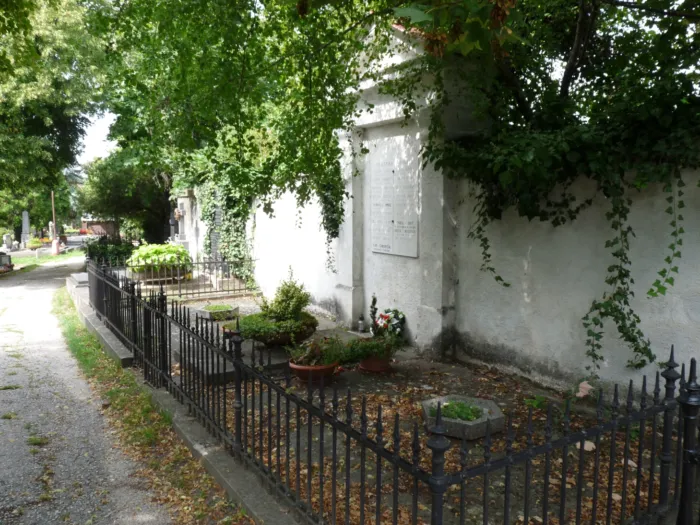
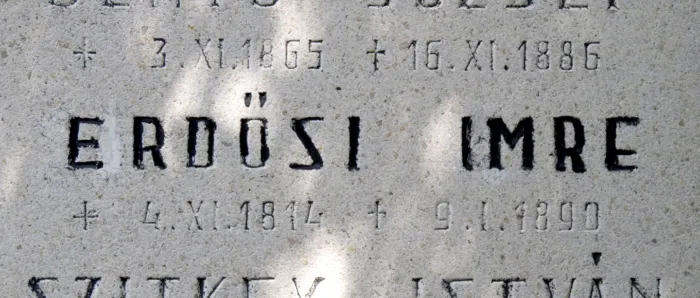
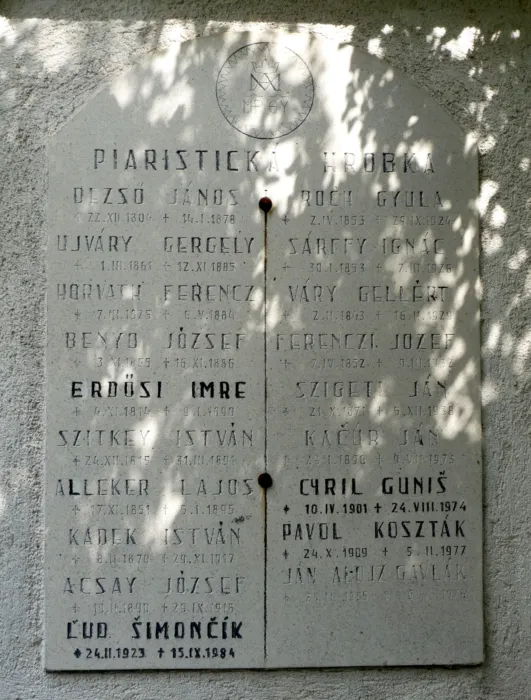
The grave of Imre Erdősi
Cemeteries, tombstones, graves
Imre Erdősi, originally named Imre Poleszni (Nyitra, November 4, 1814 - Nitra, January 9, 1890) was a Piarist monk, teacher, and a camp chaplain in the 1848-49 War of Independence. ; Imre Erdősi was born into a bourgeois family. His father, Ambrus Poleszni, was a shoemaker in Nitra, and his brother, István, also continued this trade. The family was known in the city as "Österreicher" because their ancestor moved to the city from Austria. He completed his studies at the Piarist colleges in Nitra and Léva, and then entered the Piarist order in 1832. He was ordained a priest in 1840, after which he began teaching at the Piarist school in Selmecbánya. In early 1849, when Artúr Görgey's Upper Danube Corps was fighting near the mining towns, he met Colonel Richárd Guyon. ; When the corps withdrew, he volunteered for service, and from then on he served as a field chaplain in the army until the end of the War of Independence. In the Hungarian army of the War of Independence, field chaplains were not given military rank, but they had to participate in the battles. Their task was to encourage the fighters, comfort and care for the wounded, but in many cases they also played a significant role in the successful fighting of a battle. ; The Battle of Branyiskó on February 5 made the name of not only Richárd Guyon, but also Imre Erdősi known nationwide. ; The advance of the Hungarian troops was made impossible by the Branyiskó Strait, which was occupied by the troops of General Franz Deym. On February 5, 1849, in the Battle of Braniszko, Guyon attacked the Austrians from three sides. The attack of the 33rd Csongrád Home Guard Battalion and the newly recruited 2nd Home Guard Battalion from Bánya Biszterce (mainly composed of Slovak recruits), attacking from the center, was repeatedly stopped by the enemy's high-altitude sniper fire. At this point, Poleszni himself stood at the head of the Home Guards and, with a cross raised high, rushed up the steep mountain in front of the line of strikers. "Na predek, za mni, tu je Pan Boch!" ("Forward, behind me, the Lord is with us"), he shouted. The Home Guards followed their priest with all their strength and, despite the constant enemy fire, took the Austrian positions built on the winding road leading to the mountaintop step by step. Meanwhile, Poleszni walked in front of the soldiers the whole time, fell several times, but was not wounded. In front of one of the Austrian ramparts, he waved his cross above his head, threw it into the enemy behind the rampart, and shouted: "Will you let your God fall into the hands of the enemy, and will you tolerate dirt on your flag?" The soldiers did not let him, but continued to charge and captured the rampart. Finally, Deym's army, to avoid being surrounded, fled towards Prešov. Guyon's brigade pursued them as far as Siroka, and then Poleszni held a Te Deum of thanksgiving in the church of Siroka. His brave deed made his name known nationwide. After the battle, his contemporaries also called him the "hero priest of Braniszko" or the "Hungarian Capistran". Guyon also knew that he owed Poleszni the victory, which brought him fame and recognition. From then on, he kept him by his side until the end of the War of Independence. ; Guyon's brigade, together with Poleszni, marched to Mezőkövesd via Eperjes and Košice in February 1849, and they took part in the losing Battle of Kápolna. After the battle, Poleszni, at the urging of Bertalan Szemere, took the name Erdősi. His Hungarianization of his name was published in the March 22 issue of the Gazette. During the spring campaign, he participated in the Battle of Nagysalló (April 19) and then the First Battle of Komárom (April 26). Meanwhile, on April 21, Guyon, and a few days later his camp chaplain, also managed to break through the enemy's ring and enter the Komárom castle. After Guyon was relieved of command of the Komárom castle on May 28, Erdősi also left with him for the southern theater of operations. On July 11, he was present in the victorious Battle of Kishegye against Jellasics. From July 23, 1849, Erdősi was the appointed supervising chaplain of the IV. Hungarian Corps, with a salary of 120 pengőforints. He participated in the battles of Mosorin (July 23), Szőreg (August 5), Temesvár (August 9) and the battles of Lugosi (August 15) fought after the surrender of Világos (August 13). ; On August 16, 1849, Erdősi said goodbye to Guyon, who was leaving for Turkey, in Facset (Krassó County), and returned to Selmecbánya via Debrecen. ; He was soon placed under house arrest and banned from teaching for a short time. Instead of his Magyarized family name, he had to use his original name until 1867. In 1850, he began teaching again in Nagykároly. The following year, he taught in Timisoara, then in Cluj-Napoca, and again in the Piarist high school of his hometown between 1854 and 1857. He was the head of the Piarist monastery in Kecskemét between 1861 and 1878, and then until 1888 he was the government advisor of the Piarist order in Budapest. In 1888, shortly before his death, he resigned from his office due to illness and requested a transfer to his hometown of Nitra. He lived in the Piarist monastery there until his death, which occurred at the age of 76. He was buried in the old city cemetery of Nitra, in the common tomb of the Piarists, among his fellow monks. ; The citizens of Nitra marked his birthplace in Nitra with a memorial plaque on 15 March 1894 as a public donation. The large (150 cm high, 80 cm wide) plaque made of Swedish black granite was made by the stonemason Jakab Fellner from Nitra, and the distich readable on it was written by the financial secretary Csatár Kenézy. Its inscription: ; Born here on November 4, 1814 / Imre Erdősi / the heroic priest from Branyiszko. / Amidst the excitement of battle / he walked at the forefront with the cross, / to his heroic name, oh countryman! / raise your hat. / He served God, and on the battlefield / fighting for his country, / he crowned his name with gratitude / and true piety. / March 15, 1894. ; This plaque was lost during the Czechoslovak period.