
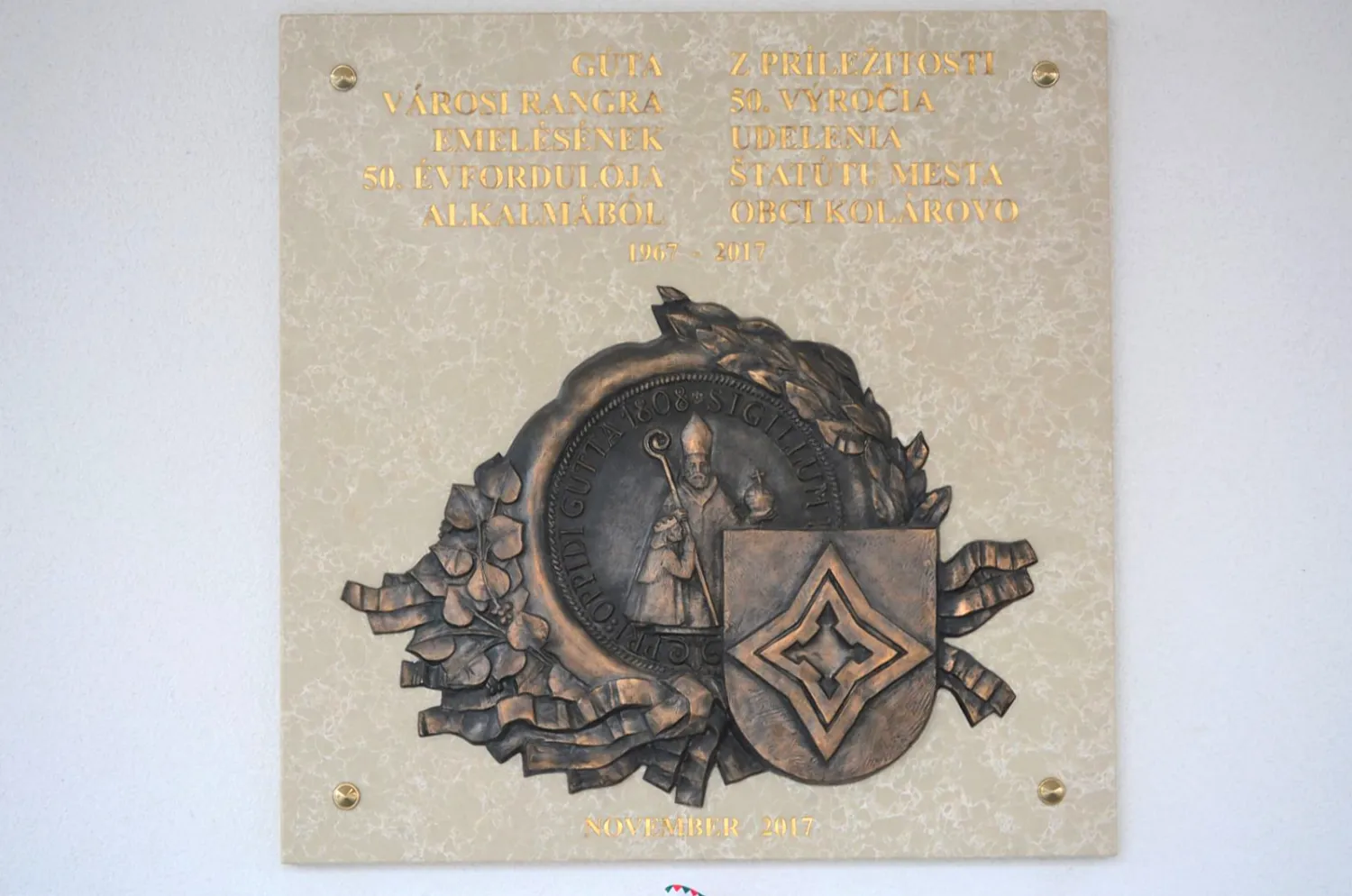
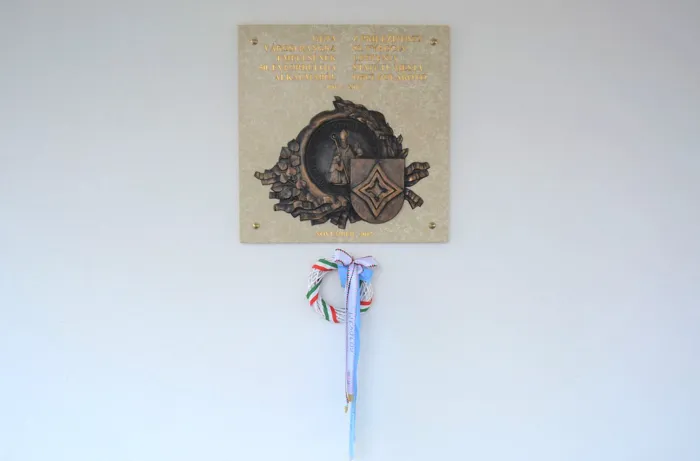
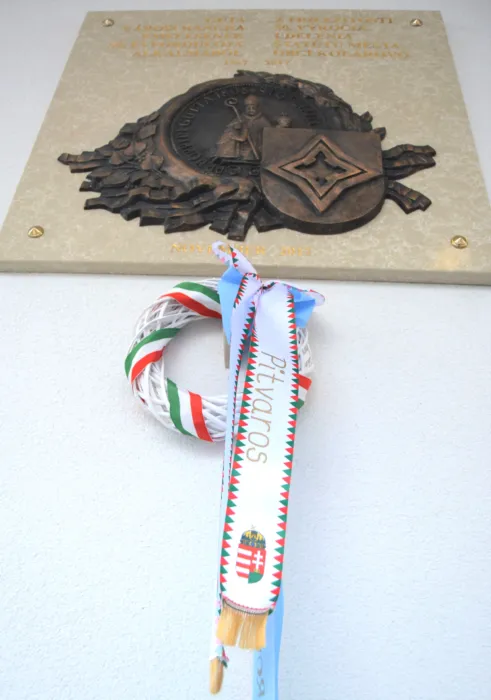
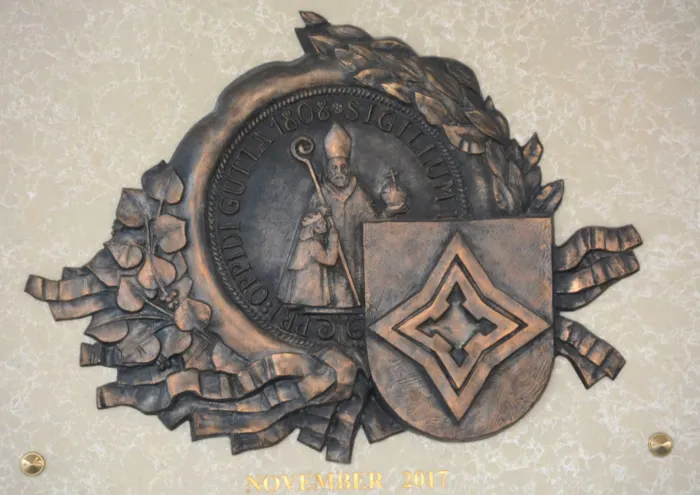
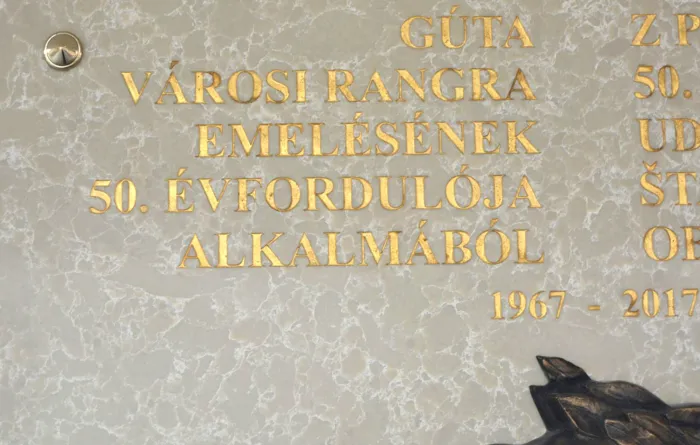
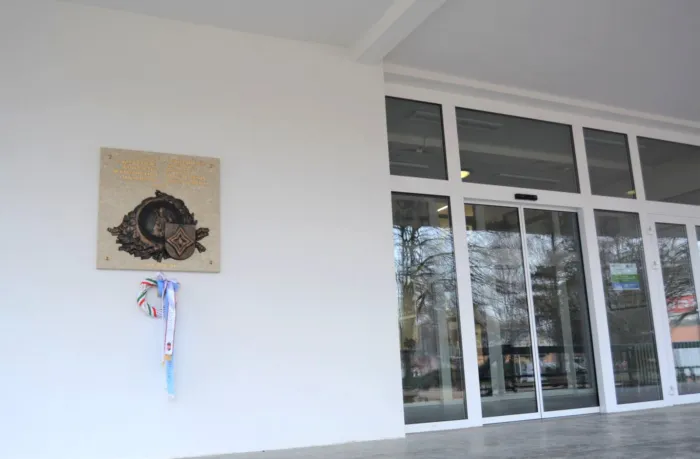
Memorial plaque for the 50th anniversary of the declaration of Gúta as a city
Statue, monument, memorial plaque
The renewal of the village, which was devastated by the flood of 1965, its changed image, and the fact that the 700th anniversary of the first written mention of Gúta was approaching, did not remain without echoes in the highest political and social circles. October 14, 1967, became one of the most significant days for the settlement, when it regained its city status. The chronicler recorded this as follows: ; ; "The festive atmosphere had been going on since morning, although the ceremonial declaration of the city was only planned for the afternoon. The residents of Gúta were awakened by fresh brass music in the morning and lured out to the square, where a real festive atmosphere already prevailed. The ceremony was attended by distinguished guests, district and district political leaders, as well as representatives of the factories and institutions that helped the city's rebirth. After the city tour, the flood memorial, a work by sculptor János Nagy, entitled "Motherland", was unveiled on Szabadság Square, symbolizing the fertile land of Csallóköz and the perseverance of the people living here. Alexander Dubček gave a speech at the ceremony and handed over the documents on the declaration of the city to János Jányi, the president of the Hungarian National Assembly." ; ; A new historical chapter began with the elevation of Gúta to city status. The exclusively agricultural village, transformed into a city, suddenly became a significant socio-cultural center with its rapidly developing industry. ; ; The 50th anniversary of the declaration of the city was honored with a commemorative plaque. The commemorative plaque placed on the wall of the city hall on November 10, 2017 – a work of Rozália Darázs, a visual artist from Ógyalla – shows the two most significant symbols of Gúta, on the one hand the city's coat of arms based on an etching from around 1600, and on the other hand the notary's seal from the early 1800s, the special feature of the latter being that it depicts Saint Adalbert, the symbol of the Diocese of Esztergom, not as a martyr, but as the baptizing bishop of Saint Stephen. During the commemorative plaque inauguration, they greeted Nagyné Mónika Magdalin, born on November 2, 1967, who was the first newborn child of the already city Gúta. “Declaring a city not only means rank, but also pride, authority and responsibility,” said Árpád Horváth in his ceremonial greeting. He highlighted that the city is also a symbol of cooperation and self-sacrifice, as these virtues were needed for its reconstruction. The Pro Urbe award was also presented at the ceremonial board meeting. The prestigious award was received by pediatrician Barnabás Guba, judo coach Ferenc Vincze and ethnographer Kornélia Harmathné Vörös. Barnabás Guba has been practicing in the city for nearly six decades since 1968, supervising the health and development of three or perhaps four generations. During Ferenc Vincze’s 36 years of coaching, more than 2,000 young people have turned up on the tatami in Gúta, winning 65 national championship medals. Kornélia Vörös, Mrs. Harmathné, tirelessly collected the settlement's ethnographic traditions, ancient vocabulary, long-forgotten stories, wedding traditions, children's games, and nursery rhymes; unfortunately, due to health reasons, she was unable to attend the ceremony in person.