
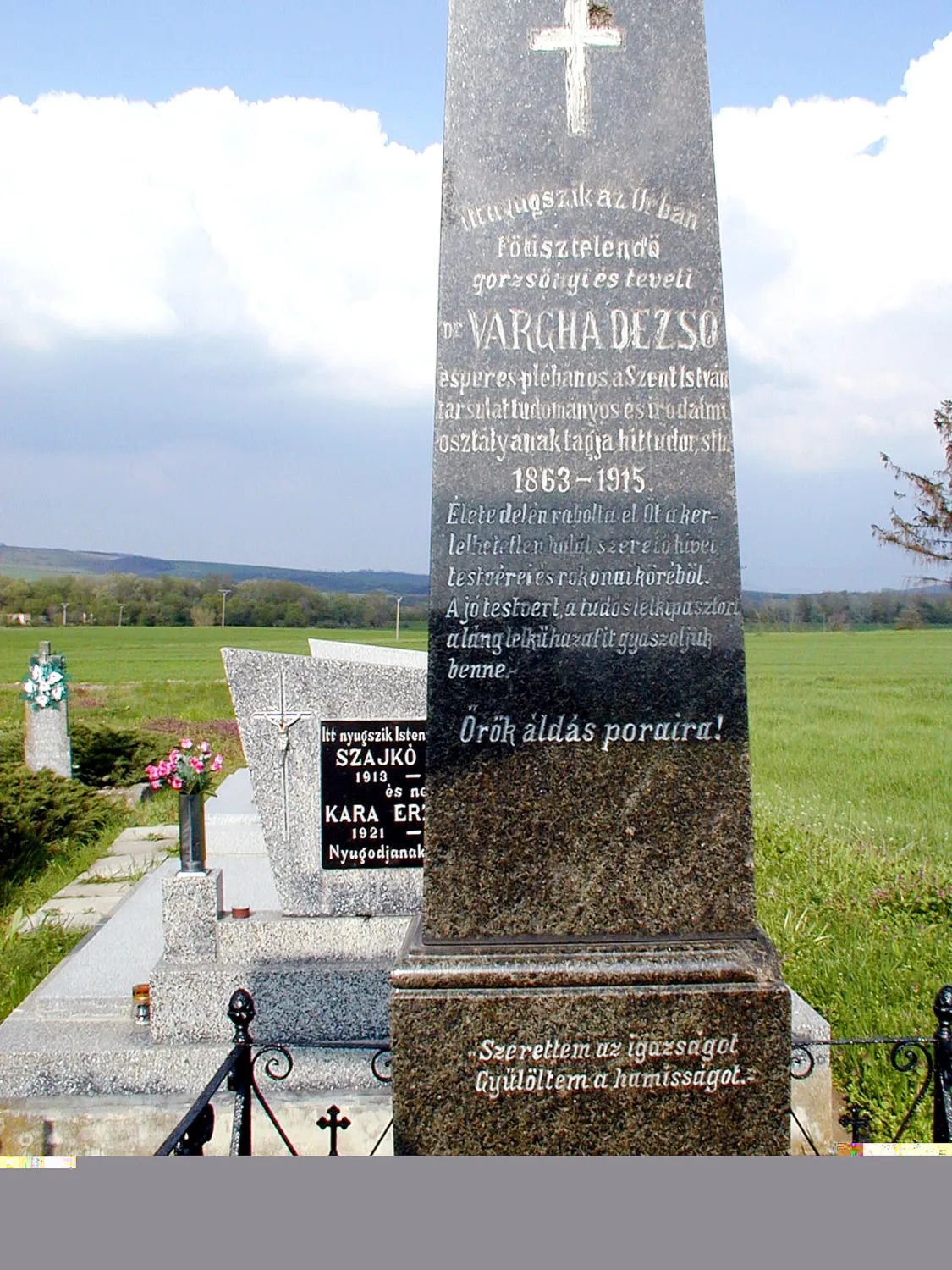
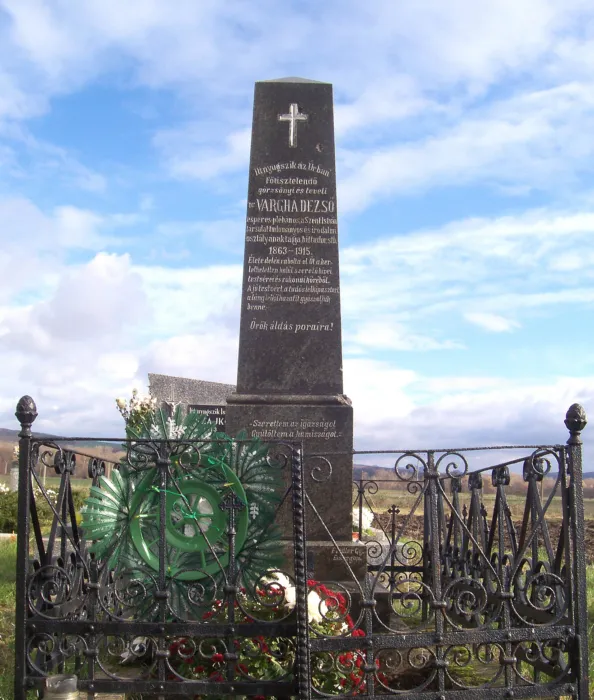
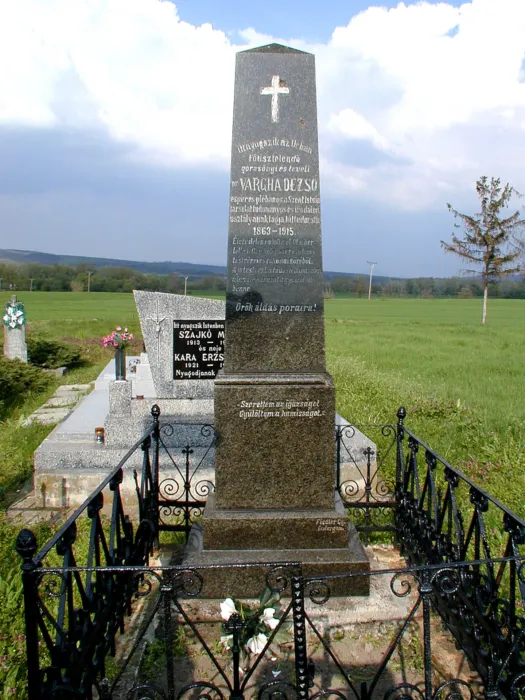
Dr. Dezső Vargha's tomb
Cemeteries, tombstones, graves
Dr. Vargha Dezső Görzsönyi and Teveli (Kőhidgyarmat, March 23, 1892 – 1915) ; ; Church figure, high school teacher, writer, notary of the Holy See, corresponding member of the Hungarian Academy of Sciences. ; He completed his secondary school studies in Győr, Nagyszombat and Esztergom, and theology at the Pázmáneum in Vienna, where he obtained a doctorate in theology. He was ordained a priest on September 30, 1885, and as a doctor of theology, he served as a chaplain in Patak and then in Érsekújvár. In 1889 he worked as a high school teacher in the royal palace in Buda, in 1890 he was appointed notary of the Holy See in Esztergom, and he worked as a notary of the archdiocese chapter meetings. On March 23, 1892, he was appointed deacon-parish priest of Kőhidgyarmat. The people respected his strict and just character. ; Dr. Dezső Vargha carried out significant literary activities in addition to his daily clerical duties and elected him a corresponding member of the Hungarian Academy of Sciences. ; The most important of his independent works are: Cultural conditions in Germany after the Reformation, in Italy (road sketches), Innocent III and his time, Agrarian socialism and the church, Church history (a textbook for school use, with which the author won a prize in the competition of the Saint Stephen Society), The legal situation of Christianity in the Roman Empire, The agrarian question in Hungary, The political behavior of prehistoric Christians, The working man before and after Christ, Early Christianity in the eyes of Latin and pagan writers. ; In addition, many of his significant articles were published in the Church Gazette, the Almanac of the Saint Stephen Society, the Hungarian Zion, the Catholic Paedagogy, the Religion, the Hungarian Review, and the Catholic Review. ; Dr. Dezső Vargha ended his rich earthly career in the year of the Lord 1915. The Kistata cemetery preserves his ashes under a black granite obelisk stretching to the sky.