
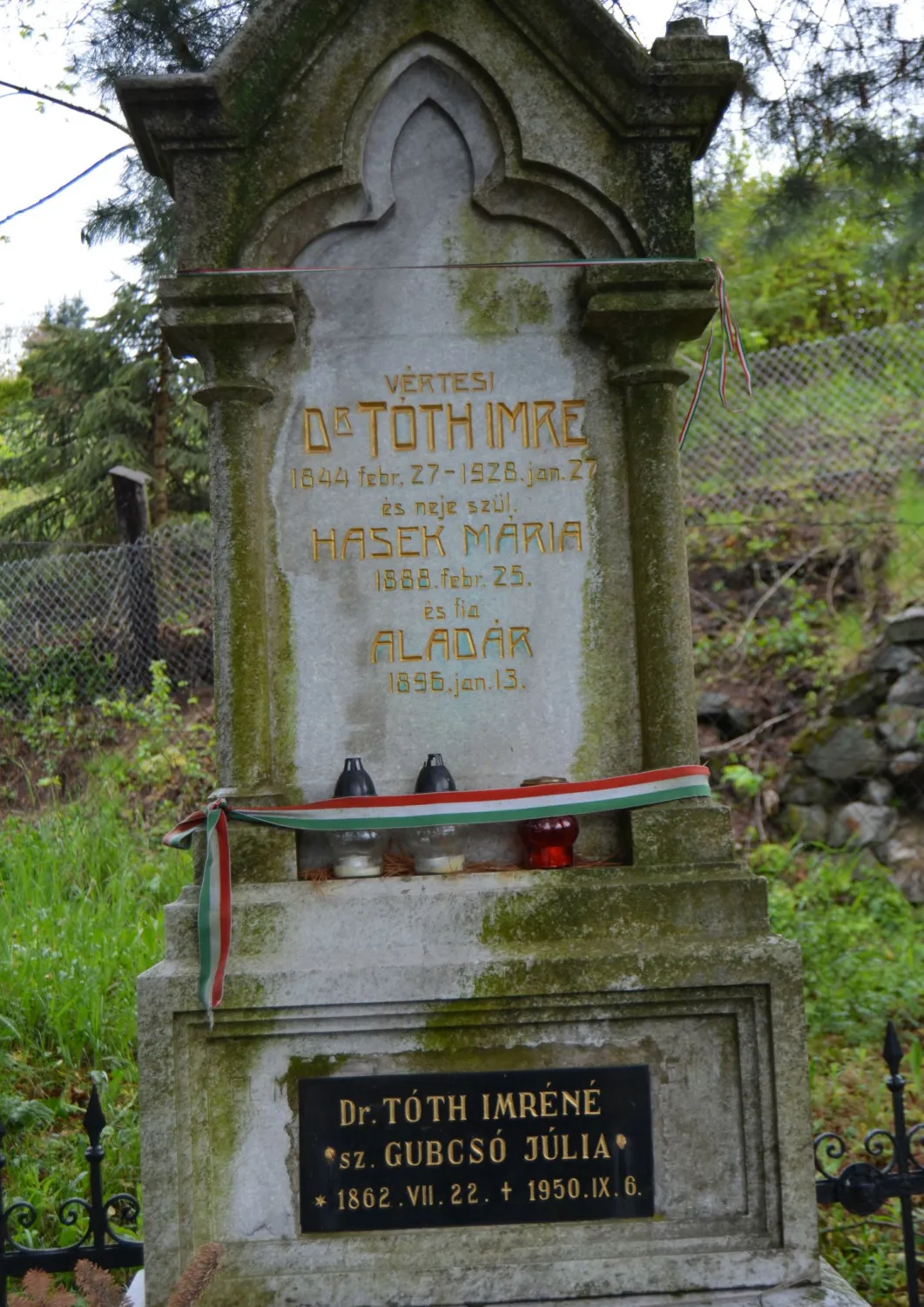
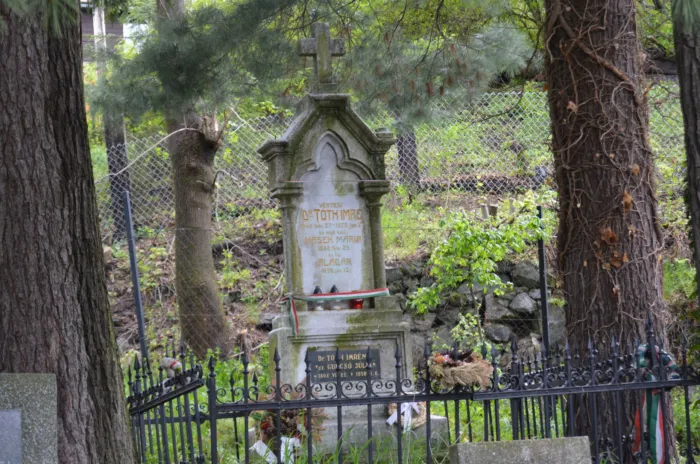
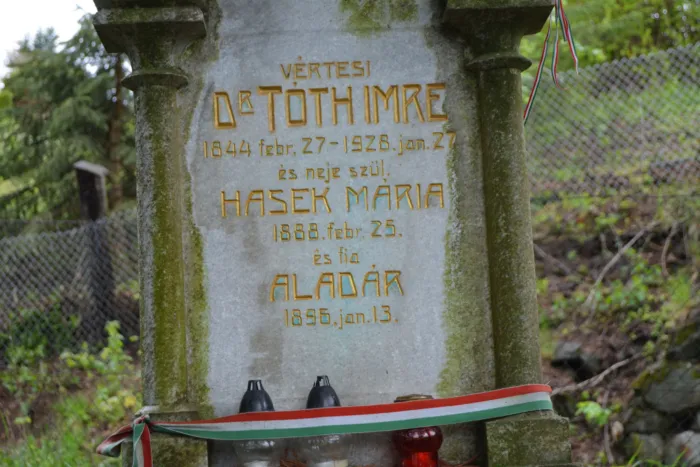
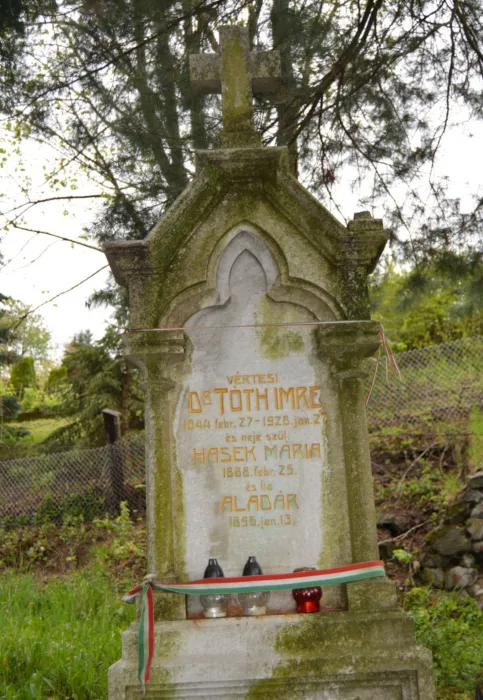
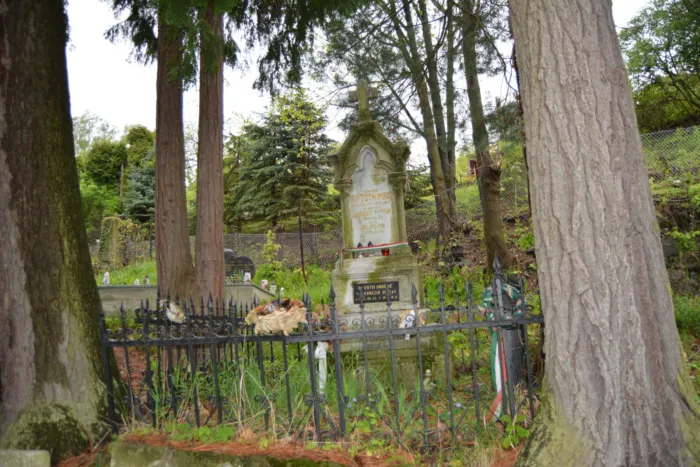
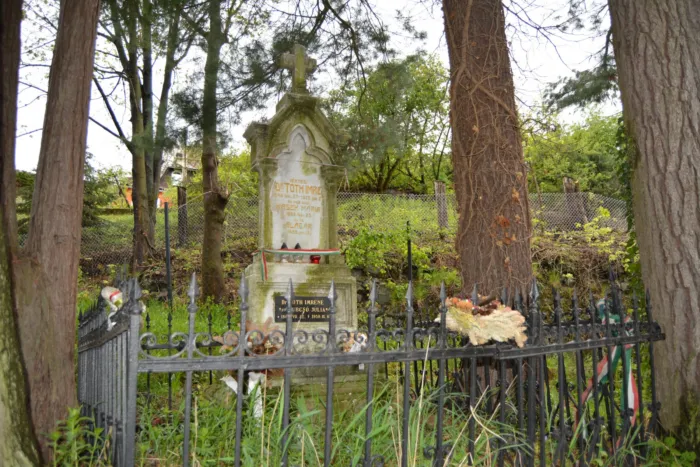
The grave of Dr. Imre Tóth
Cemeteries, tombstones, graves
It is no coincidence that in one of his short stories, Kálmán Mikszáth wrote satirically about Selmecbánya, and spoke in an ironic tone about the health condition of the people here. Unfortunately, behind the statements that almost seemed like caustic mockery, there was a lot of truth. In Mikszáth's writing entitled The Golden Lady, we can read, among other things, the following: "This is a sad town! Its air is poisoned by the evaporation of the mines, its water 'grows like a goiter on the necks of pale-faced girls and stupid men'. At the third-year recruitment, four out of six hundred young men who were conscripted proved to be 'human emperors'. I am almost ashamed to write it." And although there is some exaggeration in these writings, few young people here could really be conscripted. The number of goiter, tuberculosis and other respiratory diseases was significant, lead poisoning, leprosy, alcoholism and many other infectious and epidemic diseases were devastating. Miners died young, barely reaching the age of 40-50. In Selmecbánya, therefore, not only technology and science developed, not only the number of jobs increased, and mining became famous in Europe, but the number and type of diseases also increased from year to year. Contagious and epidemic diseases primarily devastated the lower classes. Diseases resulting from occupational hazards were hardly addressed until the 18th and 19th centuries, and no special attention was paid to them. However, some of them had already appeared in the 16th century. The mining industry was brought to our region by Italian miners, among others. This contagious disease (cachexia anaemia montana) caused weakness, dehydration and anaemia, and was caused by, among other things, bad air and drinking water, poor nutrition and alcoholism. Imre Tóth paid closer attention to the disease, which was also spreading in Selmecbánya. The excellent specialist came here from Budapest. He was born in Ságvár, Somogy County, on February 27, 1844, into a poor family. He completed his secondary school studies in Veszprém and Székesfehérvár, and then obtained his medical degree in Pest. From 1868, he was an assistant at the Rókus Hospital under the excellent surgeon Endre Kovács Sebestyén, who had ties to the Highlands. From the university clinic, he was transferred to the operating room and medical station in Selmec. He also worked in the mine hospital, and was then appointed chief mine doctor. From 1880, he lectured on hygiene in the city's secondary schools, and from 1885 at the mining academy. He was a teacher and school doctor at the Royal Catholic High School in Selmecbánya. In the school's bulletin published in 1916, he wrote the following, for example: "During the past school year at the Royal Catholic High School, I have taught nutrition, home and personal care, work and occupation, infectious disease hygiene and lifesaving in the VIIth grade, based on the book by Dr. József Fodor, in the VIIIth grade. The students answered and took exams on the subject during the year. My experience from year to year is that students are not interested in health to the extent that the importance of the subject requires, this will only happen if health becomes a mandatory, regular subject. Dr. Imre Tóth Vértesi, chief physician of the mining district." (Dr. Rauchbauer J., 1916. 16–17. p.) He was also the family physician of the Coburg ducal family in Szentantal for a while. Unfortunately, his name is not mentioned in either the Hungarian Biography Lexicon (Kenyeres Á. ed., 1969) or the Academic Mini-Lexikon (Beck M. ed., 1990). However, the Encyclopedia of Slovakia (Hajko, V. et al., 1982. p. 98. p.) praises his merits, and he is also mentioned in the publication presenting the famous personalities of Selmecbánya and its surroundings (Herèko, I., 1995. p. 257. p.), and the Yearbook of the Slovak Mining Museum publishes a longer study about him. (Blázy, M., 1979. 217–242. p.) As early as 1881, Imre Tóth made the diseases that had been prevalent among the miners of Selmec for centuries, primarily miners' fever, his research subject. He visited the mines, the miners' homes, observed the living conditions, the workers' hygiene habits, nutrition, etc. After he had come to terms with the nature of the disease and its contagious conditions, he managed to defeat it and stop it in 1882. This has not happened in Selmec since then. All this is a remarkable fact because studies on miners' fever were only published in the second half of the 19th century, by Dr. Imre Tóth. (The mining company and its octane. Medical Weekly, 1883, On the eradication of anchylostoniasis in the mines of Selmecbánya, Therapy against Wart. Berlin–Vienna, 1904)