
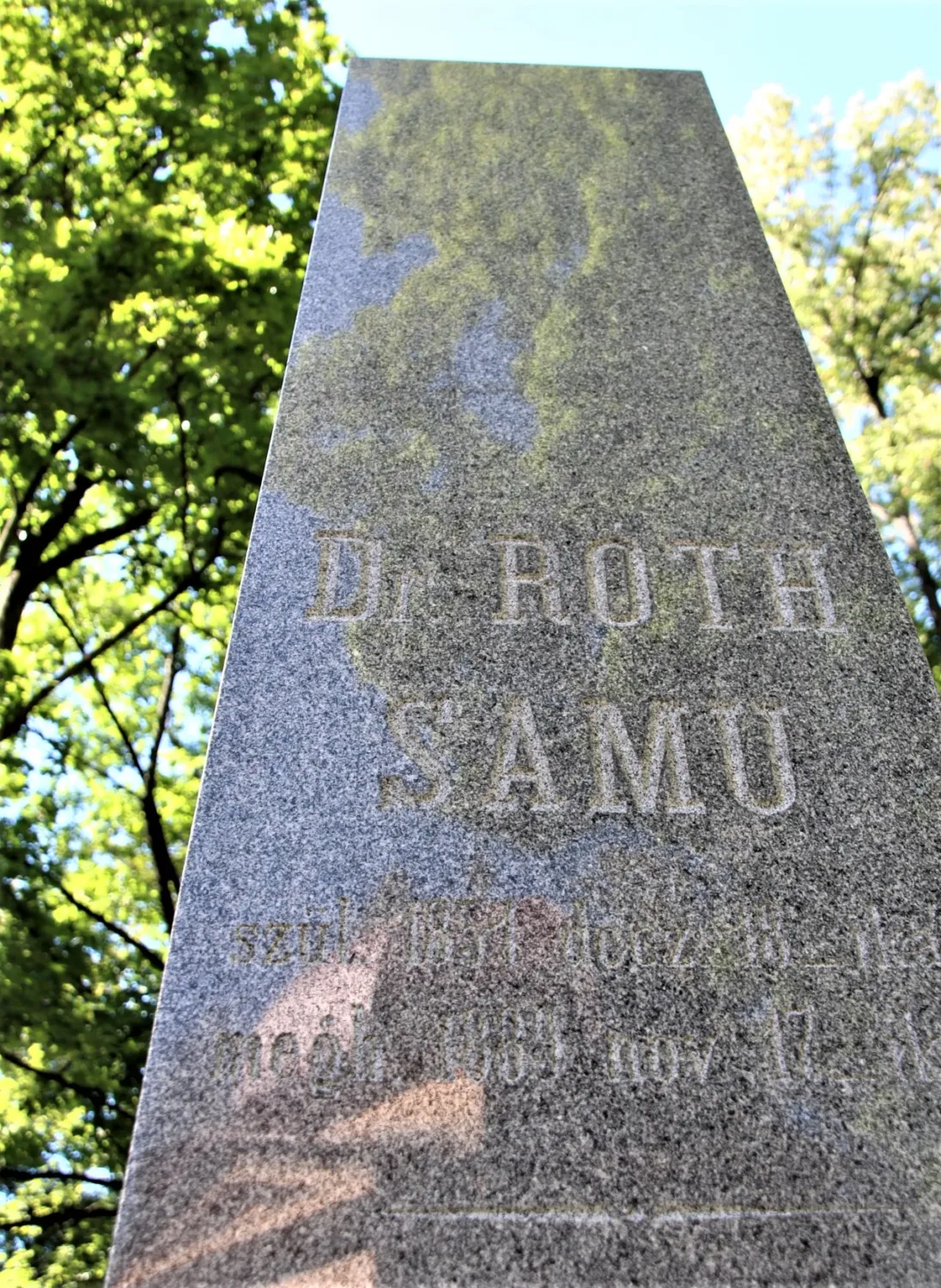
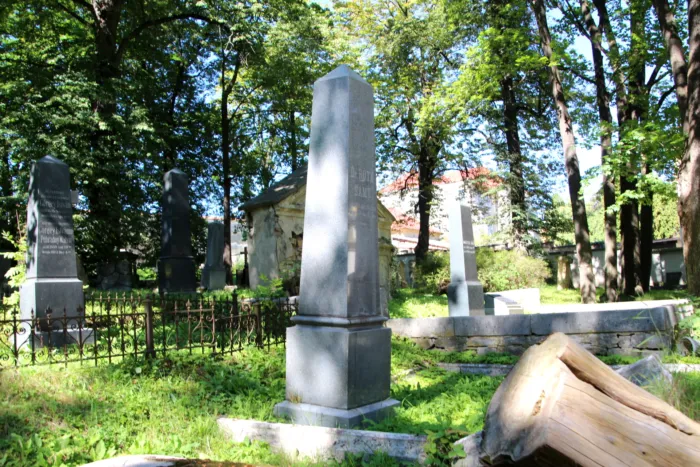
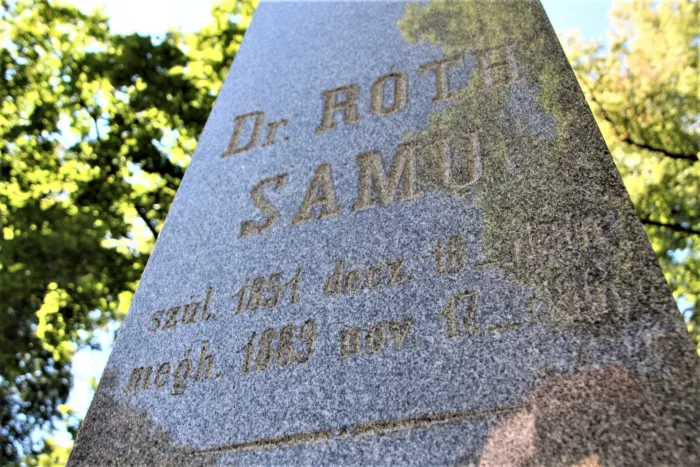
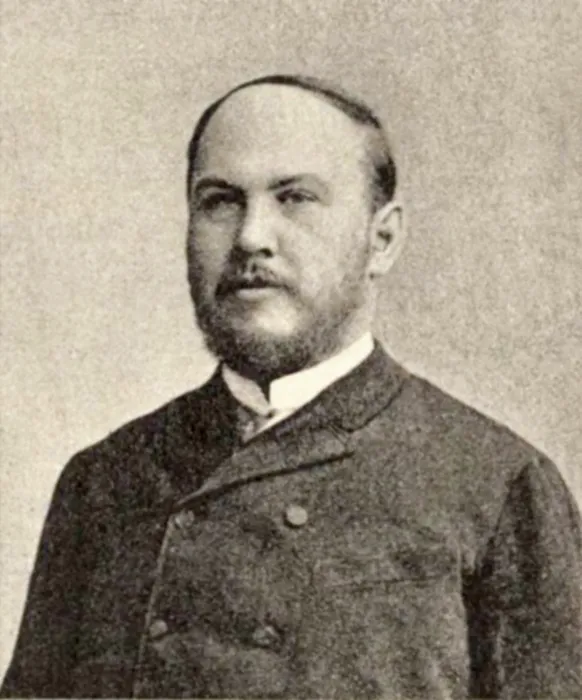
Dr. Samu Róth's grave
Cemeteries, tombstones, grave sites
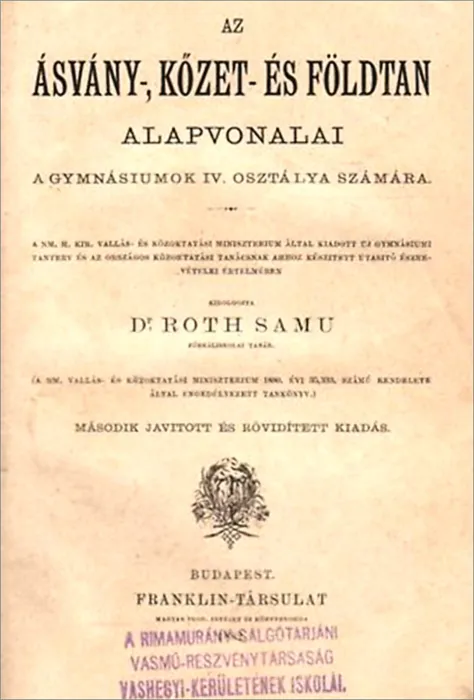
Samu Róth (Ménhárd, December 18, 1851 – Levoča, November 17, 1889) was a teacher, researcher of the High Tatras, tourist, and writer. ; His father was a butcher in Ménhárd, where he also completed his elementary school education. From there he entered the Keszmárk Lyceum in 1863, where he graduated in 1871. At the age of 20, he began his university studies in Budapest. He obtained his teaching certificate from the University of Budapest on July 26, 1874, and in October he became a teacher at the Royal Grammar School in Levoča. In 1876, he obtained a doctorate in humanities from the University of Budapest. In 1877, he married Justus Ilona. From 1885, he was the director of the Levoča Industrial School, and from 1888, the director of the Grammar School. ; He became a member of the Hungarian Carpathian Association as early as 1875. Between 1876 and 1889 – in 13 years – he wrote 18 textbooks, mainly for high school students, published 34 pedagogical and 56 scientific papers, and countless newspaper articles. He showed the traces of the former glaciers of the High Tatras – published his results. The MKE elected him as a member of its executive committee in 1877, and in 1879 he became a member of the editorial board of the association’s yearbook. From 1881 he was the chairman of the museum committee. In 1884 – when the association moved to Levoča, and when Antal Döller became the association’s acting vice-president after his retirement on August 3 – he took a lion’s share in collecting the material for the Poprad museum, building the Tatra Circuit and creating other works of public benefit serving the cause of tourism in the Tatra Mountains. It is largely thanks to him that the MKE won recognition at the 1885 national exhibition, and that the number of its classes increased from 4 to 12, and that its membership grew from 2,400 to 5,000. He was a tourist with outstanding abilities as a researcher and organizer and achieved extraordinary results, in recognition of which his oil portrait was placed in the Carpathian Museum, and the Hátsó-Gerlachfalvi peak was named after him. He was a member of the editorial board of the Szepesi Memorial Book. His writings were published in professional journals and the association's yearbooks. ; He was one of the pioneers of Hungarian cave research, exploring nearly 30 caves in the High Tatras, the Pieniny, the Branyiszkó Mountains and the Szepesi–Gömöri Ore Mountains. In 1879, Samu Róth excavated in the inner chamber of the Haligóczi Cave and in 1879–1880 in the Nagy Cave in Óruzsin. The latter cave was renamed the Samu Róth Cave in 1916 after its first excavator. Here, he discovered Pleistocene layers under the contemporary cultural layer, from which he collected roasted cave bear bones and charcoal remains, and in his work published in 1881 he stated: “I am publishing the news that diluvial man also lived in our country”. In the same year, Lajos Lóczy, Sr., doubted his claim. In fact, later on, a three-member investigation committee on site determined that the bones had been roasted afterwards in “Slavic times” and that the cave was not a homestead of prehistoric man. Samu Róth defended his truth, but he was not believed. He died in 1889 at the age of 37, waiting in vain for his discovery to be recognized throughout his life. ; Dr. Samu Róth's light gray granite tombstone can be found in Sector IV of the cemetery. ; ; Selected works: ; ; Eruptive rocks of the Fazekasboda-Morágyi mountain range (Baranya County). Yearbook of the Royal Hungarian Geological Institute, 1876. (Vol. 4) Vol. 3, pp. 103–128. ; Granites of the “High Tatras”. = Die Granite der “Hohen Tátra”. Yearbook of the Hungarian Carpathian Association, 1876. (Vol. 3) [186]–[209]. pp. ; On the geological and hydrographic conditions of the Branyiszkó Mountains. = Die geologischen und hydrographischen Verhältnisse des Branyiszkó-Gebirges. Yearbook of the Hungarian Carpathian Society, 1877. (Vol. 4) pp. 152–165. ; Data for the formation of some pistachio veins. Natural History Notes, 1878. (Vol. 2) Nos. 2–3. 165–166, 195–196. ; The Porac Cave in Spiš County. Natural History Bulletin, November 1878. (Vol. 10. Vol. 111. Vol.) pp. 409–423. ; The Porac Cave in Spiš County. Conclusion. Natural History Bulletin, December 1878. (Vol. 10. Vol. 112. Vol.) pp. 449–456. ; Valley and lake formation in the High Tatras. = Über Thal- und Seebildung in der Hohen Tátra. The Yearbook of the Hungarian Carpathian Society, 1878. (Volume 5) pp. 112–147; Geographical homologies (Read at the meeting of October 16). Geographical Bulletins, 1879. (Volume 7) Vol. 8, Vol. 302–307; Some new theories from the field of geology. Budapesti Szemle, 1880. (Volume 8) Vol. 23, No. 45, pp. 190–208; Dr. Samu Roth's comments to Mr. Lajos Lóczy on my article on the "Old Ruzyna Caves". Geological Bulletin, 1881. (Volume 2) No. 5, pp. 98–100; Dr. Samu Roth's latest letter. Geological Bulletin, 1881. (2nd vol.) No. 6. pp. 120–122. ; Description of some caves of Upper Hungary. = Einige Höhlen Ober-Ungarns. Yearbook of the Hungarian Carpathian Association, 1881. (8th vol.) pp. 367–398, 399–430. ; The caves of Old Ruzyn. Natural History Bulletin, 1881. February. (vol. 13. issue 138.) pp. 49–65. ; Description of some caves of Spiš County. Mathematical and Natural History Bulletin, 1881. (vol. 16.) No. 1. pp. 613–648. and three plates; Changes in the distribution of the seas. Budapesti Szemle, 1881. (9th year) vol. 26, no. 54, pp. 430–449; Basics of minerals, rocks and geology, for the 4th grade of high schools. 2nd, revised edition. Budapest, 1882. (Secondary school textbook); Description of the caves of the High Tatras and its surroundings. = Die Höhlen der Hohen Tátra und Umgebung. Yearbook of the Hungarian Carpathian Union, 1882. (9th year) no. 4, pp. 309–332, 333–356; (co-authored by A. Nehring) Some new data on the Carpathian Murmelthier. = Einige neue Daten über das Karpathen-Murmelthier. Yearbook of the Hungarian Carpathian Union, 1882. (9th year) no. 2 201–202, 203–205. pp. ; Tourmaline rock in the Felkai Valley. = Turmalinfels im Felker Thal. Yearbook of the Hungarian Carpathian Society, 1882. (9. vol.) 2. no. 189, 194–195. pp. ; The white edelweis (Gnaphalium Leontopodium) on granite. = Das Edelweis (Gnaphalium Leontopodium) on Granitboden. Yearbook of the Hungarian Carpathian Society, 1883. (10. vol.) 4. no. 338, 347–348. pp. ; Report on a journey in the northern part of the Presov-Tokaj mountain range. Mathematical and Natural Science Bulletins, 1883. (18. vol.) 1. no. 281–295. pp. ; On the former glaciers of the Carpathians and the middle mountains of Germany. = Die Gletscher der Vorzeit in den Karpathen und den Mittelgebirgen Deutschlands. (Book review, Buchbeschreibung.) Annual of the Hungarian Carpathian Society, 1883. (Vol. 10) No. 1. pp. 86–88, 93–94. ; Data on the former occurrence of the mountain goat and the elk in the Spiš Mountains. Natural Science Bulletin, December 1885. (Vol. 17. Issue 196) p. 505. ; Traces of former glaciers on the southern side of the High Tatras. Mathematical and Natural Science Bulletins, 1886. (Vol. 22) No. 1. pp. 1–59. and two plates ; A small tour of the High Tatras. Yearbook of the Hungarian Carpathian Society, 1886. (Vol. 13) pp. 243–245; Die Seen der Hohen Tátra. Geographical Bulletins, 1887. (Vol. 15) Supplément 83–87; The Lakes of the High Tátra (Read at the meeting of October 27 of the current year). Geographical Bulletins, 1887. (Vol. 15) vols. 9–10, pp. 545–568; Elements of Botany. 2nd, revised edition. Budapest, 1887. (Secondary school textbook); On the glaciers of the High Tátra. Proceedings of the General Assembly of Hungarian Doctors and Naturalists, 1888. No. 24, pp. 209–215; Pro domo. Tourists' Magazine, October 1889. (Volume 1, Issue 5) pp. 185–187; The Steppe Steppe Hen in Székesfehérvár. Natural History Journal, March 1889. (Volume 21, Issue 235) p. 125; The journey of Archduke Charles Louis and his majestic wife, Maria Theresa, in the High Tatras in 1889. Yearbook of the Hungarian Carpathian Association, 1890. (Volume 17) pp. 1–9.