
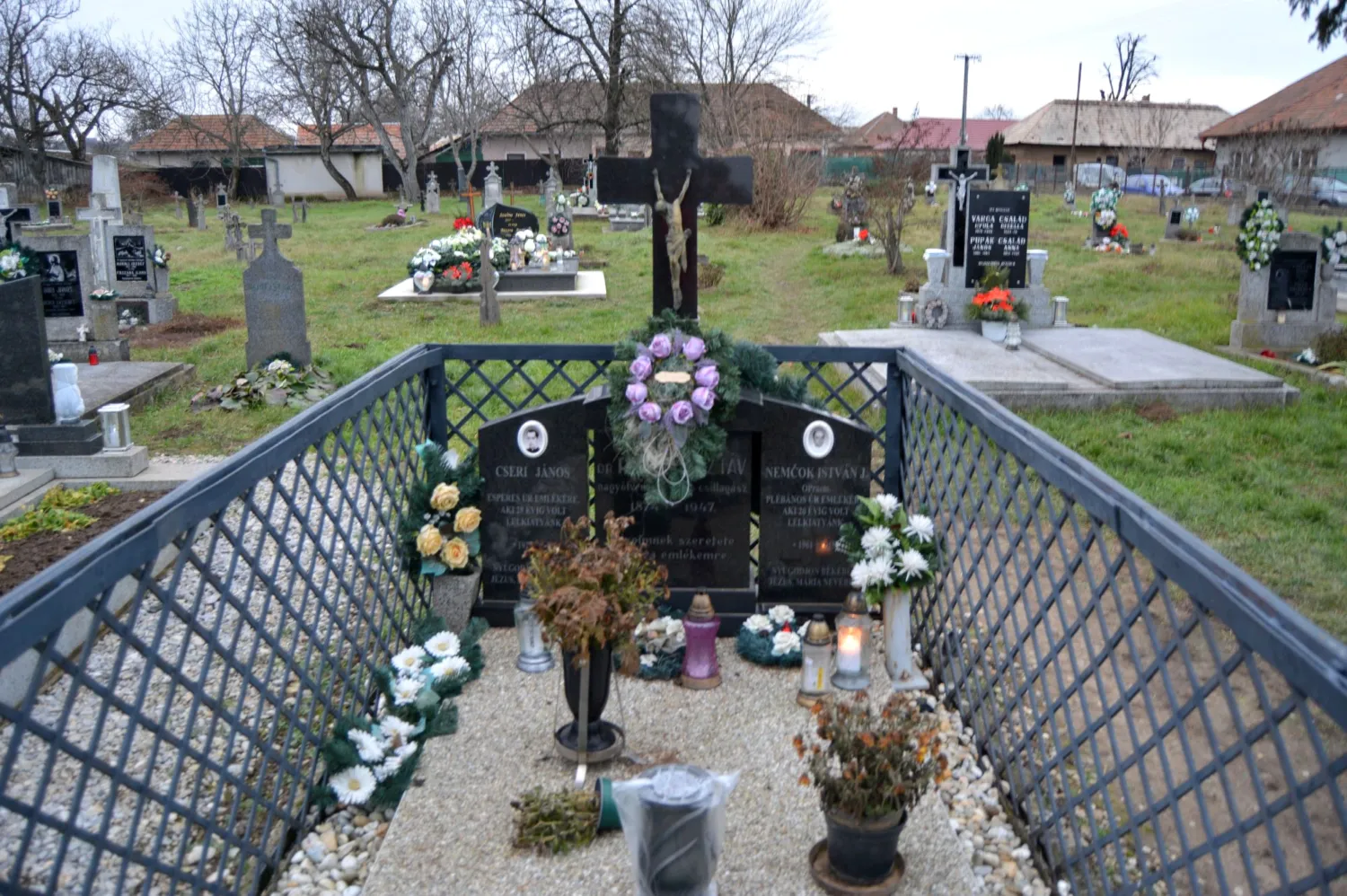
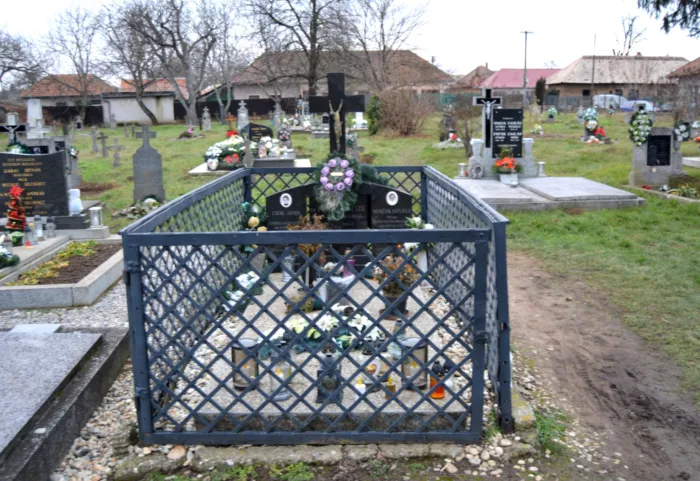
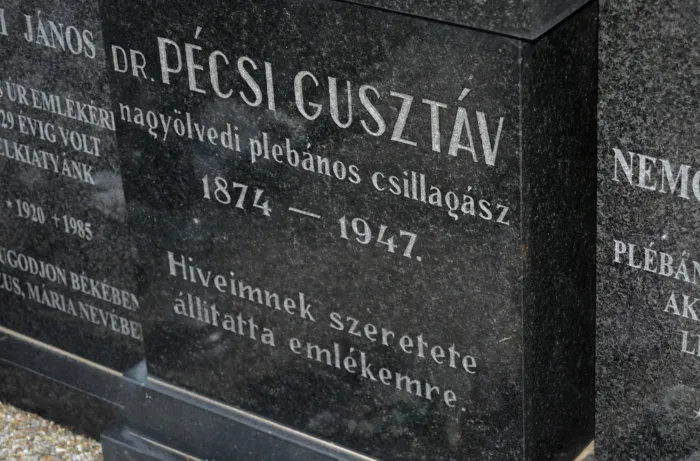
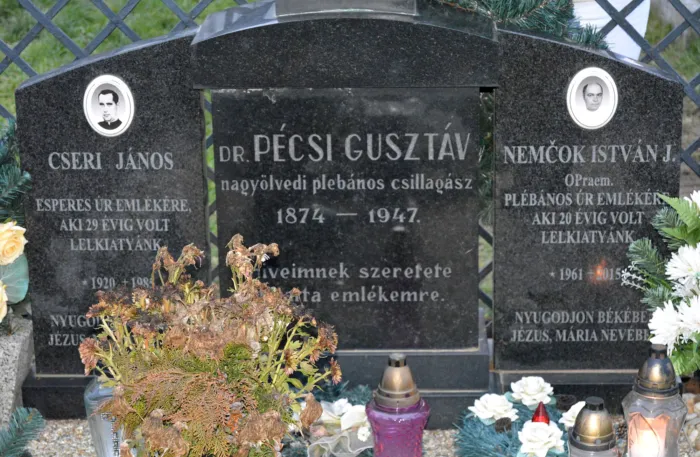
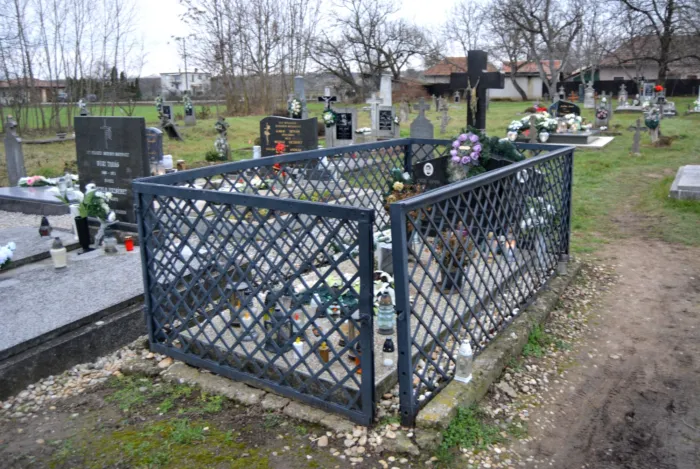
The resting place of Dr. Gusztáv Pécsi, priest, philosopher, astronomer, and physicist
Cemeteries, tombstones, grave sites
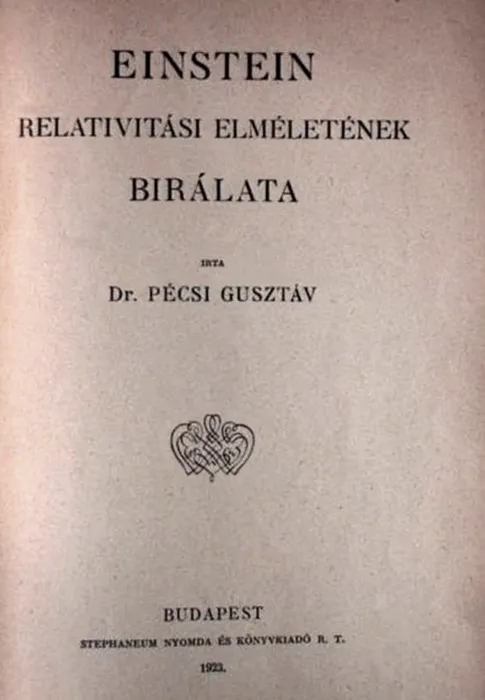
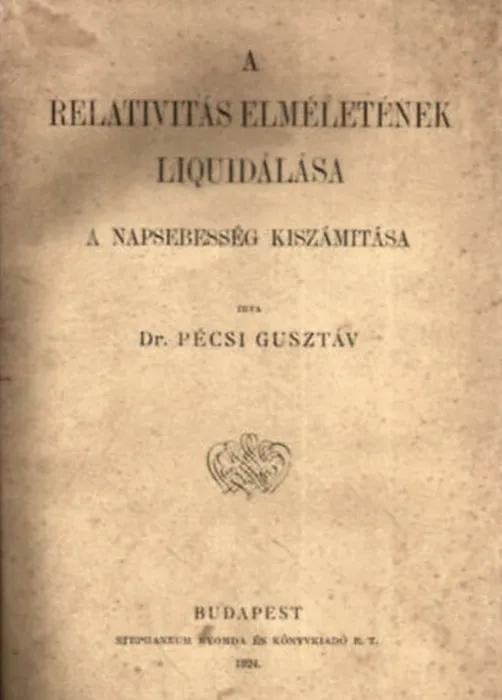
Dr. Gusztáv Pécsi * 1874. Sept. 2. Brassó – † 1947. Mar. 16. Nagyölved / priest, philosopher, astronomer, physicist; Dr. Gusztáv Pécsi was born on September 2, 1874 in Brassó. It is unknown where he completed his primary schooling, but he completed his high schooling in Budapest and Esztergom. In 1893 he became a member of the Collegium Germanicum Hungaricum, a German-Hungarian papal, Jesuit-run priest training institute, which was merged with the Collegium Hungaricum founded in 1578 on April 13, 1580. He studied theology in Rome and was ordained a priest in Nagyszombat in 1899. He returned home in 1900 and became a chaplain in Ipolyság. Between 1902 and 1941 he was a philosophy teacher at the Esztergom seminary, from 1904 he was its prefect (a manager, supervisor appointed for a specific task), and then the spiritual director of the minor seminary. He was co-editor of the Christian Catholic political weekly Esztergom. He also worked as a writer. From 1918 until his death he was the parish priest of Nagyölved. ; In fact, he was not only a priest in Nagyölved, but he also lived there for a longer period of time. He was a very kind, educated man. He liked the village, helped its inhabitants in whatever way he could, he also had land and animals. He was a wealthy priest, but he always distributed his wealth, things, and food, so he lived practically like a beggar. If they went to sing to him at Christmas or on smaller or larger holidays, he would always throw the money out the window (which he did not do out of compulsion at all, as I mentioned, he was a very kind person, so of course he was happy to help everyone). If very poor families came to him not on holidays, but on weekdays and/or weekends, for example, he would still give as much as he could, even if he could only give a few crowns. He often brought pancakes and cakes to the poor children at school. He also had a housekeeper, a kind of “servant”, who helped Gusztáv around the house, cleaned, fed the animals, and did all sorts of other things. Our pastor lived a very religious, clean life, so he would not let his housekeeper (who was a woman by the way) into his room, which is why there was dust and fleas in the room. He also had land, a total of 60 acres, and two oxen to plow it, but they were always asked for, so he could not sow or plow the land properly, and the harvest was never good. People also worked on his land. He gave out one acre for free to the poor. They could plant anything in that area. He also tried to rent out the land, although the tenants always had some excuse that prevented them from paying the rent. No matter how generous he was, there were still people who stole from him, for example plums, of which a “written record” remains. But it was not he who recorded this, but the famous László Paxy. Unsurprisingly, there were people who took advantage of him. By the way, he gave very meaningful, ambitious sermons. He encouraged many people to visit the church, and there were some who he “carved into believers” and who started visiting the church just because of him. He did not accept anything for funerals, swearing-in ceremonies, or baptisms. The official fee for the Holy Mass was 30-60-100 crowns, but he accepted a maximum of 30 crowns, and that very rarely. As a result of the above, Dr. Gusztáv Pécsi was a very good man, and as I mentioned at the beginning, he was also educated. He wrote many works related to science, corresponded with famous people, and once even confronted Einstein. He “attacked” the theory of relativity. He did not agree with it. Of course, because he was faithful to God. In fact, not only did he love the villagers, but the villagers loved him too. If he had any problems, was sick, or was just weak and could not hold mass in the church, the villagers joined together and cared for him. He always had something else assigned to him. During this time, they were able to get to know him better. Speaking of being known… by the way, everyone in the village knew him. At the end of his life, he was very thin, and many people feared for him. Not long after, he collapsed and never got up again. However, they speculate that not only his thinness and old age were to blame for his loss of consciousness, but also several people. In the last days of his life, he was under pressure, teaching stressful classes for a community, namely because during the Hungarian regime in Kural, some Slovaks demanded a Hungarian school. The school was a church school. The priest refused their request, saying that Slovaks were entitled to a Slovak school. One of his former Kural students, whom he supported financially and who rose to a fairly high position, said of this just behavior of his that the Slovaks would never forget this act, which the priest did not like very much. A few weeks later, the same official attacked Gusztáv in a harsh article. The notary sent him the reslovakization declaration twice, but he refused to sign it both times. The notary said that if he did not sign it, he would be deported to Hungary. That was when he broke down. But he signed the declaration, and died shortly afterwards on March 16, 1947. His body was buried in Nagyölveden. A large funeral was organized for him, and many people showed up. When the grave was dug up, a mouse was found in the pit, which could also be a metaphorical reference to the fact that Dr. Gusztáv Pécsi was poor, like a church mouse.