
Dr. Antal Kiss Memorial Column
Statue, monument, memorial plaque
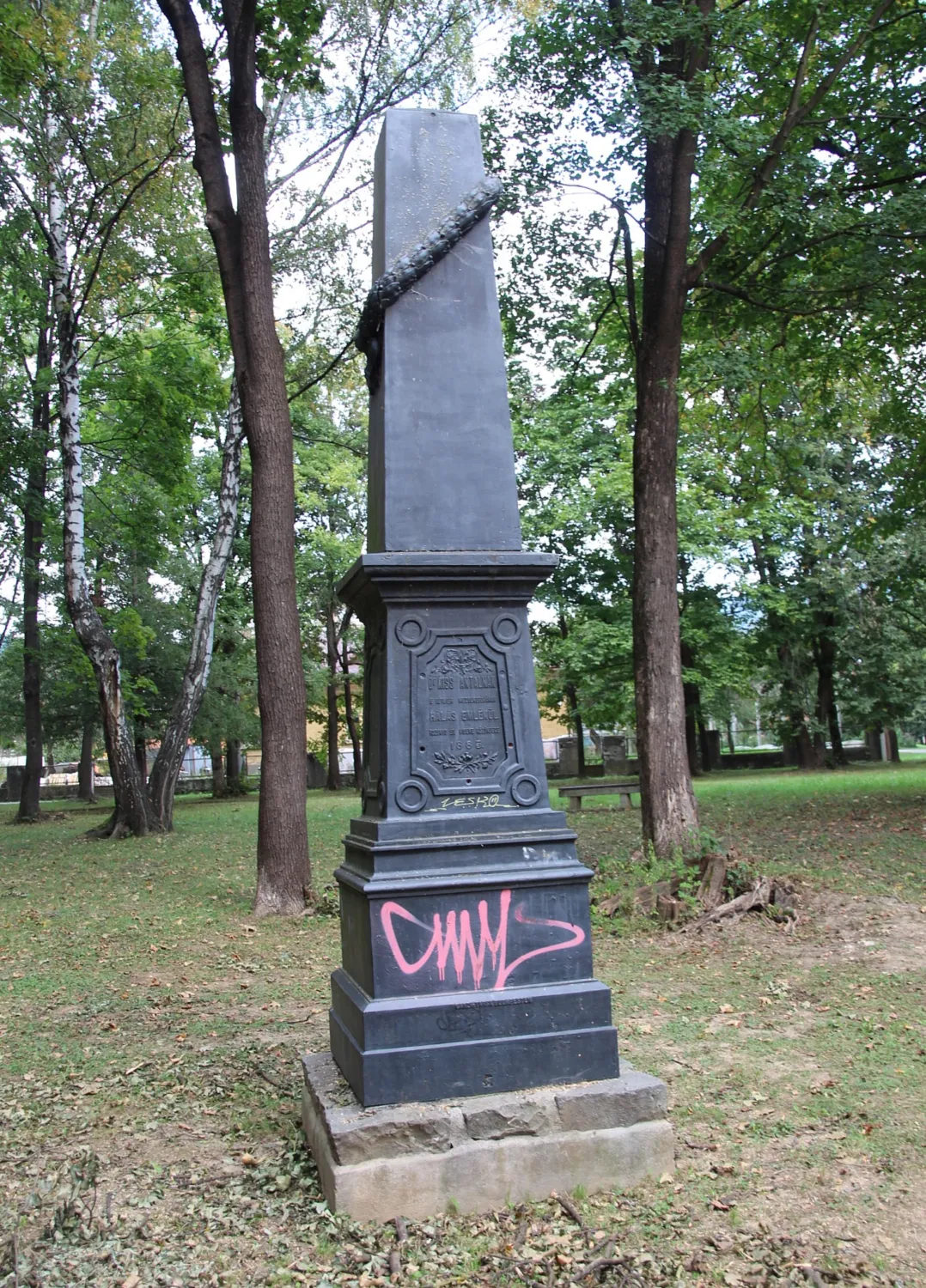
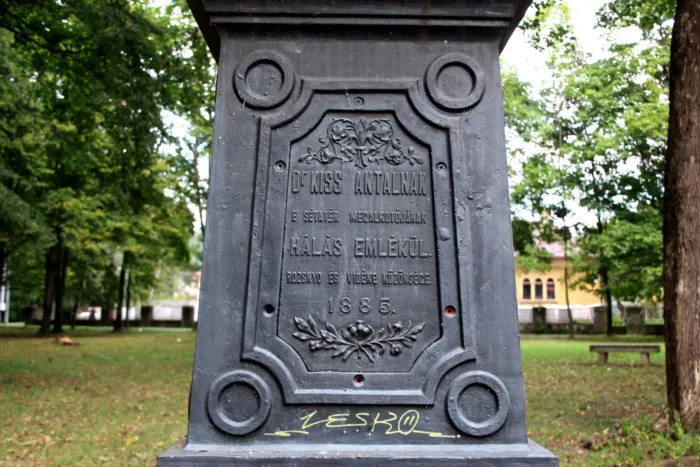
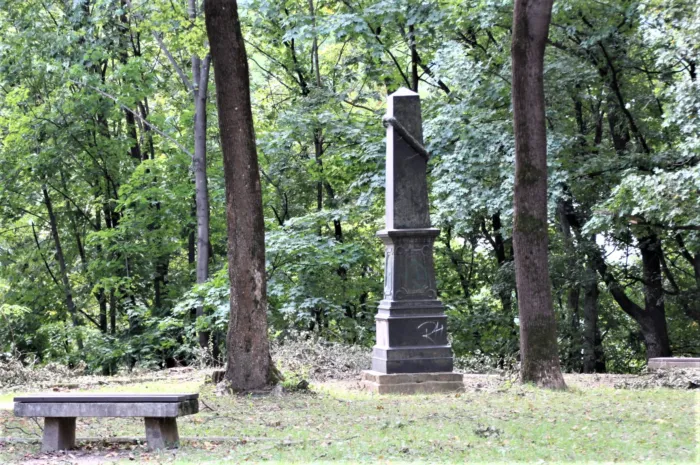
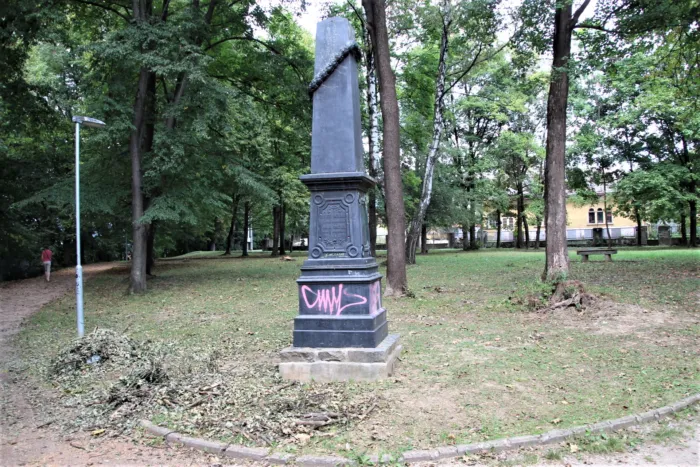
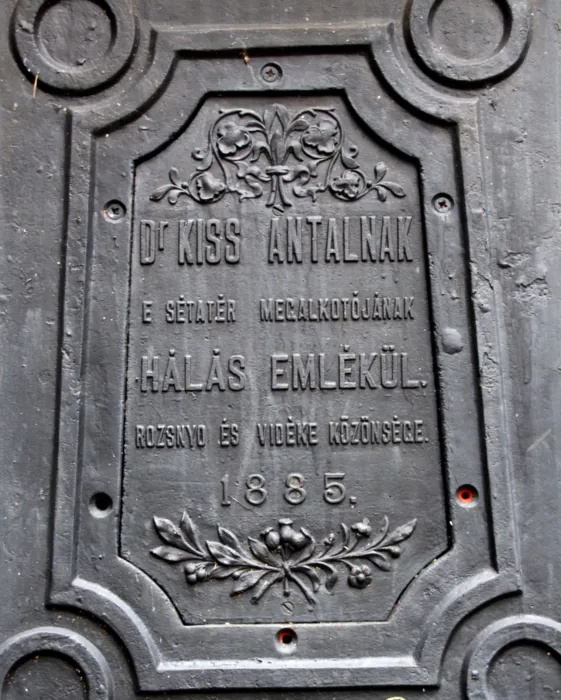
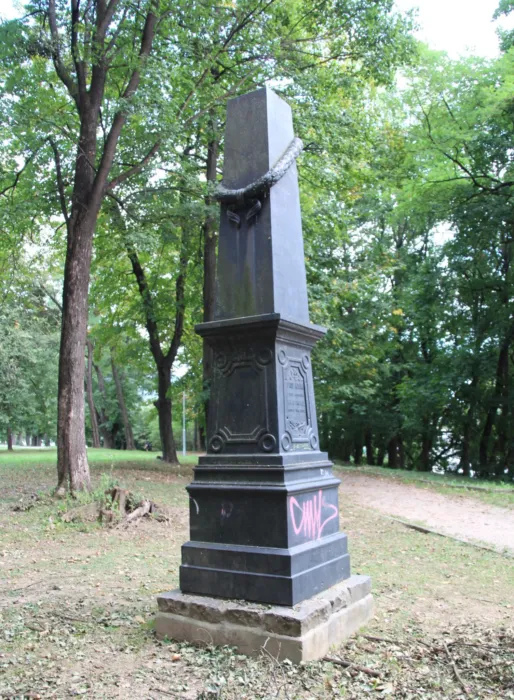
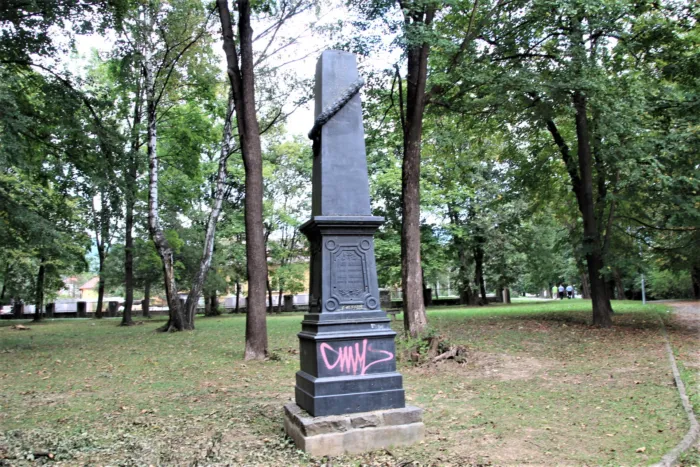
The promenade is nearly two kilometers long, lined on two sides with linden, chestnut, plane and forest deciduous trees, with resting places here and there, runs along a terrace rising like a bastion above the Sajó and, stretching in a giant E shape, provides a very pleasant and refreshing walking area. The urban and rural public expressed their thanks and gratitude to its creator with a memorial column placed in its southern corner. The lower part of the obelisk-like iron column placed on a stone base and wreathed with this inscription can be read: ; To Dr. Antal Kiss ; To the creator of this promenade ; in grateful memory ; The public of Rozsnyó and its region ; ; Antal Kiss was born in 1813 in Sátoraljaújhely. We have not found any information about his youth. He completed his medical studies in Vienna, and in 1838 he published his 44-page Latin dissertation on the “harmful effects of air on human health”. He dedicated his dissertation to the bishop of Székesfehérvár, Baron László Barkóczy. He began his career as the bishop’s court physician in Székesfehérvár. In 1846 he was already living in Rozsnyó, where he first practiced and then worked as a city and chapter physician. Gábor Tököly’s claim that he was the chief physician of the Rozsnyó military battalion organized in September 1848 is not supported by the literature: his name is not on Zétény’s list of military physicians. ; That he was already operating in Rožňava in August 1846 is confirmed by the list of participants of the above-mentioned Košice/Eperjes travelling assembly, in which Antal Kiss is listed as a practicing physician in Rožňava under number 132. Despite his young age, he also gave two remarkable lectures – both of which were included in the Proceedings edited about the travelling assembly. He gave the first one in Košice, on August 8, 1846, to the members of the Medical Surgeons’ Department. He gave his opinion on the surgical “fashion” of the time, on everything from strabismus to “club foot”, on “tenotomy” – which cured many things by cutting the tendon that attaches the muscle to the bone – based on his own experiences: “…I made several tendon and muscle incisions on the eye, neck, arm, hand and its fingers, on horse and club foot…”. Despite the fact that he has already undergone the 13th operation for “knee atrophy” – he also mentions a case he had operated on in 1842 – he urges his colleagues to be cautious and considerate. The light and not very painful tendon incision is only a preparation for “orthopedic work”. The surgical result can only be maintained by using the “compelling machine” and “gymnastic exercises” for a long time. This successful presentation certainly contributed to the fact that the traveling assembly, which had meanwhile moved to Prešov, elected Kiss, a practicing physician, as the secretary of the departmental meeting in place of the honorary chief physician of Abaúj County, Gejza Katona, who had remained in Košice. The lecture “On the necessity of opening a human corpse” held on August 14th His lecture was so successful that he was not only included in the Proceedings, but he was also asked to repeat his lecture at the joint meeting on August 16. What makes this lecture important and valuable? Our doctor tried to convince his medical and – especially – non-medical students that the “harmful prejudice” that grieving relatives prevent the autopsy of their deceased must be eliminated. He convinces the laymen with two arguments: on the one hand, with an autopsy, burial in a “willingly dead” state can be avoided, and on the other hand, the cause can be identified and thus the recurrence of a “familial” – in today’s terms, hereditary, congenital – disease can be prevented. He warns his colleagues that the doctor performing the autopsy will be more modest, more honest and, above all, more careful than his fellow doctor who ignores the autopsy. The traveling assembly, convened once a year from 1841 to different corners of the country, brought doctors and naturalists together at a common table. The example of Antal Kiss shows that these two directions often appeared in the same person. We have already referred to our doctor's naturalist self above (he was the only employee of the meteorological "detection station" in Rozsnyó and also conducted geological observations). Another example of this dual interest is his affinity for mineral waters. His article dated February 17, 1854, appeared in the "Public Administration" section of the "Magyar Sajtó". He draws attention to the fact that "one of the most precious treasures of Gömör", the effect of the mineral water of Ajnácskő is amazing, "but the disorder of the bathing place is scandalous". He carried out a chemical analysis of the water, showing its “iodine, sulphur, iron, magnesia, lime and slaked lime” content and based on this he considered the water suitable for curing scoliosis, chronic scurvy and sand fever. From a press history perspective, his comment on why he was forced to publish his water analysis in this non-“specialised” journal is important: “…I feel it is a blow to our national literature that our Hungarian medical journal does not exist, so we happily welcome the forthcoming Magyarhoni tészészbarát, with which Nyitra will overtake Pest, where natural science and geological societies languish without a communication organ”. This was not the first water analysis by Dr. Kiss. As early as 1852, he had analysed the water of the Rozsnyó spa, which was the property of the Rozsnyó bishopric and is located on the right bank of the Drázus. This is evident from the presentation that our doctor gave to the members of the 1867 Rimaszombat traveling assembly who visited the city spa. (Before the trip, however, he gave a lecture in the Medical and Surgical Department on why the life of a rural surgeon is difficult.) He also enjoyed visiting foreign spas. His travelogue entitled “Some of the most famous Czech spas and the Dresden city hospital” was published in the journal “Medicine” in 1869. This is probably the trip during which he had the opportunity to see the most famous ophthalmologist of the time, Albrecht von Graefe, during an operation in Berlin. It was not curiosity that brought him to Graefe’s private eye clinic, but the desire to learn, since he himself performed many eye surgeries – probably the first in Gömör. We recommend this “fragment” to those interested in the history of ophthalmology, since e.g. It also contains a professional description of “Graefe’s linear extraction of cataracts” – probably the first in Hungarian. We do not have space to deal with Antal Kiss’s public role, nor with a more thorough analysis of the rich publication activity that has been highlighted. However, it is clear from what has been said that an extraordinary career ended on December 30, 1883. Antal Kiss’s personality deserves more attention and perhaps even a memorial plaque in Rozsnyó.