
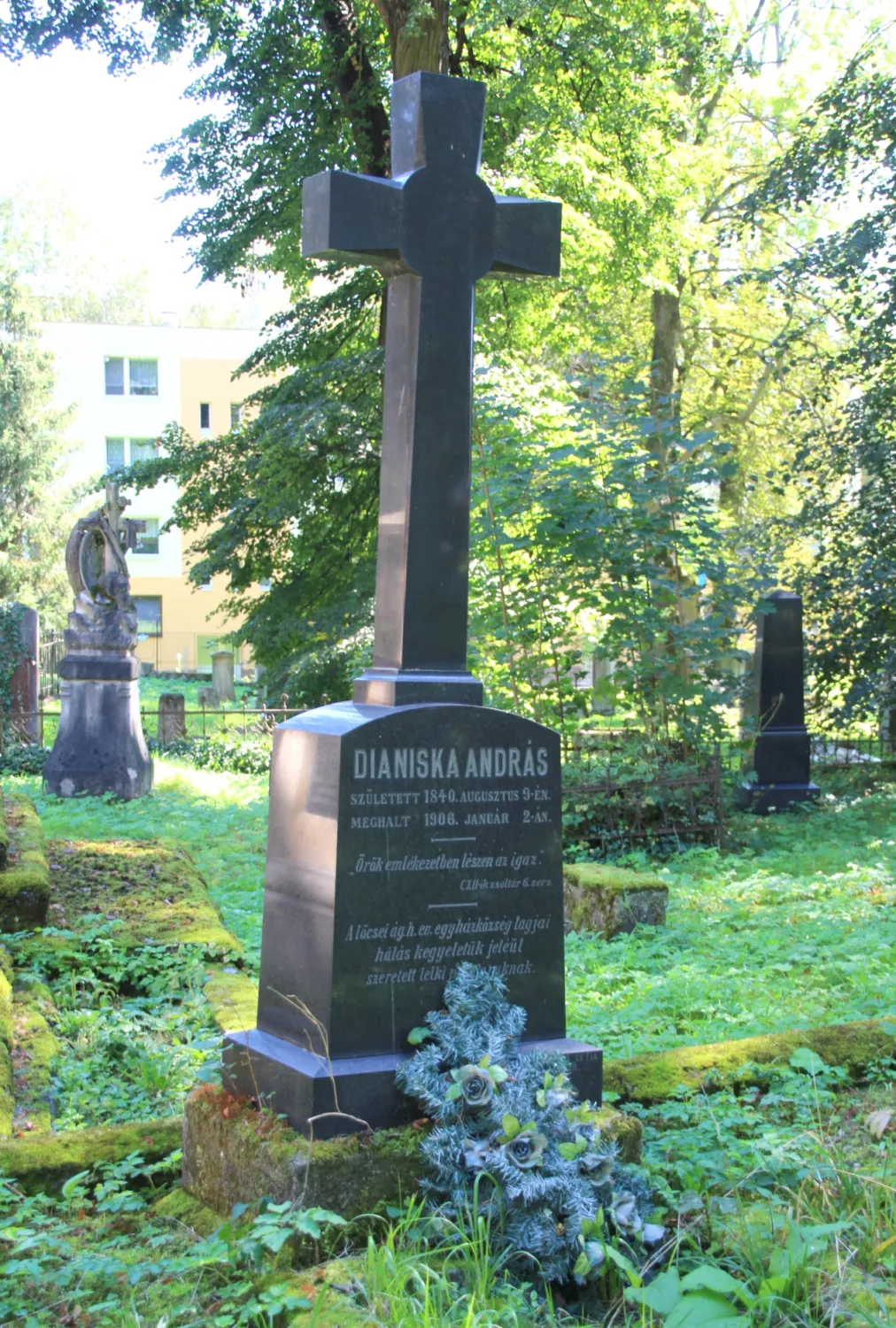
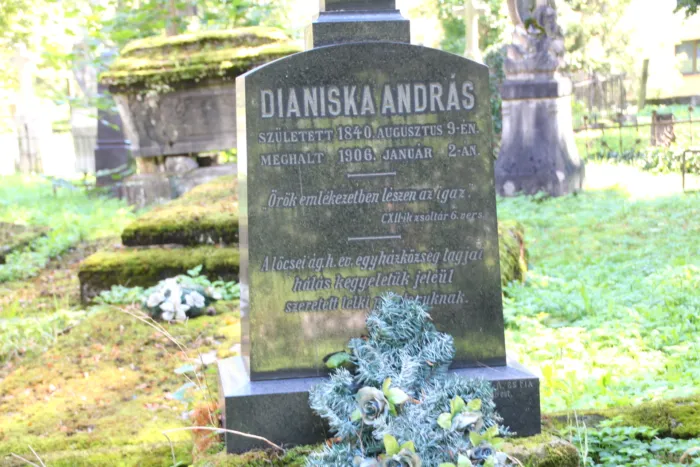
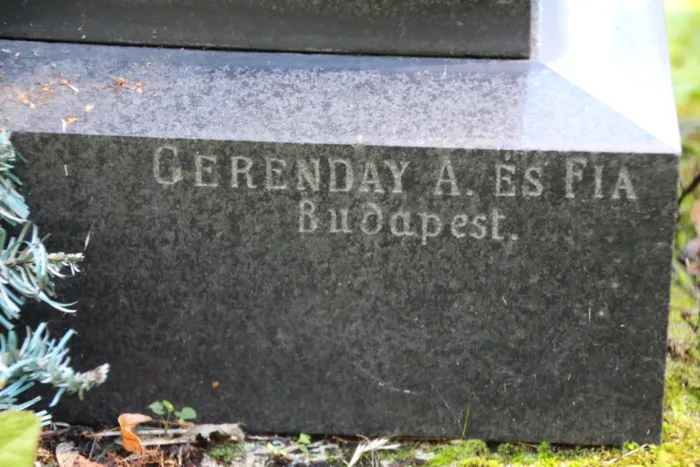
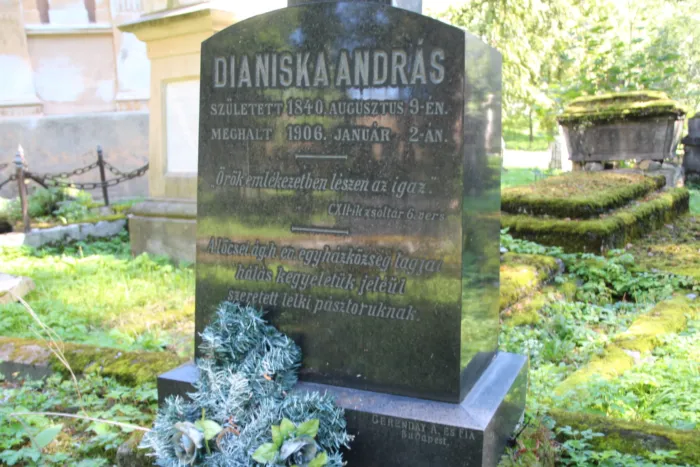
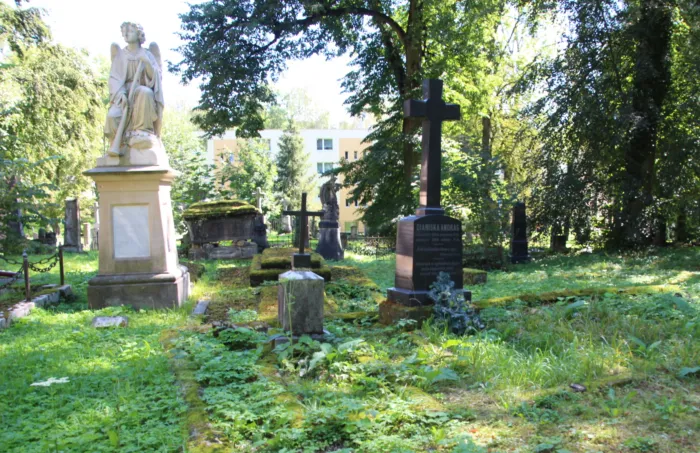
The grave of the Lutheran pastor András Dianiska
Cemeteries, tombstones, grave sites
András Dianiska, an Augustinian Lutheran pastor, was born on 9 August 1840 in Batiszfalva, Szepes County, where his father Dániel Dianiska and his grandfather András Scultéty were pastors (1809–1863). He completed high school in Levoča, Rožňava and Késmárk, and theology in Prešov, where in his last year he taught Latin, German and Tot in the lower grades of the high school. He continued his theological, philosophical and linguistic studies in Rostock, Erlangen and Vienna in 1862–64. He also stayed in Leipzig and Berlin and travelled, where he studied in particular the charitable institutions of the Belmissi and deaconesses. After the death of his father Édes, he was elected pastor of Batiszfalva in 1863, but remained abroad for two more years, and served as assistant pastor at home. After passing the priestly exam in Rozsnyó, he was ordained on July 1, 1864, and worked as pastor and district pastor in Batiszfalva until 1879, dealing with educational matters, introducing the teaching of the Hungarian language to all the schools in his deanery. With the aid of the Hitrokon, he built a church and a school in Stólán, and reorganized the elementary schools in a patriotic spirit and according to the law. At the general assemblies and annual general assemblies of the German Gusztáv-Adolf association, the Lutheran guardian institute and the Tisza church district sat. He participated ten times in his representation (general assembly 1865. Dresden, 1871. Stettin, 1876. Erfurt, 1880. Karlsruhe, 1889. Danzig, annual assembly 1876. Bielitz, 1877. Urach, 1878. Teschen, 1879. Krailsheim, 1891. Dobeln in the cities) and always provided substantial aid for domestic parishes, educational institutions, widows and orphans. He accompanied the Czech superintendent on his episcopal church-visiting tour several times as a district clerk. From 1879 he worked in Zagreb as a pastor and university professor of the Hungarian language, he was the first evangelist. pastor, who preached the word of God in Croatia in Hungarian, in addition to other languages, he was responsible for the construction of the first Protestant school, rectory and church in Croatia. For his merits in teaching the Hungarian language, he received a commendation from Minister Gyula Szapáry in a letter dated 4 August 1881. In 1882 he was transferred to Levoča as a pastor and secondary school religion teacher, where he has worked since then and since 1888 he has also been the Tisza district president of the Hungarian Evangelical Church. ; ; The issue of the weekly newspaper Evangelical Watchman published on January 5, 1906, reported on the death of András Dianiska: "András Dianiska has died. As our newspaper closed, we were struck by the shocking news that one of the most outstanding of our great priests, András Dianiska, pastor of Levoča, had moved away from us to a better country on January 2. After a serious illness, death was considered a salvation for him, but it is difficult to calm down in this consciousness for those who loved him, respected him, and could consider him their own through kinship or friendship. Exactly one year ago, he buried his brother, Albert, the pastor of Kiszeben. He quickly follows him into the lap of decay. At the age of 66, after 42 years of faithful pastoring, he is sinking into the grave. The body could no longer handle the work, but the soul still soared, the instinct for creation resided in it. He was likened to that diligent farmer who cannot bear to look at the wasteland and who plows, ploughs and sows wherever he can, so that no piece of land he has planted remains unsown or unharvested. Dianiská's last workshop was Levoca, a whole series of institutions proclaim her priestly work, her tireless hands and her captivating character. However, our entire church feels the loss. She was the last dean of the dissolved VI. Free King. City deanery, for a long time president of the Tisza district guardianship institution and a permanent strong link between our guardianship institution and the Gustav Adolf Association, and a judge of the universal court. Her individual excellences paved the way in social life as well, despite her great modesty. One of the leading figures of Levoca, who conquered everyone who came into her environment with her great education and loving heart, see, for authority and moral power you do not need a distinguished birth, no need for a fortune, no need for effort, — only faithful fulfillment of duty, honest character. ; Time is short to write her life's journey in detail. If only the memoirs of this fertile soul had remained. How many lessons, what a wealth of life experiences would be revealed there before our eyes! Although normally great workers, people of action rarely have time to write down their thoughts and reflections, no matter how beautiful writing talent and great knowledge they possess, no matter how great spiritual damage may result from their silence. However, Dianiská had other means of immortality: her works, the Levoča hospital, orphanage, etc., which will survive even the generation that felt the rays of her warm soul. ; Peace to the ashes! Blessings to the memory!" ; ; His articles and speeches on ecclesiastical, theological and doctrinal issues were published in the following newspapers, magazines and yearbooks: Priatel školy a literátory (Budapest 1860–61), Zeitschrift für Mission (Erlangen 1863–64), Dr. Delitsch's Saat und Hoffnung magazine (1864–65. Die Juden in Ungarn), Népsikolai Olvasókönyvek (Békés-Csaba 1869–81. stories and religious and moral poems), Gustav Adolfs Bote (Darmstadt 1871. 1880.), in the central bulletins of the Gustav-Adolf-Egylet (Leipzig, 1871. 1876. 1880. Stuttgart 1877. 1879.), Gustav Adolfs Blätter. (Stuttgart 1877–81. Der Protestantismus in Kroatien und Slavonien, Die evangelische Gemeinde Agram, 1891. Die magna charta der ungarischen Protestanten sat.), Prot. Egyh. és Isk. lap (1877.), Evangelical Church and School (Bratislava, 1886.), Evangelische Glocken (Bratislava, 1890. Eine Gustav-Adolfs Reise, 1891. Die Gustav-Adolf Vereine und ihre Versammlungen). Czikkeit was taken up by several Hungarian, German and Swiss newspapers. ; ; Works: ; 1. Gyámintézeti beséd. Bpest, 1878. (Tót nyelven.) ; 2. Gastpredigt Agram, 1878. ; 3. Abschiedspredigt. U. ott, 1882. ; 4. Jahresbericht der evang. Agram parish 1879. 1880–81. ; 5. Inaugural sermon on July 16, 1882. Leutschau, 1882. ; 6. Memorial of the late Kálmán Okolicsányi-Zsedényi. U. ott, 1882. ; 7. In memory of the Luther celebration in Leutschau 1883. ; 8. The work of the Gustav Adolf Association and the activities of women in this area. Késmárk, 1884. ; He has many church and occasional songs and poems in Hungarian and German. Levski, 1883–92. ; Annual reports on the Levski ev. church for the years 1882–91 in German. ; Reports on the general assemblies of the Levski ev. church guardian institutes in Hungary for the years 1888–91 in German. ; Manuscript: The Levski branch. History of the Evangelical Church and its Lyceum in German and Hungarian.