
Tímea Csank's ceramics
Foreign regional unit value
"But it's not just important that it exists, but also that we dare to devote our own time to it. My hobby is ceramics," says Tímea Csank.
Tímea Csank was born on December 10, 1974, as Ádám Tímea in Rimavská Sobota. She began her primary school studies in 1981 at the Hungarian-medium Primary School in Rimaszombat. Between 1989 and 1993, she was a student at the Rimaszombat Gymnasium, and then continued her studies for 2 years in Léván (Levice), where she obtained a teacher's qualification.
She has been versatile since childhood. She has been a music lover, which is proven by the fact that she persistently studied piano for 8 years and sang in choirs. Sport also plays an important role in her life; she played handball for 10 years and excelled in athletics.
In 1996, she started her career as a teacher in the local children's home in Korlát (Konrádovce). A year later, in 1997, she was given the opportunity to put her talent to good use at the Hungarian Teaching Language Elementary School in Détér. Having experienced the beauties of pedagogical work, she felt and knew that she had chosen well. She found her place not only in the world of work, but in all areas of life. That same year, she married István Csank, with whom she had two children: Mátyás (2002) and Máté (2008). Since 2010, she has been a teacher at the Tompa Mihály Elementary School in Rimaszombat.
She has always been a fan of folk art and folk applied arts. In 2007, she founded a traditional women's choir, which has been operating ever since with the support of the Csemadok foundation organization in Détér. She has been the president of this organization for 18 years. They have revived the harvest and wedding customs of the past, the nativity scene and the rukula of the recruits, and they also hold craft activities for children. Since 2012, she has been a member of the Rimaszombat Regional Committee of the Csemadok and the organizing committee of the Tompa Mihály National Competition. In 2018, she received the Csemadok Public Culture Award.
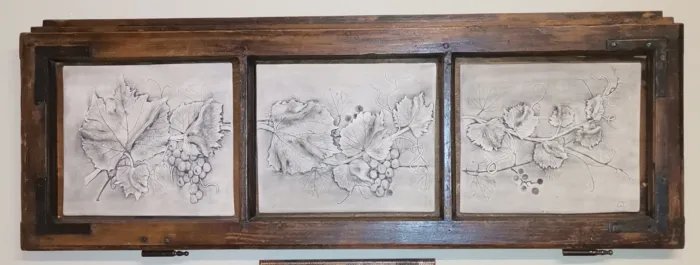
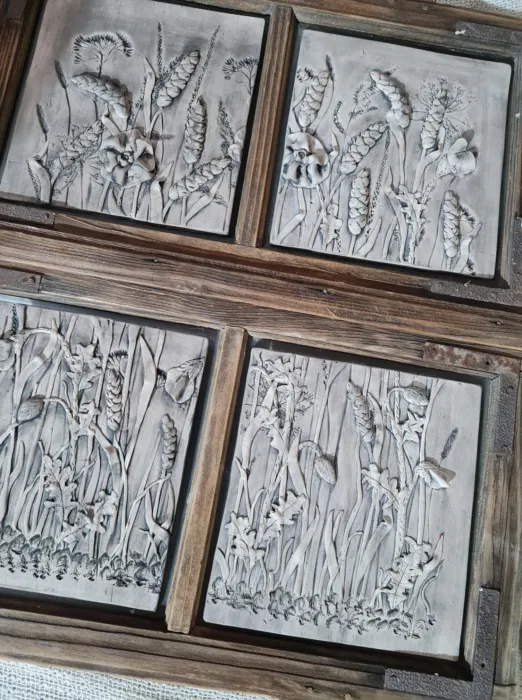
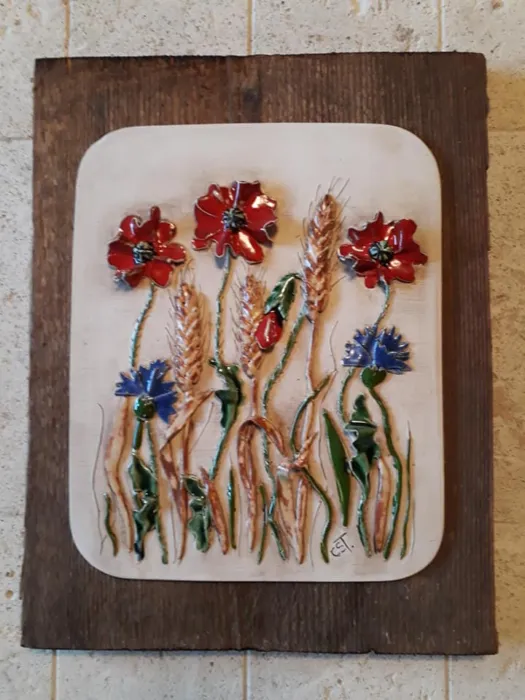
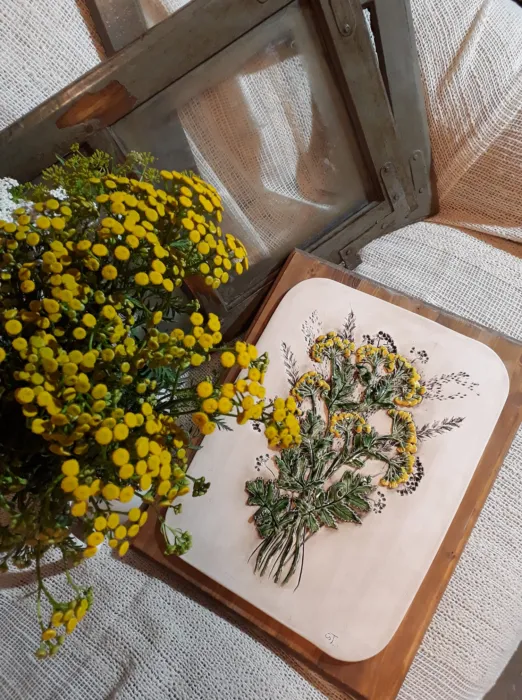
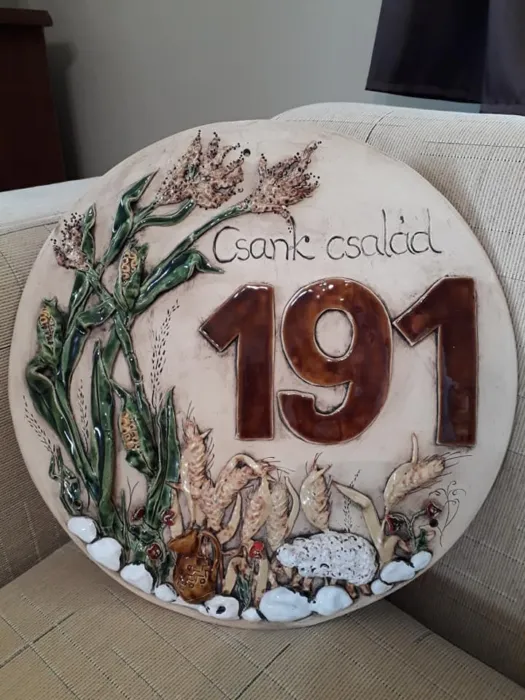
In 2014, a great wish came true when her husband surprised her with a small kiln. This device opened up new possibilities for her. She became thoroughly acquainted with the material at her disposal: clay. She searched, tried, and studied the mysteries of pottery making. With patience, step by step, and in an autodidact manner, she mastered the art of shaping clay, glazing, and firing. Pottery became her hobby. At first, she made ceramic pictures. He was inspired by the living nature around him. The diversity of plants, their shapes, and colors. When creating his paintings, he tried to faithfully depict the natural reality of plants, paying attention to the appropriate composition. Just as no two plants are the same, no two pictures are the same, because he shapes everything by hand down to the smallest details, and makes every detail by hand. The finished works are given a wooden base and are decorated in old window frames. He often uses boards from 100-120-year-old demolished barns and salvaged windows from old houses and buildings for this purpose.
Clay and wood. The pairing of these two natural, ancient materials is dazzling to him. In 2021, he sent his works for professional evaluation. Since then, his products have carried the trademark of GÖMÖR–KISHONT REGIONAL PRODUCT. “I experience my relationship with clay as a wonderful discovery. My hobby and profession fit perfectly together and complement each other. I often give clay or other natural materials to the children entrusted to me so that they can learn about the basis of life, the magic of crafts. This is how they experience, learn, create – just like I did. ”
Tímea Csank’s aunt was also a painter, so she had someone to inherit her talent from. Ceramic objects were always close to her, and the touch of clay filled her with a pleasant feeling.
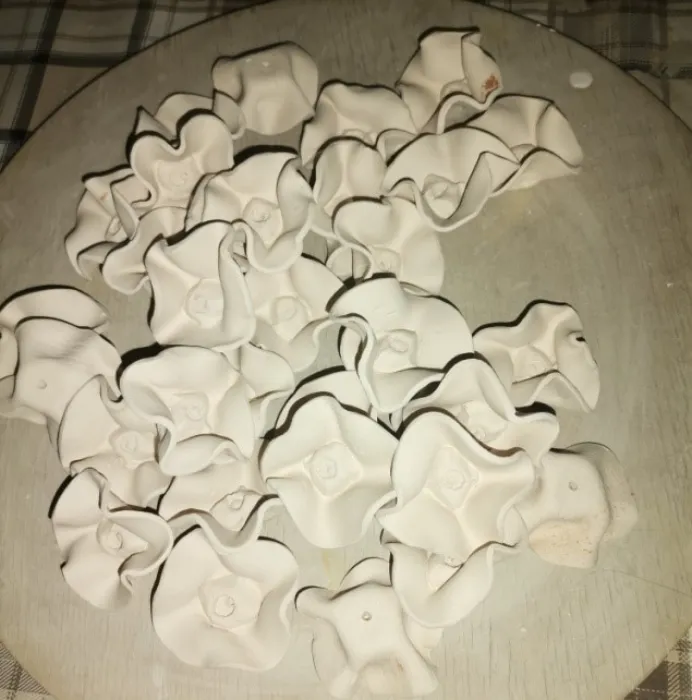
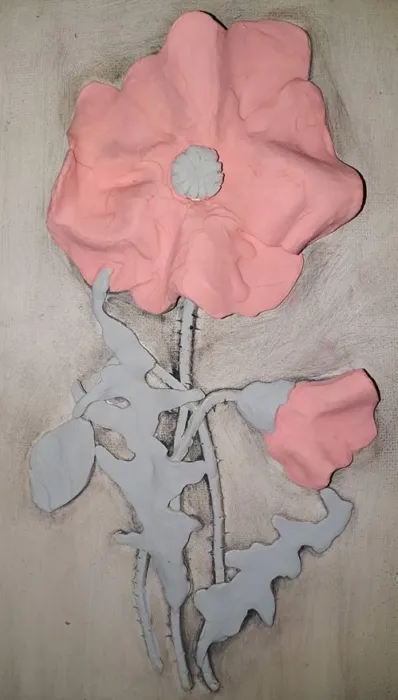
She made little angels and houses as a trial. Later, she wanted to try playing discus, but this did not capture her imagination, so she tried pictures for her own amusement, rejoicing in the results she got. She makes a coaster from the miracle material, clay, by kneading the clay and then smoothing it out on a kneading board with a skimmer. From this not too thin layer of clay, he cuts out the base for the picture in the shape he has imagined. From the remaining clay, he shapes flowers, plants, and fruits, glues them to the base, and then smooths them with a brush. He makes the formed pattern in the picture lifelike with the imprints of living plants. Because his pictures initially reflected the image of flowers and plants, mainly wild plants. At this stage, the picture is clay-colored and wet, so he lets it dry for a week or two. He must pay great attention to weighting the pictures. While the clay dries and the water evaporates from it, it must be weighted to keep it straight, because otherwise it will bend and then it cannot be fitted to a wall or wooden base. The next phase is firing in the kiln.
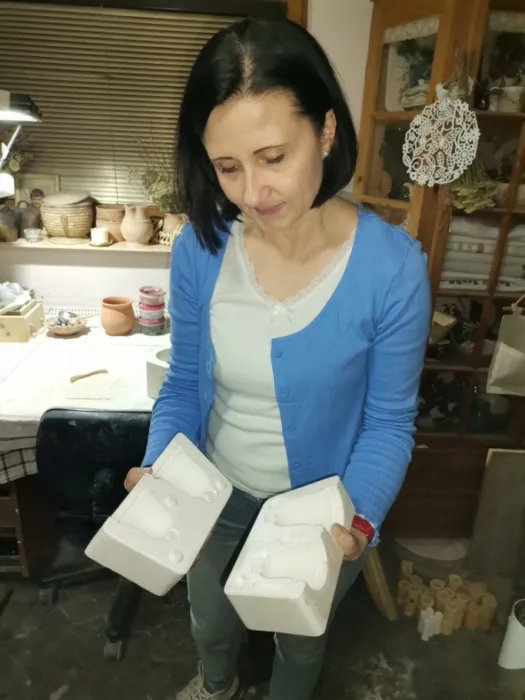
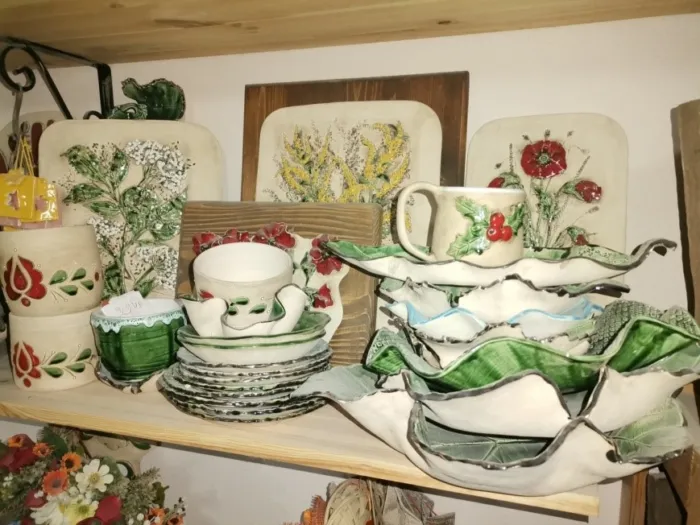
After firing, the clay turns white, becomes hard, and brittle. Firing is followed by painting, of course, with ceramic paint. When the paint dries, it can be diluted with water and then applied to the surface with a brush, or, like the mugs, dipped in glaze. In this case, the surface is dull and shows somewhat strange colors. The final shiny glazed surface with wonderful bright colors is only achieved by another firing. In every phase of the work, you have to be very careful with the image waiting to be processed, as there is always the possibility of making a mistake, and then the object cannot be saved, and the work has to be started again. For example, during firing, the surface may crack, or bubbles may form in the paint, and other deficiencies may appear. Tímea Csank is a demanding master, she wants to get the best and most beautiful possible out of her work. She uses molds to shape the mugs and bells. The mold consists of two parts. At the beginning of the pouring, he joins the two molds together and fixes them, then fills the space provided by the mold with thinner clay. Let it dry. By removing the molds, he obtains the primary object, the processing of which is identical to his paintings.
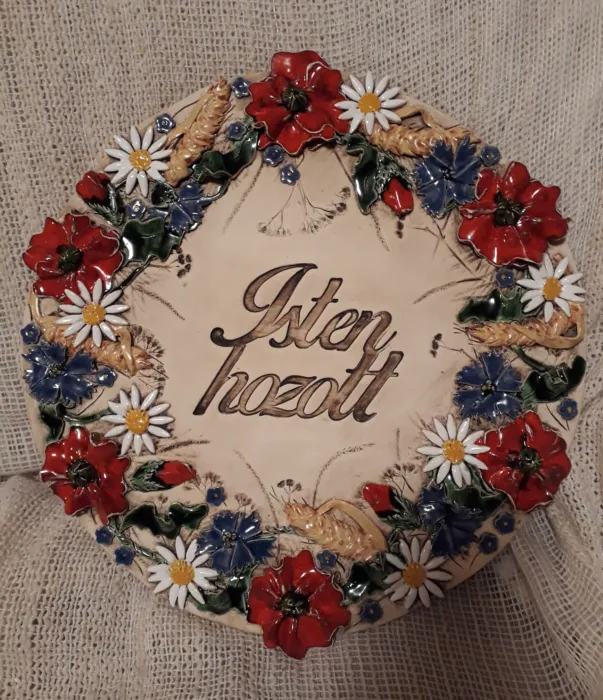
Each ceramic object is stamped with the ceramist's seal, which consists of the initials of his name. He likes to depict his favorite flowers, poppy, daisy, elderberry and cornflower, as well as fruits such as wheat ears, rose hips and juniper berries.
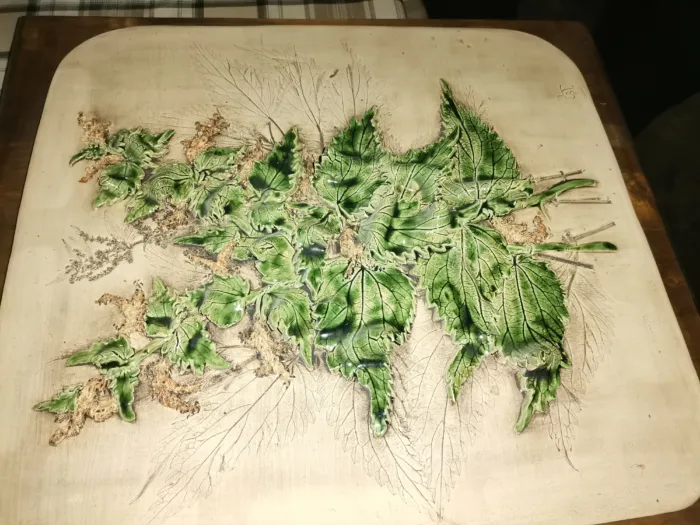
His first painting, which not only has elements protruding from the base surface, but also recessed into the surface or background, was a representation of nettle. Before applying any elements to the surface, he made impressions in the surface with the leaves, stems and flowers of the nettle. This gave the picture depth and ultimately made the picture richer and closer to nature. These lines were only given a brown tint when painted (with a manganese oxide sponge), thus ensuring the three-dimensional effect. By folding the leaves in a wave-like manner and patterning the nettle flower, the plant itself becomes the center of attention.
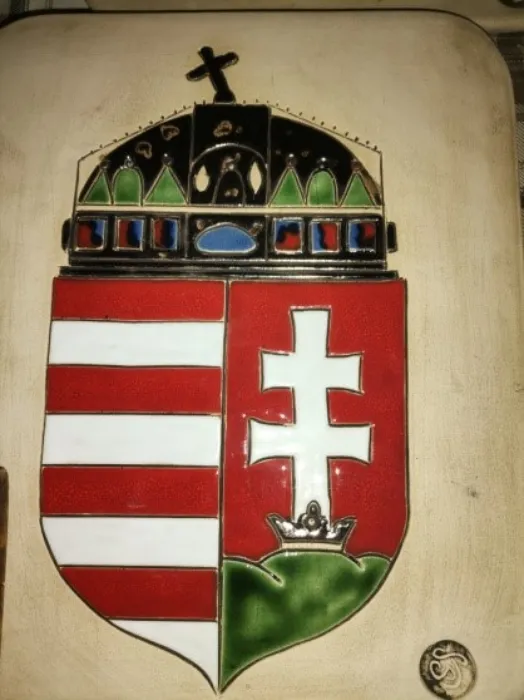
To the great joy of Tímea Csank, her son Máté is also interested in clay. They spend their evenings together in the workshop, where he gradually learns the basics of clay. The creation of objects made on a wheel caught his attention the most, a faster form of casting and painting, dipping. He has already made mugs and bells, which his mother decorated. He has already shown his works to his friends at school during an exhibition. It is important to Tímea Csank that God created him for Hungarians. In her work, she likes to use folk motifs and the corresponding colors. She also makes a Hungarian coat of arms. She produces each piece by hand, which means that each is a unique copy.
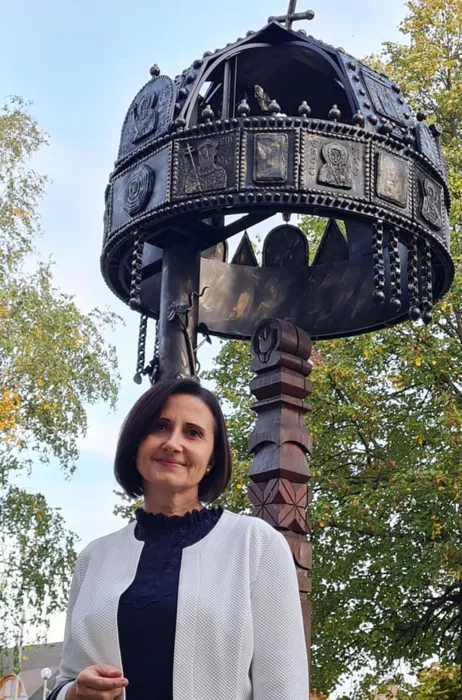
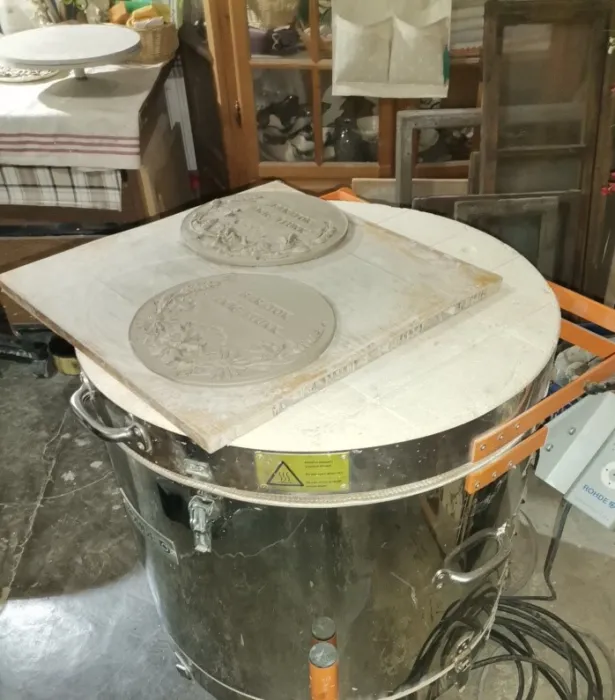
He is very proud to have participated in the work of making the Holy Crown placed in the Arad 13 Memorial Park in Naszvad. At the request of the Hanva blacksmith Ottó László, he made the models and images of the crown out of clay. He took his work seriously and felt a great responsibility. He knew that the theme required maximum demands from him. He shaped the reliefs to the best of his ability for half a year, faithfully adhering to the exact transfer of the smallest details. He worked carefully guiding every line and counting every small detail precisely. Finally, a silicone mold was made from the reliefs, which were filled with castings. These were placed on the wrought iron crown. He participated in the handover ceremony in Naszvad on October 8, 2022, deeply moved. According to his confession, he was possessed by a wonderful feeling, which gives him great enthusiasm in his upcoming mission.
Béla Hrubík, the president of the Naszvad Foundation of the Csemadok, said the following in his ceremonial speech: “The memorial site inaugurated today is marked by the names of 8 creators, who were asked by the local organizers to carve a piece of their own self, soul, and knowledge into wood, forge it into iron, and burn it into fire enamel, so that it can be seen, and so that others can see it by looking at it. Because he who understands and makes others understand also makes a nation live.
The memorial columns were carved by Szilveszter Sidó, Béla Hrubík, Dávid Ambrus, Norbert Gerendás, and István Katona, the fire enamel portraits were created by Károly Balanyi, a fire enamel master from Kecskemét, and the forged copy of the Holy Crown was made by Ottó László, with the assistance of ceramist Tímea Csank.
Eight different destinies, souls, and perhaps even worldviews, although I wouldn’t dare to swear to this, that our worldviews would be so different, but one goal and one will, which hold together the foundation and walls, on which we can boldly build a nation, a homeland, a home, a love of the native land, enriching it with the knowledge and creation received from our ancestors.
This is a strong bastion. There are still many of us who dare, and can build, and create. Because what is false falls through the sieve of time. Only true values remain. As water runs, but the stone remains. On the unpredictable path of fate or what we also consider fateful, today the work, works, and acts of goodwill of many honest people crossed paths and brought people closer together who may have never met before. And if so, this only strengthens the fact that someone is paving our paths.“
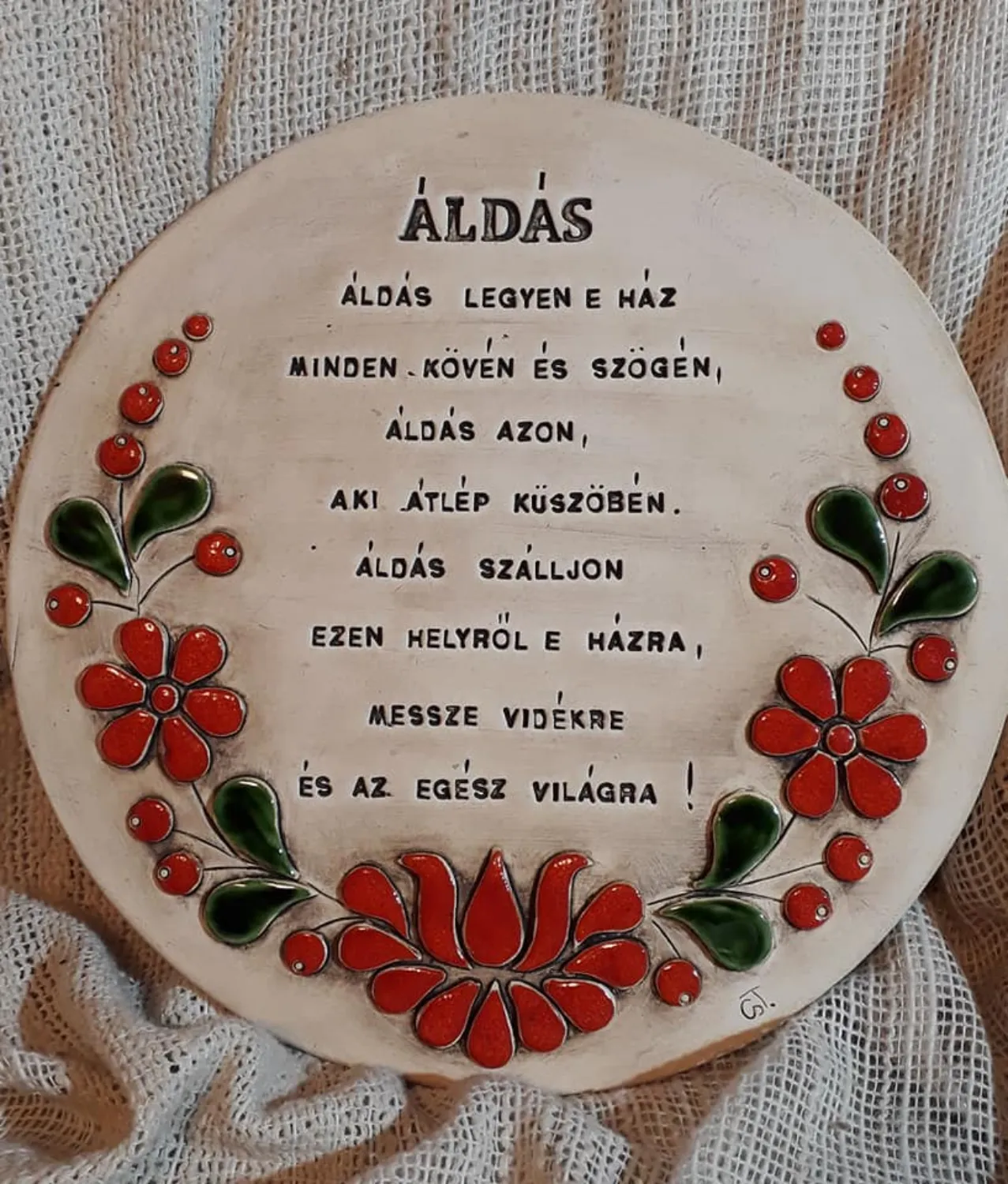
The signature of ceramist Tímea Csank is unique, her style is easily recognizable. She carries out her value-creating work with great responsibility. With her ceramics, she brings a lot of joy to the people around her, who want to give gifts to their loved ones or send messages to each other with texts burned into clay.
We saw her carefully made plaques:
• at the events of the Association of Hungarian Teachers in Slovakia,
• at the jubilee celebration of Csemadok,
• at the XXIII. ÓSSIRÓZSA Hungarian Song Singers National Competition in Ipolynyék (2022),
• at the XIX. Diocesan Choir Meeting in Lénártfalva (2022),
• at proms and graduations,
• as well as at family events and anniversaries.
Most of all, she was inspired by the wonderful plants of God's created world and their structure. She depicts them faithfully in every form available to her, which can be immortalized with clay. The matte or shiny fairy-tale objects deeply touch the human soul in a way that cannot be expressed in words. As they pluck a string, they bring a smile to your face or tears to your eyes. These are poems, ceramic poems.
Tímea Csank was born on December 10, 1974, as Ádám Tímea in Rimavská Sobota. She began her primary school studies in 1981 at the Hungarian-medium Primary School in Rimaszombat. Between 1989 and 1993, she was a student at the Rimaszombat Gymnasium, and then continued her studies for 2 years in Léván (Levice), where she obtained a teacher's qualification.
She has been versatile since childhood. She has been a music lover, which is proven by the fact that she persistently studied piano for 8 years and sang in choirs. Sport also plays an important role in her life; she played handball for 10 years and excelled in athletics.
In 1996, she started her career as a teacher in the local children's home in Korlát (Konrádovce). A year later, in 1997, she was given the opportunity to put her talent to good use at the Hungarian Teaching Language Elementary School in Détér. Having experienced the beauties of pedagogical work, she felt and knew that she had chosen well. She found her place not only in the world of work, but in all areas of life. That same year, she married István Csank, with whom she had two children: Mátyás (2002) and Máté (2008). Since 2010, she has been a teacher at the Tompa Mihály Elementary School in Rimaszombat.
She has always been a fan of folk art and folk applied arts. In 2007, she founded a traditional women's choir, which has been operating ever since with the support of the Csemadok foundation organization in Détér. She has been the president of this organization for 18 years. They have revived the harvest and wedding customs of the past, the nativity scene and the rukula of the recruits, and they also hold craft activities for children. Since 2012, she has been a member of the Rimaszombat Regional Committee of the Csemadok and the organizing committee of the Tompa Mihály National Competition. In 2018, she received the Csemadok Public Culture Award.
In 2014, a great wish came true when her husband surprised her with a small kiln. This device opened up new possibilities for her. She became thoroughly acquainted with the material at her disposal: clay. She searched, tried, and studied the mysteries of pottery making. With patience, step by step, and in an autodidact manner, she mastered the art of shaping clay, glazing, and firing. Pottery became her hobby. At first, she made ceramic pictures. He was inspired by the living nature around him. The diversity of plants, their shapes, and colors. When creating his paintings, he tried to faithfully depict the natural reality of plants, paying attention to the appropriate composition. Just as no two plants are the same, no two pictures are the same, because he shapes everything by hand down to the smallest details, and makes every detail by hand. The finished works are given a wooden base and are decorated in old window frames. He often uses boards from 100-120-year-old demolished barns and salvaged windows from old houses and buildings for this purpose.
Clay and wood. The pairing of these two natural, ancient materials is dazzling to him. In 2021, he sent his works for professional evaluation. Since then, his products have carried the trademark of GÖMÖR–KISHONT REGIONAL PRODUCT. “I experience my relationship with clay as a wonderful discovery. My hobby and profession fit perfectly together and complement each other. I often give clay or other natural materials to the children entrusted to me so that they can learn about the basis of life, the magic of crafts. This is how they experience, learn, create – just like I did. ”
Tímea Csank’s aunt was also a painter, so she had someone to inherit her talent from. Ceramic objects were always close to her, and the touch of clay filled her with a pleasant feeling.
She made little angels and houses as a trial. Later, she wanted to try playing discus, but this did not capture her imagination, so she tried pictures for her own amusement, rejoicing in the results she got. She makes a coaster from the miracle material, clay, by kneading the clay and then smoothing it out on a kneading board with a skimmer. From this not too thin layer of clay, he cuts out the base for the picture in the shape he has imagined. From the remaining clay, he shapes flowers, plants, and fruits, glues them to the base, and then smooths them with a brush. He makes the formed pattern in the picture lifelike with the imprints of living plants. Because his pictures initially reflected the image of flowers and plants, mainly wild plants. At this stage, the picture is clay-colored and wet, so he lets it dry for a week or two. He must pay great attention to weighting the pictures. While the clay dries and the water evaporates from it, it must be weighted to keep it straight, because otherwise it will bend and then it cannot be fitted to a wall or wooden base. The next phase is firing in the kiln.
After firing, the clay turns white, becomes hard, and brittle. Firing is followed by painting, of course, with ceramic paint. When the paint dries, it can be diluted with water and then applied to the surface with a brush, or, like the mugs, dipped in glaze. In this case, the surface is dull and shows somewhat strange colors. The final shiny glazed surface with wonderful bright colors is only achieved by another firing. In every phase of the work, you have to be very careful with the image waiting to be processed, as there is always the possibility of making a mistake, and then the object cannot be saved, and the work has to be started again. For example, during firing, the surface may crack, or bubbles may form in the paint, and other deficiencies may appear. Tímea Csank is a demanding master, she wants to get the best and most beautiful possible out of her work. She uses molds to shape the mugs and bells. The mold consists of two parts. At the beginning of the pouring, he joins the two molds together and fixes them, then fills the space provided by the mold with thinner clay. Let it dry. By removing the molds, he obtains the primary object, the processing of which is identical to his paintings.
Each ceramic object is stamped with the ceramist's seal, which consists of the initials of his name. He likes to depict his favorite flowers, poppy, daisy, elderberry and cornflower, as well as fruits such as wheat ears, rose hips and juniper berries.
His first painting, which not only has elements protruding from the base surface, but also recessed into the surface or background, was a representation of nettle. Before applying any elements to the surface, he made impressions in the surface with the leaves, stems and flowers of the nettle. This gave the picture depth and ultimately made the picture richer and closer to nature. These lines were only given a brown tint when painted (with a manganese oxide sponge), thus ensuring the three-dimensional effect. By folding the leaves in a wave-like manner and patterning the nettle flower, the plant itself becomes the center of attention.
To the great joy of Tímea Csank, her son Máté is also interested in clay. They spend their evenings together in the workshop, where he gradually learns the basics of clay. The creation of objects made on a wheel caught his attention the most, a faster form of casting and painting, dipping. He has already made mugs and bells, which his mother decorated. He has already shown his works to his friends at school during an exhibition. It is important to Tímea Csank that God created him for Hungarians. In her work, she likes to use folk motifs and the corresponding colors. She also makes a Hungarian coat of arms. She produces each piece by hand, which means that each is a unique copy.
He is very proud to have participated in the work of making the Holy Crown placed in the Arad 13 Memorial Park in Naszvad. At the request of the Hanva blacksmith Ottó László, he made the models and images of the crown out of clay. He took his work seriously and felt a great responsibility. He knew that the theme required maximum demands from him. He shaped the reliefs to the best of his ability for half a year, faithfully adhering to the exact transfer of the smallest details. He worked carefully guiding every line and counting every small detail precisely. Finally, a silicone mold was made from the reliefs, which were filled with castings. These were placed on the wrought iron crown. He participated in the handover ceremony in Naszvad on October 8, 2022, deeply moved. According to his confession, he was possessed by a wonderful feeling, which gives him great enthusiasm in his upcoming mission.
Béla Hrubík, the president of the Naszvad Foundation of the Csemadok, said the following in his ceremonial speech: “The memorial site inaugurated today is marked by the names of 8 creators, who were asked by the local organizers to carve a piece of their own self, soul, and knowledge into wood, forge it into iron, and burn it into fire enamel, so that it can be seen, and so that others can see it by looking at it. Because he who understands and makes others understand also makes a nation live.
The memorial columns were carved by Szilveszter Sidó, Béla Hrubík, Dávid Ambrus, Norbert Gerendás, and István Katona, the fire enamel portraits were created by Károly Balanyi, a fire enamel master from Kecskemét, and the forged copy of the Holy Crown was made by Ottó László, with the assistance of ceramist Tímea Csank.
Eight different destinies, souls, and perhaps even worldviews, although I wouldn’t dare to swear to this, that our worldviews would be so different, but one goal and one will, which hold together the foundation and walls, on which we can boldly build a nation, a homeland, a home, a love of the native land, enriching it with the knowledge and creation received from our ancestors.
This is a strong bastion. There are still many of us who dare, and can build, and create. Because what is false falls through the sieve of time. Only true values remain. As water runs, but the stone remains. On the unpredictable path of fate or what we also consider fateful, today the work, works, and acts of goodwill of many honest people crossed paths and brought people closer together who may have never met before. And if so, this only strengthens the fact that someone is paving our paths.“
The signature of ceramist Tímea Csank is unique, her style is easily recognizable. She carries out her value-creating work with great responsibility. With her ceramics, she brings a lot of joy to the people around her, who want to give gifts to their loved ones or send messages to each other with texts burned into clay.
We saw her carefully made plaques:
• at the events of the Association of Hungarian Teachers in Slovakia,
• at the jubilee celebration of Csemadok,
• at the XXIII. ÓSSIRÓZSA Hungarian Song Singers National Competition in Ipolynyék (2022),
• at the XIX. Diocesan Choir Meeting in Lénártfalva (2022),
• at proms and graduations,
• as well as at family events and anniversaries.
Most of all, she was inspired by the wonderful plants of God's created world and their structure. She depicts them faithfully in every form available to her, which can be immortalized with clay. The matte or shiny fairy-tale objects deeply touch the human soul in a way that cannot be expressed in words. As they pluck a string, they bring a smile to your face or tears to your eyes. These are poems, ceramic poems.