
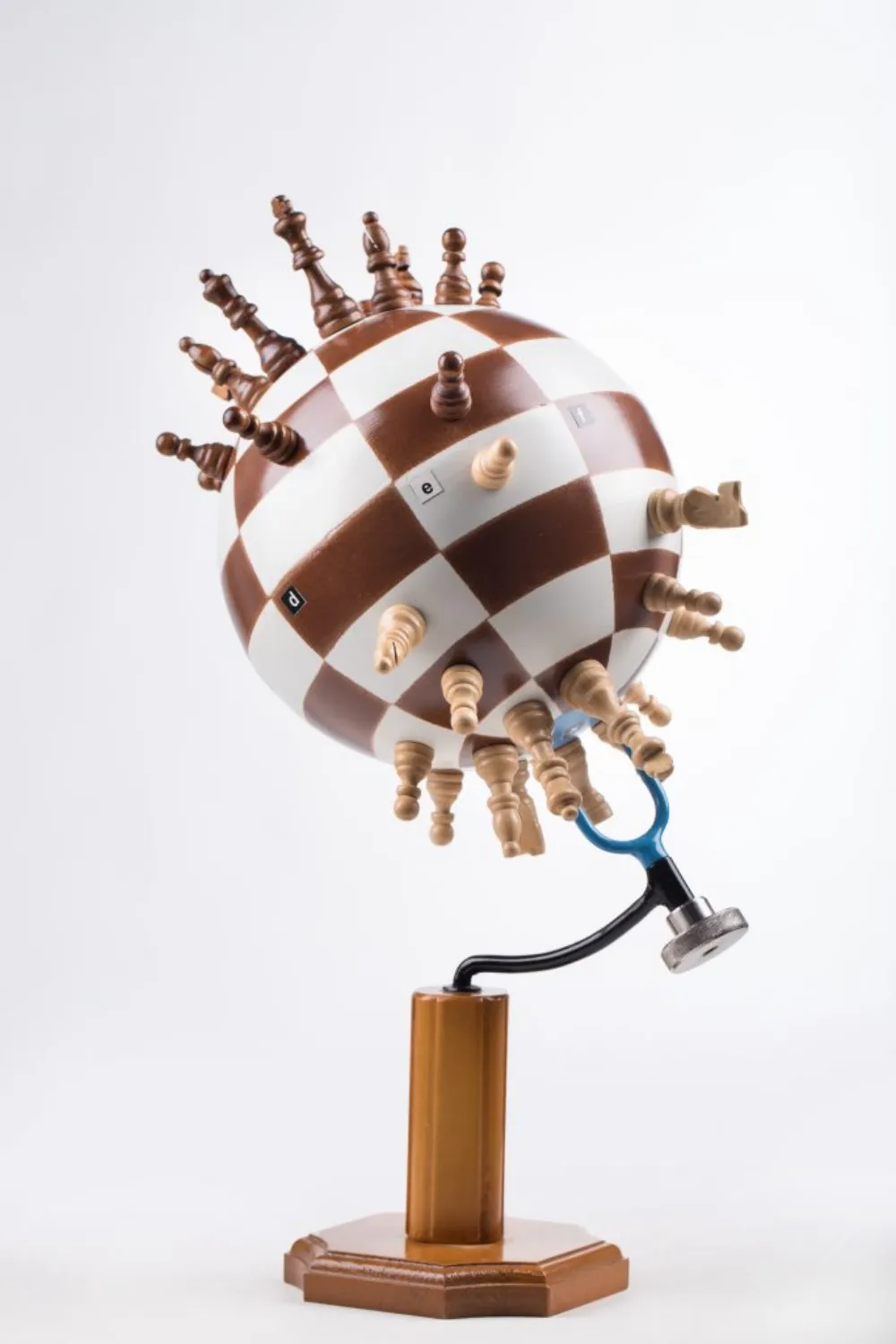
János Boholy's chess ball
Foreign national part value
The inventor of the chess ball, János Boholy, who lives in Bátka, did not like to be cornered on a traditional chess board and get checkmated, so he invented the chess ball. ; János Boholy is a member of the Hungarian Inventors Association. ; 2. Introducing the chess ball from the inventor's pen ; The problem solved: The pieces of the traditional chess game are moved in a square (8 x 8, on light and dark squares, bounded by edges and corners). The biggest disadvantage of the traditional flat chess board is that the effectiveness of the pieces decreases strongly on the corner squares as they approach the edges of the board. This negative property remains on any two-dimensional chess board, since the aforementioned properties cannot be eliminated on a flat playing field. The traditional edges of the chess board can only be eliminated if the given playing surface is placed in three dimensions. This is possible if the flat chessboard is redrawn onto a spherical surface, which is transformed into a circular playing surface. ; ; Definition: The negative properties of the traditional chessboard automatically disappear on the new three-dimensional playing surface, since the edges and corners of the playing field disappear on the surface of the chess sphere. Thus, the pieces can exert their effectiveness on the circular fields without limits, since with this simple solution every field has a neighboring field in every direction. On the infinite, but in principle finite, new playing surface, a more complex, and therefore more innovative, range of piece movements opens up. The spherical chess game continues to be played according to the rules of traditional piece movements, expanded with new possibilities. A previous guideline of the flat chess game has been rearranged and expanded to 3+1. Thus, the basic types of spherical chess games and their radically innovative operating principles could appear on the surface of the chess ball. ; ; Introduction: The chess ball is actually nothing more than a traditional chessboard (with 8 x 8 + 2 squares) placed on a spherical surface. Due to the structure of the sphere, we get a playing field without edges and corners, on which the pieces are given the opportunity to achieve their greatest efficiency. Their movement can only be hindered by their own or the opponent's pieces. They are not stopped by the edges and corners of the chessboard, thus they are not put at a disadvantage in the traditional sense. ; All 64 squares are considered equal middle squares and thus, under optimal conditions, the pieces can be moved with maximum efficiency. The difference in value between the squares (depending on the position of the position) can only be changed by the quality and efficiency of the pieces. This is a big step forward compared to the traditional flat chessboard, where the aforementioned value differences were mainly determined by the effects caused by the edges and corners of the board. The closer we got to the edge or corner of the board, the worse our situation became. ; ; On the traditional chessboard, we can only reach a given square (pawn) of the opponent from a given square via one route. For example, we can attack or defend a given piece via one route with the rook, bishop and king. In contrast, on the chessboard, with these pieces and movement rules, we can reach our goal via several routes. The easiest way is to provide two routes, but four routes can also be built on the four sides of the ball. By connecting the king, bishop and rook in a star-like manner, we can further increase the number of paths for the piece. The two or four possible paths of the bishop, rook and king against one square are a revolutionary new solution in the history of chess, the understanding and use of which is the alpha and omega of the new game. For example: On the spherical surface, the bishop has the opportunity to change the color of the top square, any square of any color is available to him, thereby further increasing his performance. The traditional lonely bad bishop of chess games loses his previous negative sign, because he can (change) choose the diagonal of the color that suits him. ; ; 3. Brief introduction to the four basic variations of the spherical chess game ; ; • Game on circular rows and columns of limited length ; For a beginner, mastering the game on the chess sphere is simpler and easier if he does not take into account the top squares, but only uses the original 64 squares of the chess game. In practice, this option is a simpler and easier version of the spherical chess game. The pieces do not step on the top squares X and Y (the bottom and top corners of the sphere) and do not pass symmetrically over them. The horizontal rows act as an infinite ring, thus creating 16 middle squares on rows 4 and 5. ; ; • Playing on the ring rows, diagonals and columns ; For the advanced player, it is already recommended to use the full 64 squares and the partial use of the two top squares. This option is an optimal, but also more demanding version of the sphere chess game. The pieces pass symmetrically over the X and Y squares, but cannot stop on them. In this version of the game, the top squares act as neutral squares, since no pieces can be placed on the top square. Neutral squares prevent officers from having a total effect on the columns and diagonals. By having to pass through our top square without stopping, any square out of the 64 acts as a center square. Any square in the first and last row has a neighbor square from the 4th side, in addition to the traditional 3 sides, across the top square. Thus, for the first time in the history of chess, the pawns from these squares are given the opportunity to reach their maximum efficiency under the most optimal conditions possible. ; ; • Playing on the circular rows, diagonals, columns and the top square ; An experienced player can use the full number of squares, i.e. 66 squares. This option is the top-valued version of the ball chess game. The pawns pass symmetrically over the X and Y squares, but they can also stop on them. A pawn can be placed on the top square. The top squares act as high-value center squares. The position of the highlighted center allows the pawn on it to exert total influence on the columns and diagonals from there. During the game, the officer placed on the top square exerts full influence on all eight columns and diagonals, which is limited only by the pawns. The movement of the pawns on the surface of the sphere takes place under the constant protection or constant threat of the pawns placed on the two center squares. ; ; • The asymmetrical basic position ; Due to the structure of the chess ball, symmetrical opposition of the pawns on the surface of the sphere can be avoided. At the beginning of the game of sphere chess, the positions of the leaders are decided by agreement. They cannot be placed on the basic square of any column, not opposite each other. The positions of the others are shifted proportionally in relation to it. This solution is beneficial for those who want to solve more innovative position variations. Due to the structure of the ball chess game, in the case of a non-symmetrical position, conditions for castlement to the opposite side may develop. Attacking to the opposite side, depending on the degree of shift, leads to previously unknown position variations, since symmetrical opposition is not necessary on the ball chess. The half-base position can be used in all three variations. ; ; Justification ; ; The ball chess and its inventor have received numerous awards at home and abroad and became known to the public through the aforementioned reports, newspaper articles and statements. Its fame has grown beyond Bátka and the Upper Hungary. Therefore, we ask for its inclusion in the Upper Hungary Value Register and we propose to nominate it further to the Hungarian Value Register among the outstanding national values. ; The circular playing surface of the ball chess is a huge storehouse of possibilities, the exhaustion of which provides innovative opportunities compared to previous ones. Strategic and tactical variations may emerge that require more complex thinking and creativity from players who only have to confront the opponent's knowledge of the edges and corners. The ability to think in three dimensions while using the chess ball is a matter of course. A direct consequence of this is the description of a new chess theory, which was published in book form under the title "The Basics of the Game of Chess with the Ball". ; ; A novelty is the asymmetrical (opposite) basic position, which conceals wonderfully interesting possibilities, previously unknown variations of positions. It is an excellent terrain for those who are not slaves to traditions and familiar templates. Thus, they can test their creativity using the possibilities offered by the chess ball. It can be applied in the field of sports and in the areas of theoretical, research and practical implementation of innovative (more than 2D) chess games. The diverse and diverse possibilities of the revolutionary new chess game develop the individual's thinking. The experiences gained can also be applied in other areas of real life. ; ; A given problem's one-solution flat view (2D) can also be defined as "I believe it when I see it". I define a given problem in a circular view (3D) as "even if I don't see it, I know that more than one solution is possible". ; The flat playing surface has a 2D limited guideline and a 2D limited operating principle. The circular 3D playing surface has 3+1 guidelines and 24 unlimited, but in principle finite operating principles! ; ; This game develops spatial awareness, creativity, sharpens memory, and encourages perseverance, even if the user does not want to be an elite athlete. Those who embrace its operating principles can also use their more complex vision in the real world. ; ;