
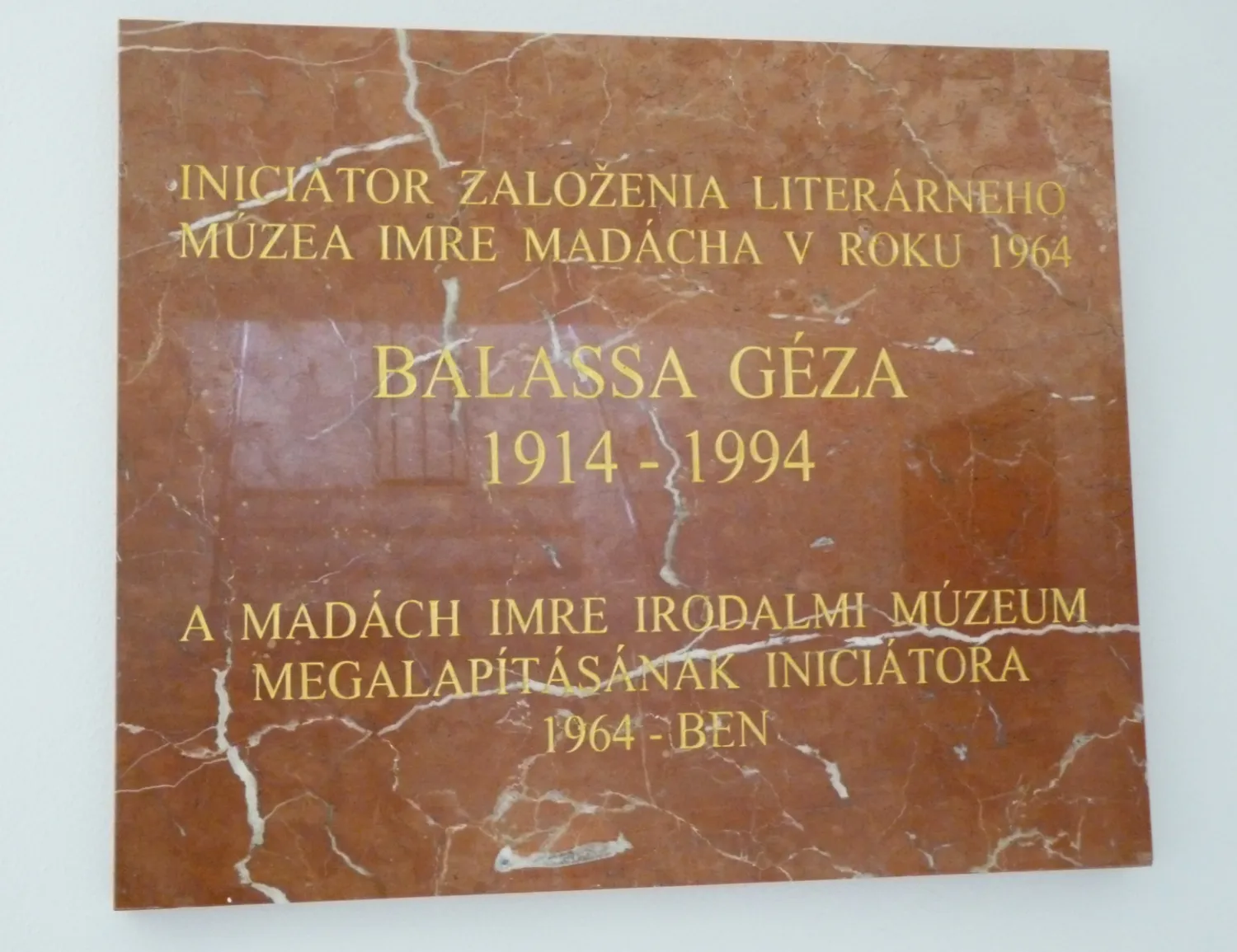
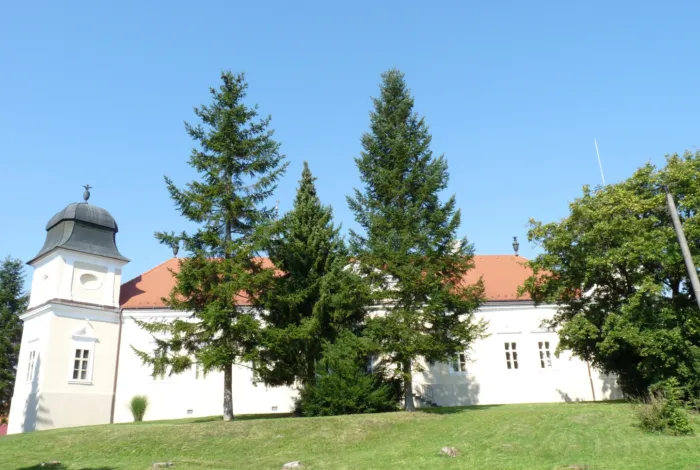
Géza Balassa's memorial plaque
Statue, monument, memorial plaque
Géza Balassa (1914. III. 10. Felsőbaka – 1994. II. 20. Bratislava) ; ; Born on March 10, 1914 in Felsőbaka (Hont County). His father was Gusztáv Adolf, a Lutheran village cantor teacher born in Zvolen. His mother was Teréz Okos, a Reformed woman from Cegléd. He graduated from high school in Körmöcbánya in 1933. He began his university studies at the Lutheran Theology School in Bratislava (1933/34), then enrolled at the State Pedagogical Academy in Bratislava, where he obtained a primary school teacher qualification in 1935 and a civil school teacher qualification in 1939-40 (Slovak language, geography, history). ; Meanwhile, due to a decree that required state employees in the first Slovak Republic to use only Slovak-written surnames, his family name was Slovakized (Balassa → Balaša). ; In 1941, he initiated the establishment of a local history museum in Zvolen, which opened in 1944. After the World War, he considered the saving of the Zvolen castle to be a matter of the heart. Thus, he became the initiator and supervisor of the renovation of the castle. It was then that Mayer Ede II. discovered the statue of Ferenc Rákóczi, which he later dedicated to Borsi, and which has stood in front of the prince's birthplace since 1969. In 1949, on the occasion of the fifth anniversary of the Slovak National Uprising, he organized an exhibition in the castle from the material collected up to that point. ; From 1944, he worked as the secretary of the State Archaeological Institute (ÁRI) in Túrócszentmárton. ; On February 19, 1945, he enrolled at the Slovak University in Bratislava. In 1947, he qualified as a high school teacher in geography and history, and two years later he qualified as a high school teacher in geography and history. In the meantime, he also studied archaeology. He received his diploma on June 1, 1949. ; From 1948 to 1952, he worked in the Radvány library and archives (State Institute of Land Economics – Štátny pôdohospodársky archív). During this work, he visited the abandoned mansions and castles of the area by truck to save the archival materials of the noble families who had fled from destruction. He then ended up at the Banská Bystrica Museum on the recommendation of the ÁRI (1952-1962). His excavations formed the backbone of the museum's archaeological material. He was forced to leave the museum in 1962. The background to the conflicts was my father's Hungarianness. ; He became a department head at the head of the restoration and documentation department in the district headquarters of the Monument Protection Office (SUPSOP), and then briefly deputy director, but due to the reorganization after 1968 - since he had never been a party member - he could not hold this position. He worked here from 1963 to 1976. During this time, he edited and wrote the office's periodical professional journal called Zpravodaj from 1963 to 1973, a total of 14 issues. ; He personally supervised numerous monument restorations (in Bány Beszterce, Selmecbány, Alsósztregová, Korponá, Turdosin, Kosztolány, Zolna). He led the excavations of Znióvár (Turul-vár), about which his publications were also published (1965). He also excavated in the medieval castle of Liptov, and reported on this to the public (1973). Under his leadership, the 14th century Pónik church (Zvolen County), which preserves the first authentic depiction of the Hungarian flag, regained its original beauty. ; Among his studies published from his art history research, we mention the papers Monuments of the Rimaszombat District (1968) and Monuments of the Zvolen District (1969). – In 1966, he published an exhibition catalogue on the protection of monuments in Central Slovakia. In 1971, he edited the publication Census of Movable Monuments in Central Slovakia. ; He wrote the history of Zvolen (1956) and Korpona (1964). We mention the bibliography of Banská Bystrica (1955) and the city of Zvolen (1959). He translated into Slovak and revised Mihály Matunák's work on the history of the Véglési castle (1960). In the same year, his work on the ancient population of central Slovakia was published. He revised the historical monuments of the Zvolen district (1964). His work Zvolen in the time of the Lusatian culture was published in the same year. ; He also published the results of his archaeological excavations in numerous publications (Zvolen /1952/, Pereszlény /1955/, Korpona /1957/, Gyügy /1956, 1960/, Tornalja-Dobogó /1959/, Darnya /1962/, Banská Bystrica /1956/...) ; His only Hungarian-language work, Gömör az přeskorban, was published in 1971, which is a translation of an earlier study (Praveké osídlenie Gemera, 1965). ; He is credited with more than 9,000 definitions of unprocessed money. ; After retiring, he moved to Bratislava. ; He passed away on February 20, 1994. His remains were laid to rest in the Lutheran cemetery in Banská Bystrica, where his faithful companion, his wife, also rests. ; László Zolnay (1916 - 1985), archaeologist and art historian, wrote about him: “His role in saving the monuments and even the artifacts of Central Slovakia, in their restoration and, last but not least, in their publication, can only be compared to the role of our great pioneers – Rómer, Henszlmann, Ipolyi.” ; ; In 1964, he developed the script for the Madách Museum in Alsóstregova, collected a significant part of its material, the castle was restored under his leadership, and the exhibition was opened in a ceremonial setting.