
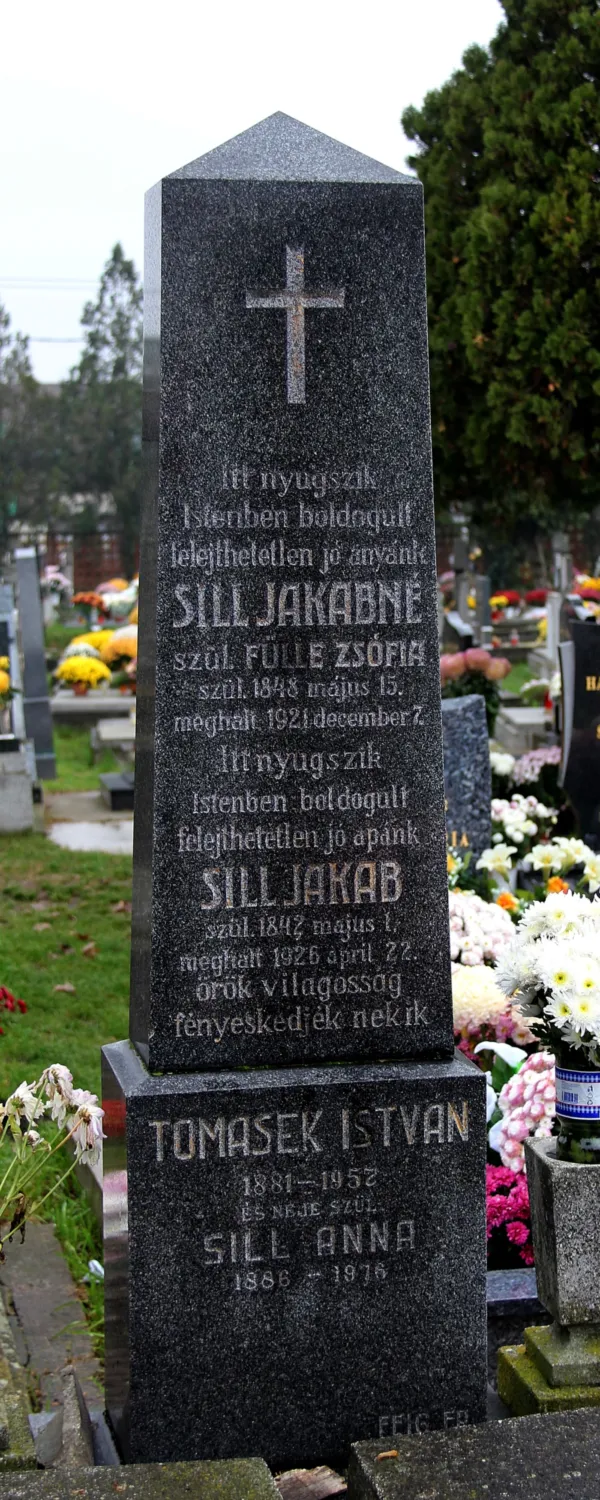
The tomb of Jakab Sill, who erected the altar, and his wife Zsófia Füle
Cemeteries, tombstones, graves
The most important of the sacred places and monuments in the village or on its outskirts is the cemetery. Since the decree of Saint Ladislaus (“If someone buries their dead not next to the church, he should do penance on bread and water for twelve days”), the burial place of the temple settlements has been near the church. This was the only way to ensure that the dead were no longer buried in a pagan way. ; ; The first known cemetery of Csútsót was therefore also around the church until the end of the 18th century. The cemetery was later surrounded by a wall, and a circular cemetery chapel was built near the church, which was dedicated to the Holy Cross. We also know of cemetery chapels built near such churches in other places (e.g. Bény). Later records suggest that this chapel was a rotunda built at the time of the church's construction, i.e. in the 13th century, and with its tower it reached 20 meters (a report from 1870 says it was 10 fathoms high). ; Canonical visitations from various periods mention this cemetery chapel, and even the wall surrounding the cemetery. In 1678, donations were even collected for their renovation (Archbishop György Szelepcsényi himself gave 24 forints), which was done. According to a report in 1766, the cemetery wall still exists, but the chapel's tower was struck by lightning, is in a dilapidated state, and is used by the parish priest as a chamber. ; In 1780, since its repair was impossible, the chapel was demolished (its stones were incorporated into the new parish house built at that time). After its demolition, a six-meter-wide stacked vault was found underneath, which when opened revealed a burial place, a crypt. According to contemporary accounts, there were iron coffins and human bones in it. Meanwhile, due to the heavy rain, there was a smell of death around the crypt, so the crypt was permanently buried. Arnold Ipolyi saw the foundations of the chapel in 1850, and assumed that the crypt underneath could have been one of the burial places of the Szentgyörgyi family. (The exact location of the chapel and the crypt underneath could only be determined by excavation.) In 1799, burials in the cemetery around the church were also prohibited, although the walls of the cemetery were still standing at that time. ; Incidentally, in the Middle Ages, burials were also held in the crypt under the sanctuary of the church; among others, Alnádor Mihály Mérey is buried here. Burial in the crypt under the sanctuary ceased in 1756. ; The new cemetery was consecrated in 1780 and opened at the beginning of the then non-existent southern street of Pozsony Road, roughly in the area of the so-called Prokopec House. We also know that Mátyás Füle had the high cross of this cemetery erected. However, after the new street, today's Felsővégi Street, was built, no burials were held here anymore. ; The current cemetery was consecrated in 1842, in which the high cross was erected at the time of the consecration. This high cross stood until 2010, when a new one was erected.