
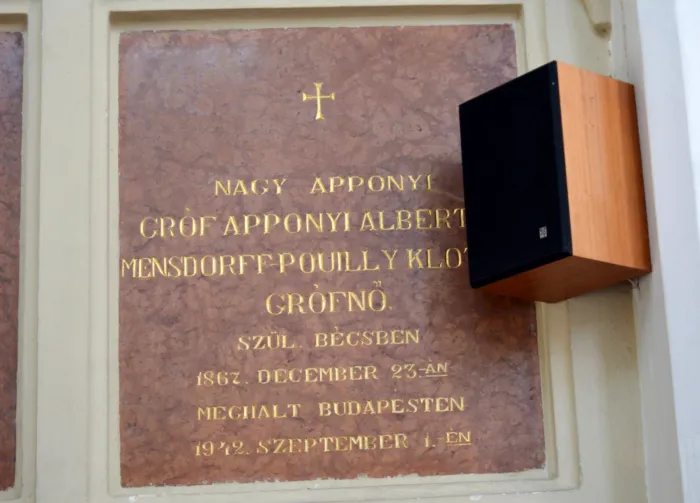
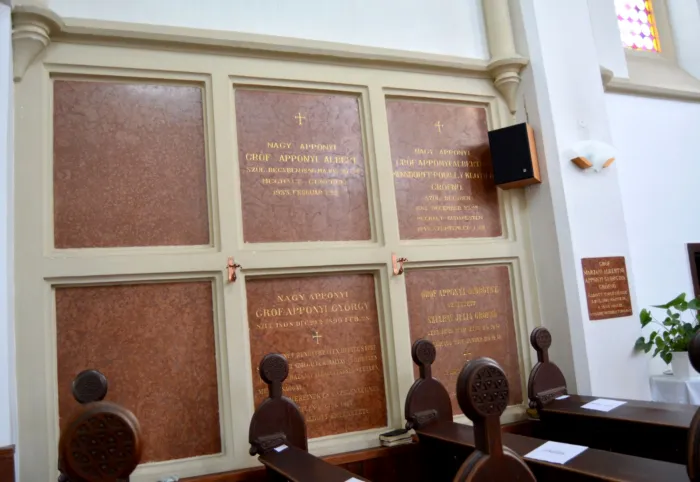
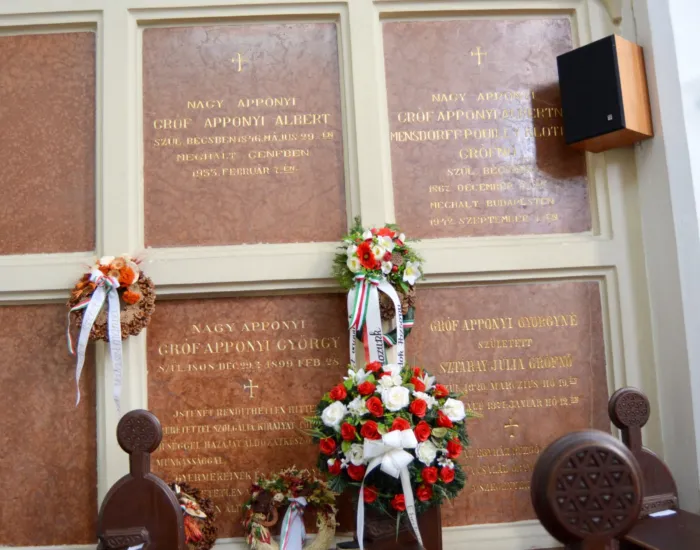
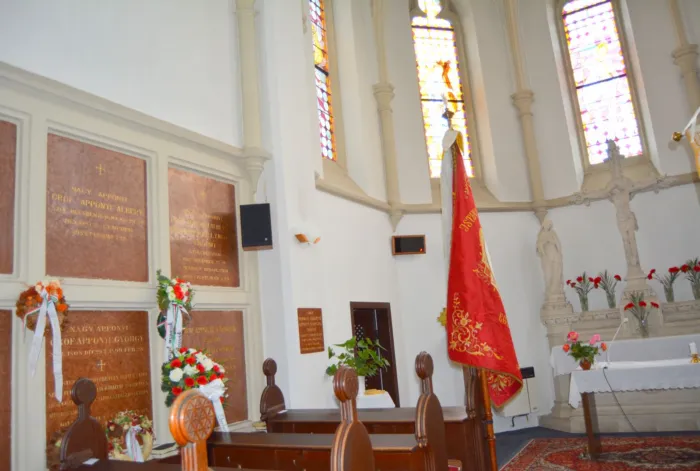
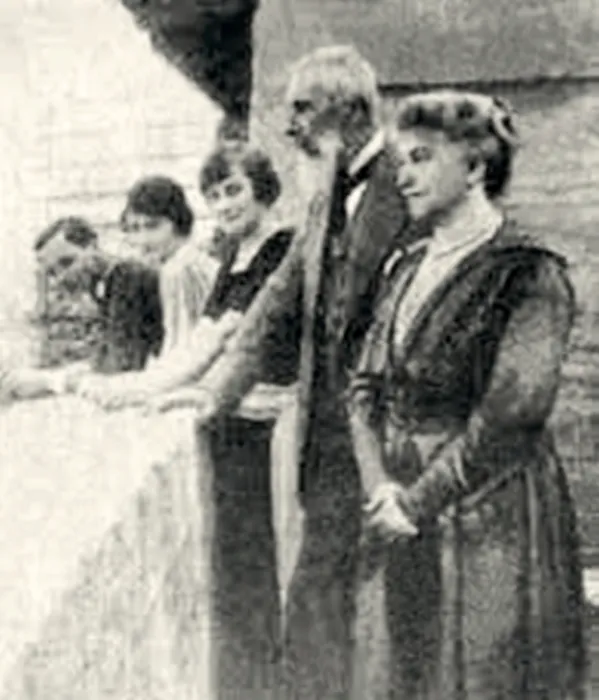
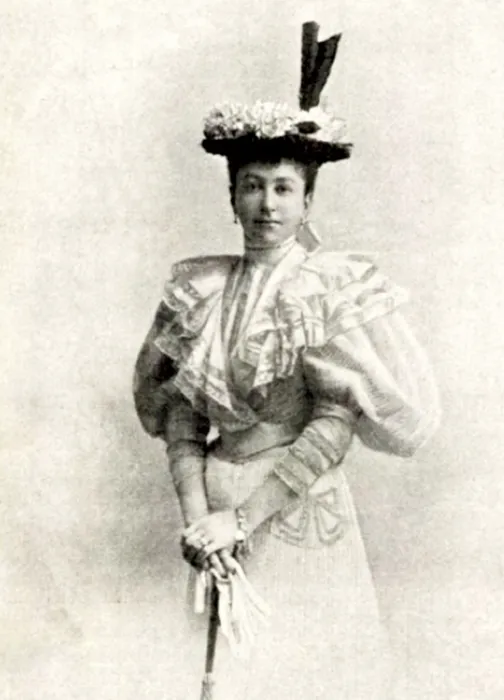
The resting place of Mrs. Albert Apponyi
Cemeteries, tombstones, graves
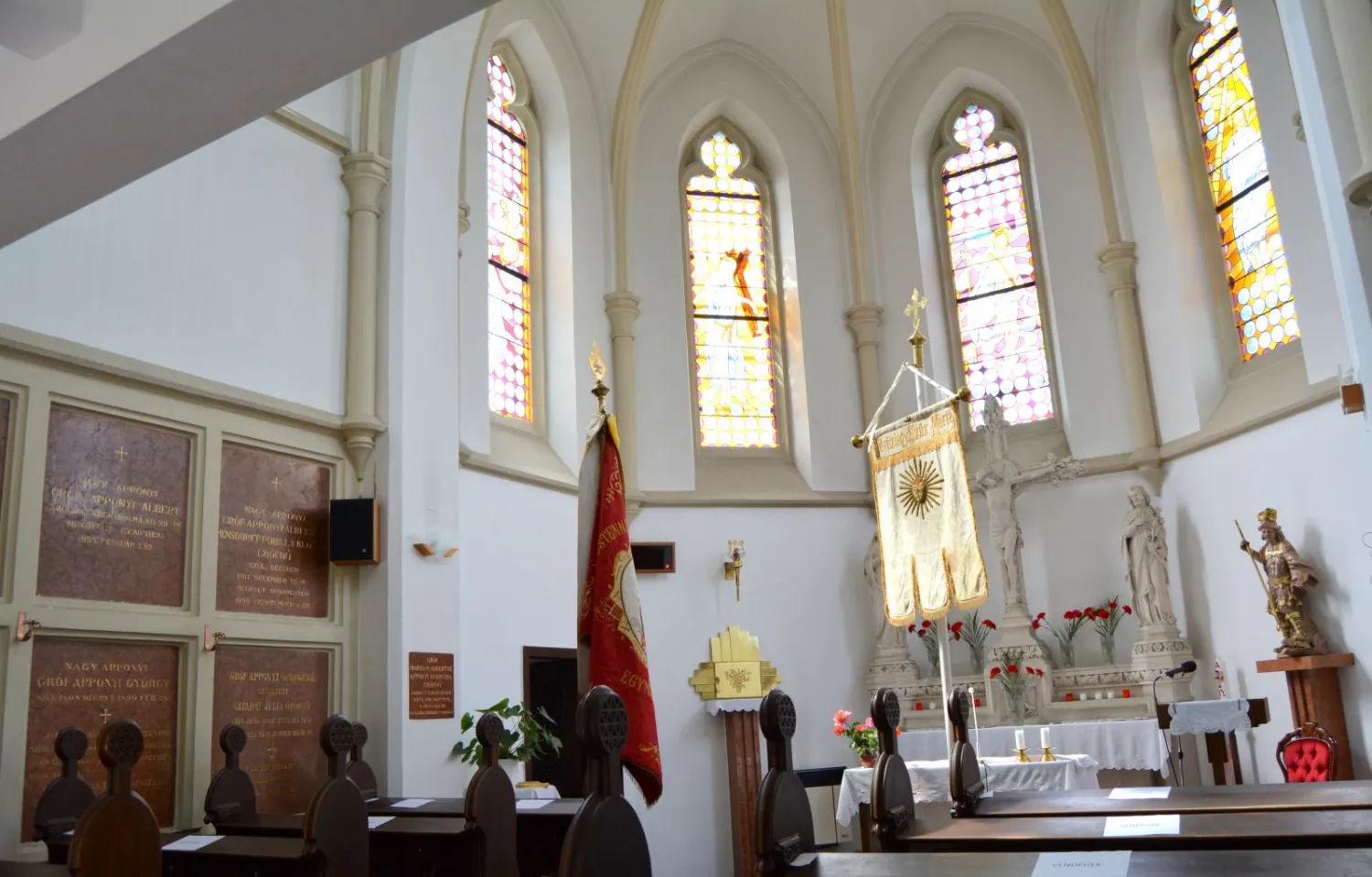
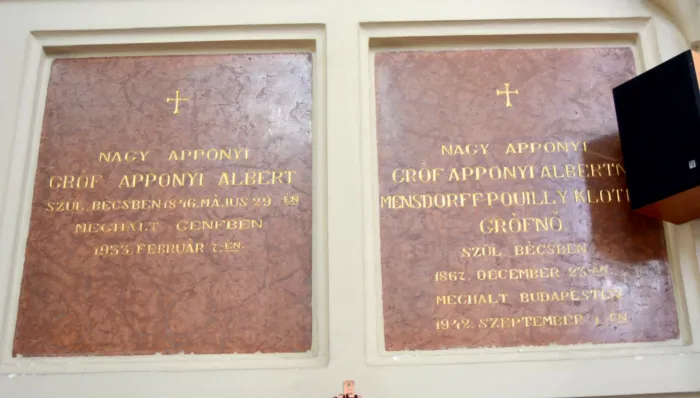
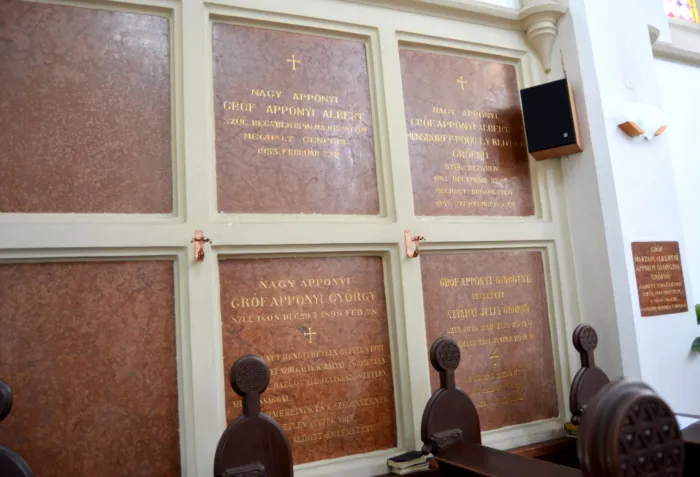
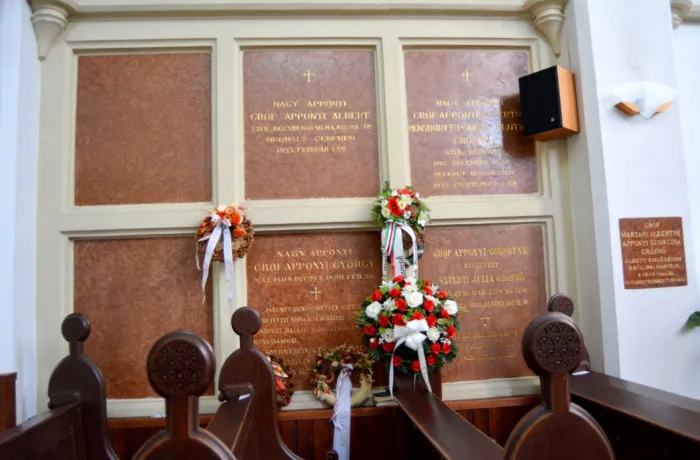
Always serious and impeccable, Apponyi handled his affairs with great discretion. Due to his tactful manner, we know little about his love affairs and their fruits. ; In the mid-1890s, Apponyi met Countess Dietrichstein-Mensdorff-Pouilly Klotild (1867-1942). The lady belonged to the imperial aristocracy living in Vienna, but she also considered Queen Victoria of England to be a distant relative. Countess Klotild's grandmother was the sister of the queen's mother.113 Her father, who had previously been a general and imperial minister, received the title of duke from Franz Joseph for his services, which was inherited by his eldest son after his death. The countess could call herself the owner of the Order of the Star Cross. Their first meeting took place at a noble wedding in Bratislava, which was followed by several meetings until Apponyi proposed to the countess – as she was called in family circles: Clo-Clo – for her hand. Through the marriage, Apponyi gained an influential Austrian noble family. His older brother-in-law, Hugo, who was a soldier, held the title of duke, which gave him access to the imperial court. At the time of the wedding, he was serving as one of Franz Joseph's aides-de-camp. His younger brother-in-law, Albert, was a diplomat and, at the outbreak of World War I, the Austro-Hungarian Monarchy's ambassador in London. The Dietrichstein-Mensdorff-Pouilly family had estates and castles all over Austria. Their summer castle was in Weidlingau, close to the imperial city. Apponyi kept his proposal and the wedding preparations a secret, initially informing only his trusted friends and close relatives. “During the last few weeks, the decision has matured in me that I will marry a woman excellent in every respect, with whom chance, or rather: the special grace of providence, has brought me together, Countess Clotilde Mensdorff, if she so wishes. She had bad enough taste to return my affection, and so we were already aware of each other, and I was just about to tell my father when his illness intervened. Thank God things have turned for the better, and so on Saturday I will go to Vienna to officially establish what is really a fait accompli [irrevocable fact]. Clotilde's dear mother and brothers know everything and will welcome me with open arms, otherwise we have decided that - until the improvement in my father's health has taken a more definite shape - no one except those closest to us should know about the matter. Of course, I include Clarisse [the wife of the recipient Count Sándor Károlyi] and the children among these, and you will certainly join us to be happy. I think I have not done anything better in my life, Clotilde is already looking for a Hungarian language teacher, and in her letter received today she writes that she “wants to be a completely Hungarian woman” – she is such a mature, determined character that castles can be built on her every word. Would you have believed this? I wouldn’t, but thank God it is still there.” Two weeks later, my good friend Sándor Károlyi received another letter about the wedding preparations. “The day of my wedding [1897] is set for March 1, unless my father’s very doubtful and recently more worrying condition throws an obstacle in our way. I hardly need to say that I warmly welcome your presence at this decisive step of mine, and so I ask you to be kind enough to act as a witness on my behalf, together with my brother-in-law Marzani. (…) Since I am stressing the quiet nature of the wedding, - which is a bit difficult to achieve with my future mother-in-law - I have to set a good example, and so I cannot invite anyone from my circle of relatives except those with the Apponyi name, I think everyone would be more happy if this way they could escape from a corvée [forced], but if there are any who are surprised, please explain the matter to them. I would also like to ask Mihály [Károlyi] to come down and take on the role of one of the best men on my behalf, with Gyula Apponyi and the young Marzani, from the Dietrichstein-Mensdorff side they will present one, the younger brother, Albert Mensdorff, who is at the embassy in London. "My father's fluctuating and not entirely progressive condition is a very embarrassing circumstance, especially for the poor girl, whom I have not yet been able to bring here - because my father feels too weak to even dare to accept her - knowing the old gentleman, and imagining on the other hand how much he may wish to see his future daughter, you can imagine how seriously ill he is." ; The contemporary press reported in detail about the wedding. About one hundred and forty guests were invited to the Dietrichstein Palace in Vienna for this occasion. The Habsburg dynasty was represented by Archduke Louis Viktor – the monarch’s brother. The princes of Lichtenstein, Schwarzenberg, Thurn-Taxis, Windischgraetz, dignitaries of the imperial and royal courts, ambassadors, the joint ministers in office, Hungarian lords and a delegation from Apponyi’s party came with him. The presence of the high-ranking guests was not only an acceptance of the invitation, but also a sign of the social status of the bride and the titles and ranks held by the groom’s parents. The marriage ceremony, held in the chapel of the Dietrichstein Palace, was celebrated by Bishop Pál Szmrecsányi of Szepes. On the occasion of the wedding, congratulations arrived one after another from various local organizations of the National Party, the Independence Party, from the Jászberény constituency in large numbers, the parliamentary correspondents of the press addressed a joint letter to her. In her reply to one of her husband's political colleagues, she commented on the congratulations as follows. "Many are happy with me, including those whom I have not known as friends until now, but when they realize what kind of woman I am bringing to our country, they will all bless this moment and the grace of Divine Providence." ; A year and a half after the wedding ceremony, Sándor Károlyi reported to his wife, Countess Klarissza Kornis, about the circumstances of the birth of Apponyi's first child. “From June 29 to June 30, we spent 18 very difficult hours, which my dear wife endured with heroic fortitude. Her reward was an extremely strong, lively little boy, who weighed 3 kilos 600 grams at birth and is constantly getting stronger, almost swelling with health. Clotilde is as well as can be, she will pull herself together in the shortest possible time. Her first thought, when the baby born 60 minutes earlier was brought to her dressed, was to speak only Hungarian to the nanny, even half-fainting, and turning to me, she whispered: the child must only hear Hungarian. But this alert awareness of the national duty she had undertaken at such a moment was very touching. With God's help, we will raise a very worthy man out of the baby in the sign of the cross and the homeland. You can imagine my father's joy.” ; “I want to be a completely Hungarian woman…” – Apponyi wrote about his bride. Ten years later, the Vasárnapi Ujság reported to its readers that this had come true. “The Austrian-born, Austrian-raised Countess Mensdorff, who ten years ago did not know a word of Hungarian, had no reason to know it. And now she speaks no other language than Hungarian with her husband or children.” ; Three children were born from their marriage. ; The birth of the eldest child, György Apponyi (1898-1970), was also witnessed by the elderly Chancellor grandfather, after whom his grandson was named. György Apponyi fought in the First World War, and after Trianon he worked as a farmer. Odescalchi led Princess Margit to the altar on May 18, 1923. Their marriage was one of the great events of the Hungarian aristocracy in the 1920s. The princess was related to the widow of Crown Prince Rudolf, Princess Stephanie of Belgium, who after her husband's suicide married Elemér Lónyay, who was then given the title of prince. Later, the marriage broke down and ended in divorce. György Apponyi was a member of parliament from 1931 to 1944, following in his father's footsteps, first as a Legitimist and then as a Liberal Democrat. After the Nazi occupation of Hungary in 1944, he was immediately arrested by the Gestapo and taken to the Mauthausen concentration camp. After the World War II, he did not return to Hungary. ; Apponyi György's son, Apponyi Albert Jenő Zoárd (1926-1998), worked in a cannery at the beginning of the communist dictatorship, where, according to informant reports, he was involved in a legitimist conspiracy with Miklós Almásy, Miklós Esterházy and Gyula Jankovich. According to some accounts, he fled to the West in 1948, while others say he studied at an economics university, from which he was expelled in 1949 due to his noble origin, and then defected to Brussels, where his father had already settled. A third source claims that he was still living in Hungary in the early 1950s. With the support of Béla Fábián, he founded the Democratic Party in the United States in December 1951. During the 1956 revolution and war of independence, she came to Sopron from Austria for two days to try to assess the chances of a democratic political development in the country. ; Albert Apponyi's second child, Mária (1899-1967), married a German prince, Karl Anton Rohan, who in the 1930s and 1940s showed himself to be an enthusiastic Nazi sympathizer. From the time of her marriage, Mária lived in Germany and Austria on the Rohan family estates. After 1945, her husband supported György Apponyi in starting over in Western Europe after he was released from the Mauthausen concentration camp, but he did not want to return to his homeland. ; Albert Apponyi's younger daughter, Júlia (1903-?) founded a women's fashion salon. First, she opened a hat shop with a friend in the fashionable French seaside resort of Biarritz, where she made the hats herself, and then settled in the family's palace in Buda Castle, but as business was getting better and better, she moved her salon to Váci Street (Párizsi Udvar) in December 1935. Júlia Apponyi continued to work here as a ladies' tailor after 1945. Her shop became a popular meeting place for aristocratic ladies who remained in Hungary at the turn of the 1940s and 1950s. In this salon, the secret police of the communist dictatorship forced Count Istvánné Keglevich (born Gizella Tóth) under the pseudonym Vera to observe women of high social standing, who fled abroad during the 1956 revolution and war of independence. Júlia Apponyi married twice in her life, divorcing both husbands. The woman's emancipation is indicated by the fact that her business provided her with financial independence during the Horthy era, when independent income generation was not at all typical of aristocratic women, but in the absence of private property and with two divorces behind her, she was forced to earn money. ; Count Albert Apponyi, widow of the late Hungarian statesman, died in September 1942. For decades, she participated in a wide range of cultural, charitable and public health movements. Her work was universally recognized. Her coffin was laid to rest in the chapel of the Farkasrét cemetery, where the chapel was packed with mourners. The funeral was attended by Minister of the Interior Ferenc Keresztes-Fischer, Minister of Public Education Jenő Szinyei Merse, and State Secretary of the Prime Minister István Bárczy. Several of Count Albert Apponyi's former colleagues and colleagues were also present. The associations in whose activities the deceased Countess played a leading role were represented. Bishop János Mikes of Szombathely performed the church ceremony. She was laid to rest in a tomb donated by the capital. She had been a widow for nine years. She was a “great witness of great times.” Countess Apponyi was related to the English royal family, but she never spoke about this familial connection. She was like that, modest, simple, and yet noble. A close acquaintance of the family said after her death: “When I last saw her shortly before her death, she was not even sick. So fresh and so pale – her ivory-colored forehead almost merged with her snow-white hair.” When Count Albert Apponyi died in 1933, his ashes were temporarily placed in the crypt of Matthias Church. The great Hungarian statesman had wished during his lifetime that his body be transported to Éberhárd in Bratislava County after the liberation of his family estate, because he would like to sleep his eternal sleep there. Countess Albertné Apponyi was buried in the Farkasrét cemetery. On the one-year anniversary of her death, her body was exhumed and after the funeral mass, her ashes were transported to Éberhárd together with her husband. Prime Minister Miklós Kállay and Minister of Justice László Radocsay were also present on behalf of the government at the funeral mass, which was held in the Matthias Church. Count György Apponyi, a member of parliament, and all members of the Apponyi family attended the funeral mass, led by the deceased's son. The ceremony was addressed by Papal Chamberlain Béla Kátay, the parish priest of the Coronation Church in Buda Castle. ; After the consecration of the ashes, the coffins were transported to Éberhárd.