
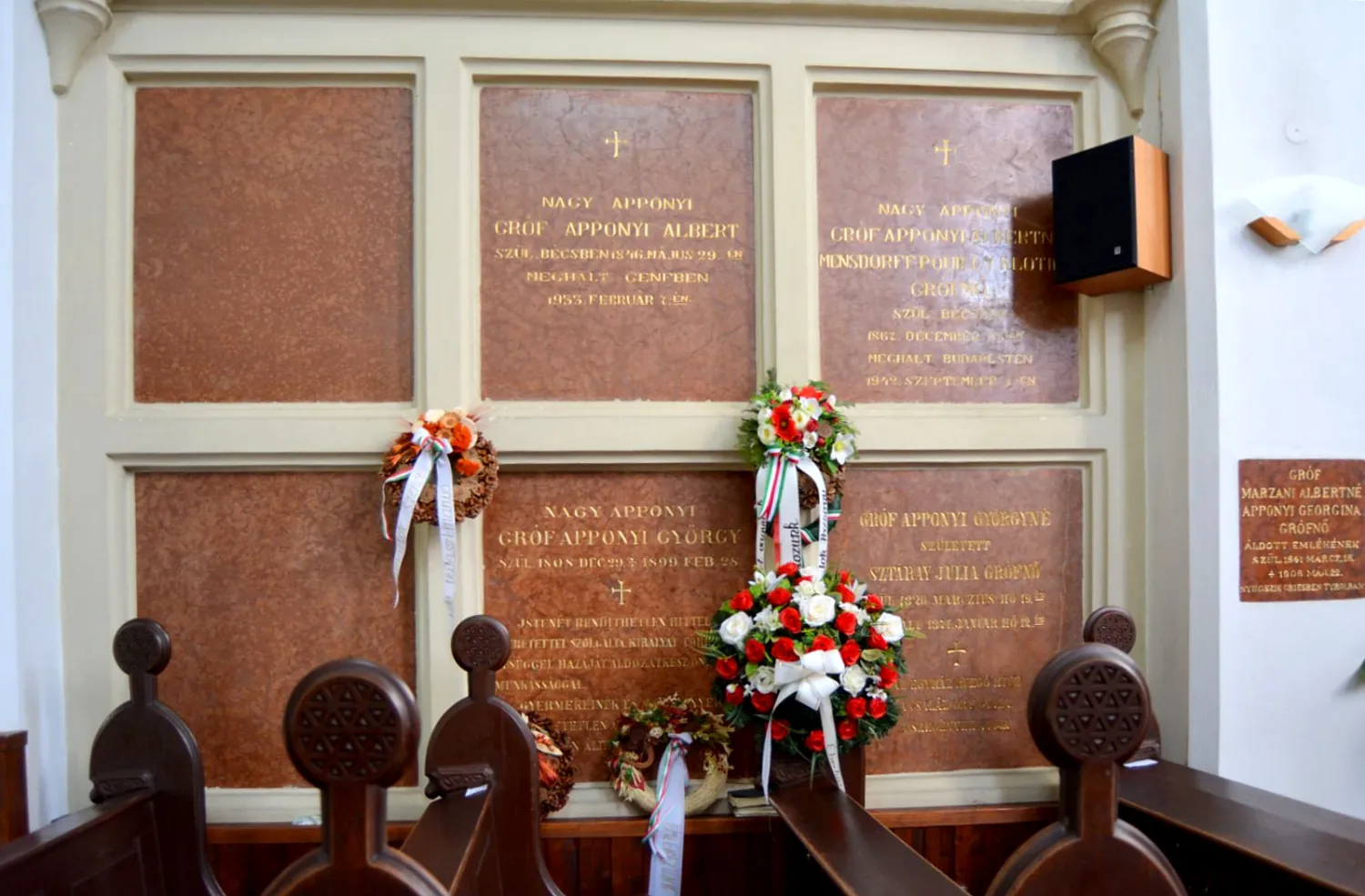
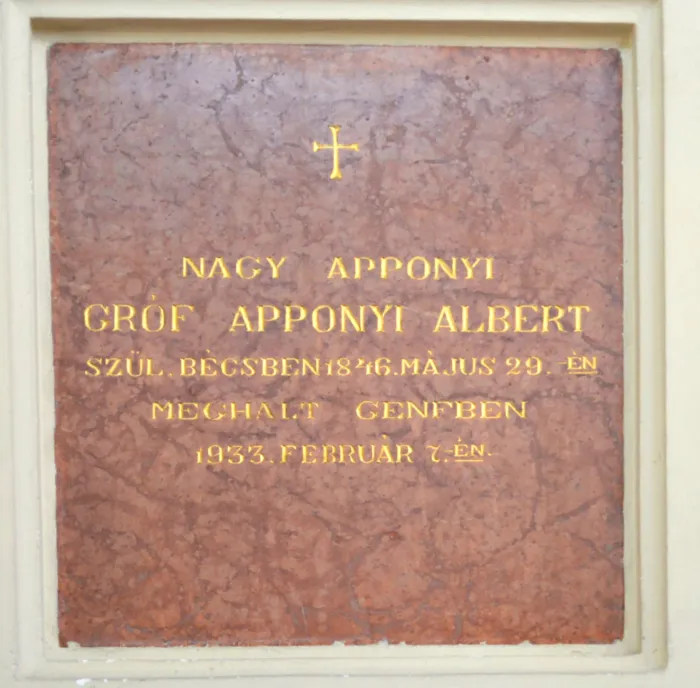
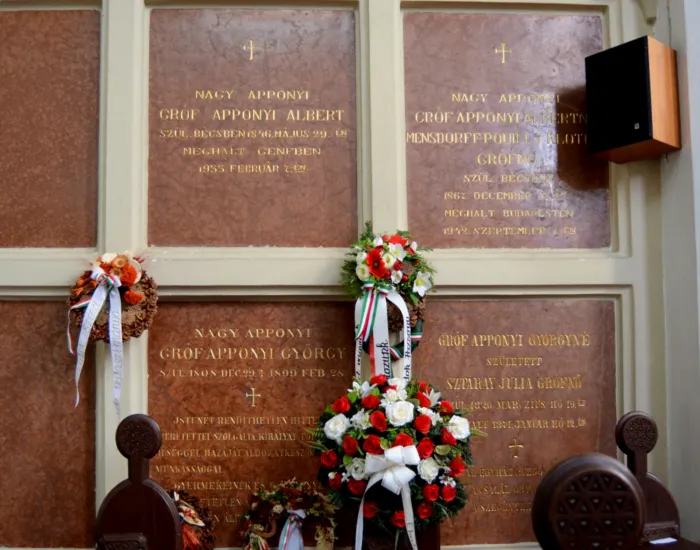
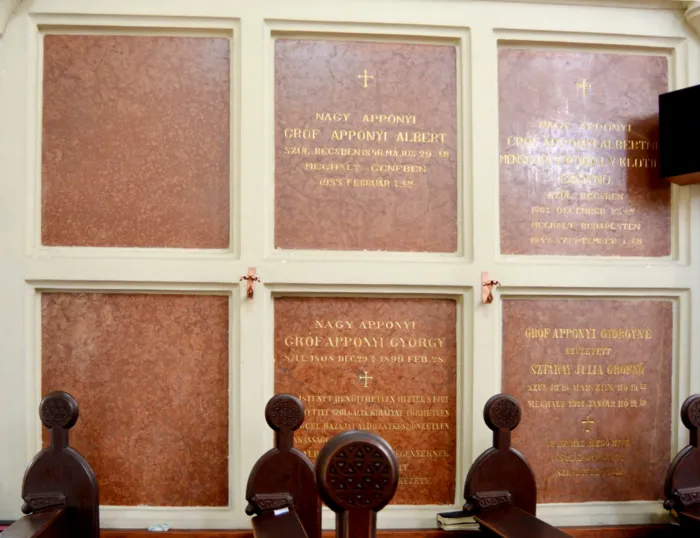
Albert Apponyi's resting place
Cemeteries, tombstones, grave sites
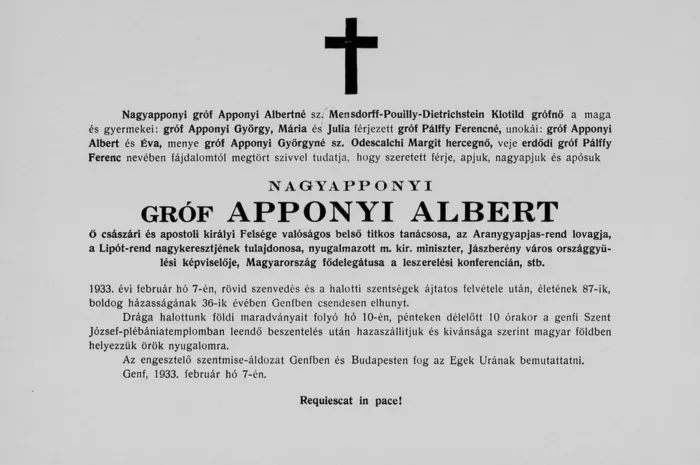
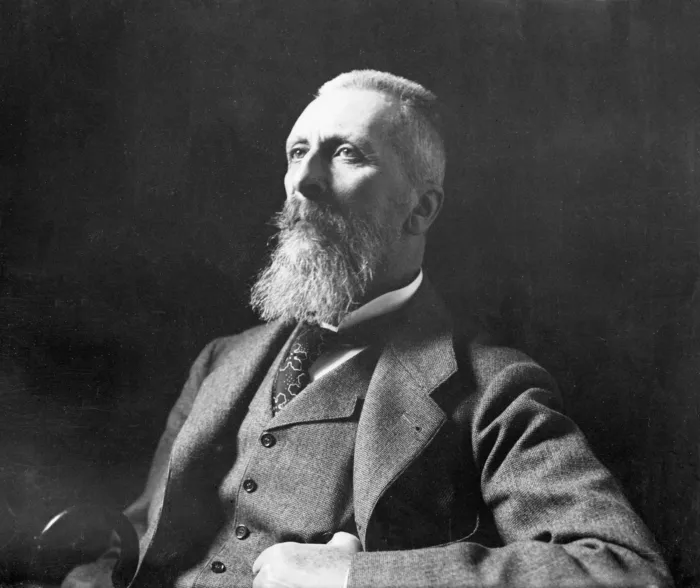
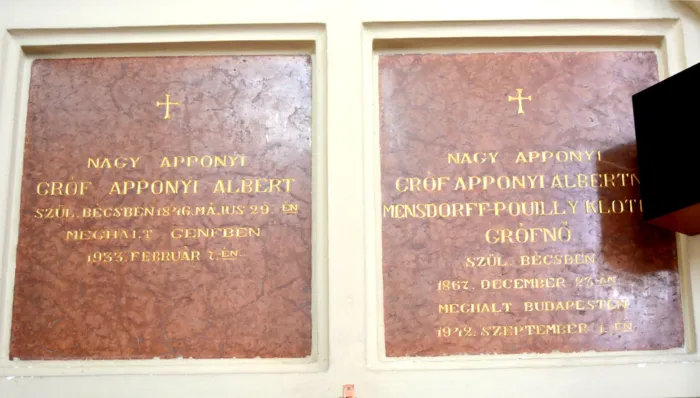
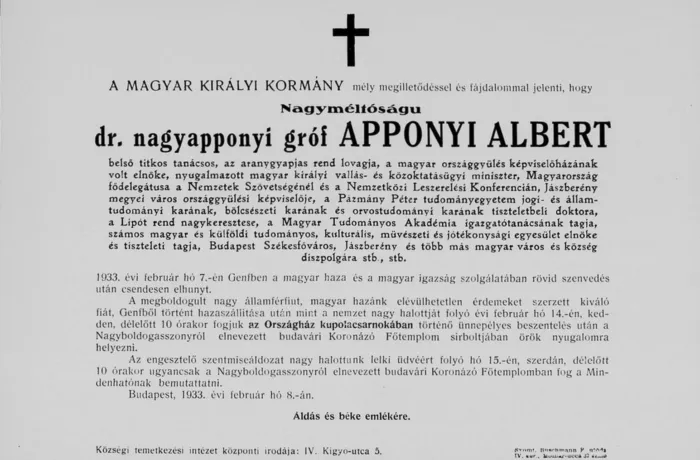
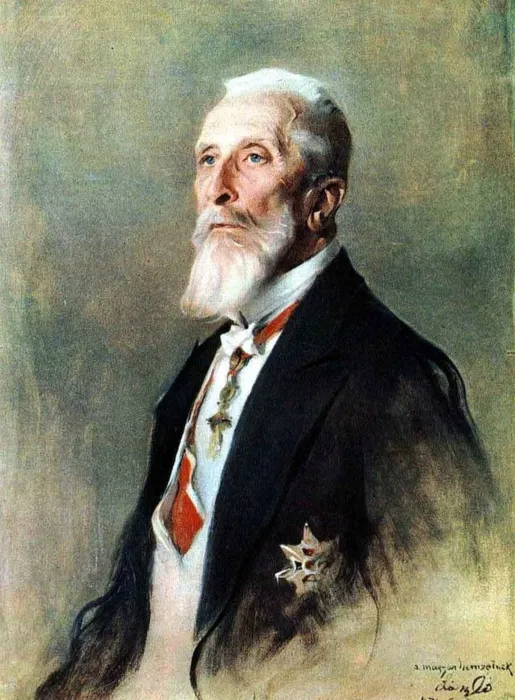
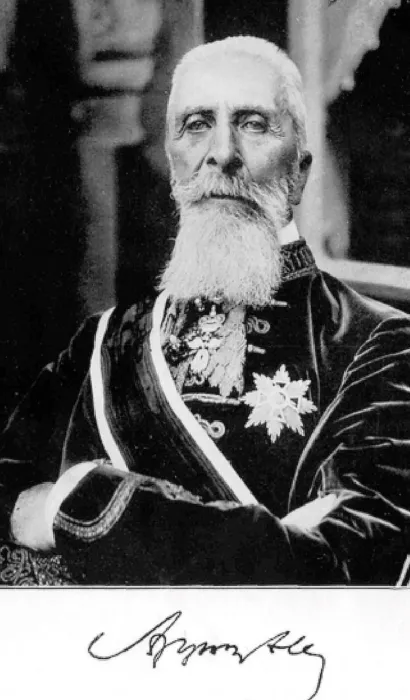
Count Apponyi Albert Nagyapponyi was born on May 29, 1846 in Vienna. He came from an aristocratic family that was loyal to the king and supported the Habsburg dynasty. His father was Count György Apponyi and his mother was Countess Júlia Sztáray. He completed his secondary school studies at the Kalksburg Institute of the Jesuit Order, then studied political science and law at the universities of Vienna and Pest. He made a study trip to Western Europe between 1868 and 1870. ; Albert Apponyi was a representative of the Deák Party from 1872 to 1875, then a member of the conservative opposition. From 1878 he became a leading politician of the United Opposition, and from 1892 he became the leader of the National Party. From 1881 until his death he represented the Jászberény parliamentary constituency in the Hungarian Parliament. In the late 1880s, he abandoned his old-conservative views and included the enforcement of the national rights formulated in the Compromise (1867) in his program, demanded the Hungarian language of command in the army, supported the economic demands of the agrarians and the introduction of protective tariffs. ; In the 1890s, he was one of the initiators of the church-political struggles that brought about the separation of state and church, but he no longer accepted mandatory state registration (i.e. the exclusive legal validity of civil marriages). In 1898–99, he and his political movement played a decisive role in the overthrow of the government led by Baron Dezső Bánffy. Apponyi then joined the Liberal Party with his party, and from 1901 was the president of the House of Representatives for two years. In 1903, after the “handkerchief vote” on the military issue, which was against the rules of the house, he left the ruling party and reorganized the National Party. ; In 1904, he joined the Independence and 48 Party with the followers of Albert Apponyi. After the defeat of the liberal ruling party in the 1905 election, he sided with the constitutional national resistance and criticized the “scattered government” illegally appointed by Baron Géza Fejérváry. Between April 8, 1906 and January 17, 1910, as Minister of Religion and Public Education in the coalition government of Sándor Wekerle – the first Hungarian prime minister of bourgeois origin – he introduced free elementary school education and raised teachers’ salaries. ; In 1907, he required non-Hungarian native children studying in minority schools to acquire a basic knowledge of the Hungarian language within four years (lex Apponyi). In 1909, when the Independence and 48-Party split, he joined the more conservative wing led by Ferenc Kossuth, and after Ferenc Kossuth's death in 1914, he became the chairman of the reunited party. At the beginning of World War I, he called for national unity, but from 1916 he began to attack Count István Tisza and his government. He demanded the introduction of universal suffrage. From June 15, 1917 to May 8, 1918, he was again Minister of Religion and Public Education. He retired in October 1918, and in 1919, during the Soviet Republic, he lived on his Eberhard estate, which was occupied by the Czechoslovaks. At the end of 1919, Prime Minister Károly Huszár appointed Albert Apponyi as the leader of the Hungarian delegation at the Trianon peace negotiations. In his speech of 16 January 1920, delivered in three languages and considered an outstanding oratorical achievement even by his opponents, he tried to defend the integrity of historical Hungary at the peace conference with historical and legal arguments and by referring to the fight against Bolshevism. On 15 February 1920, he took over the peace dictate in Neuilly, then the entire delegation resigned, and the treaty was signed by Minister Ágoston Benárd and Ambassador Alfréd Drasche-Lázár. From 1920, Apponyi became one of the leaders of the non-party legitimist opposition in the National Assembly, but Prime Minister Count István Bethlen gradually marginalized and then pushed the popular, royalist politician into the background, who then focused more on foreign policy. In 1922 he was the chairman of the National Assembly, from 1923 he became the chief delegate of Hungary to the League of Nations, demanding revision and referendums in areas with mixed populations. Apponyi was a member of the Hungarian Academy of Sciences from 1898, a member of the board from 1908, a member of the Kisfaludy Society from 1893, and president of the Saint Stephen Academy from 1920. In 1921 he was made a Knight of the Order of the Golden Fleece. At the time of Apponyi's death, he was working as the chief delegate of the Hungarian government to the Geneva-based League of Nations. Albert Apponyi died in Geneva on 7 February 1933. ; On 8 February 1933, between five and six in the afternoon, Apponyi's body was transferred from the Geneva Forensic Pathology Institute to the Church of Saint Joseph, where it was placed in a triple coffin. “The innermost coffin is made of pine wood, the middle coffin is lead, and the outermost is made of beautifully crafted mahogany wood.” Imre Lippay, a correspondent for the Nemzeti Újság, highlighted that the deceased’s “chest shines with a miniature copy of the Order of the Golden Fleece. And the coffin is embraced by the all-encompassing symbolic warmth of the Hungarian flag with the coat of arms.” ; Otto Habsburg also appeared at the count’s funeral. The Swiss authorities waived the law according to which Habsburg could not enter the country’s territory, and within a few hours they granted entry permission to “King Otto,” who, according to contemporary newspapers, was mourning his great and inner advisor in Apponyi. ; The funeral service was held at ten o’clock in the morning on February 10, 1933, in the Church of St. Joseph in Geneva. The mass was celebrated by Besson, Bishop of Geneva, Lausanne and Freiburg – according to one report, with the assistance of Petit, the deputy Bishop of Freiburg, Canon Lachenal, and the parish priest Schöbel. The train carrying the body rolled out of the Geneva station at 2:27 p.m. The Hungarian embassy received the remains of the diplomat count with a silent memorial at the Vienna railway station. ; On February 11, 1933, Austrian President Wilhelm Miklas laid a wreath on Apponyi's coffin at Attnang-Puchheim station and prayed for him. At 3:30 in the afternoon, the train arrived at the Westbahnhof in Vienna – Albert Apponyi's hometown – with the grieving family on board. In addition to the students of the Jesuit Gymnasium in Kalksburg and the Pazmaneum in Vienna (Apponyi was a student of these two educational institutions), all the staff of the Hungarian embassy in Vienna – led by Ambassador Jenő Nelky – as well as Federal Chancellor Engelbert Dollffuss and Secretary General of Foreign Affairs Peter also paid their respects at the temporary coffin. ; At six twenty-five minutes the train arrived at Hegyeshalom, on the western border of Trianon Hungary. Here, from the Győr-Moson-Pozsony k. e. e. (administratively unified for the time being) county, Pál Nagy, Lord Chief Justice and Miklós Skultéty appeared. The Catholic Church was represented by the Premontre archpriest of Csorna, Leó Peér, the theology teacher Ágoston Ipoly and the students of the Piarist school in Magyaróvár – led by director János Mátray. Jenő Szontagh, member of the Upper House, gave a speech at the station. ; At half past seven, the train carrying Apponyi's body arrived in Győr. During the short eulogy by Deputy Mayor Vilmos Höfer, scouts lined the railway station and the tracks. In Komárom, Registrar István Csukás remembered Apponyi, and in Bicske, Member of Parliament Miklós Grieger spoke about the merits of the great deceased. At nine in the evening, the "huge Swiss-built wagon, SBB 18825, whose leaded door is covered with a cross made of large green pine branches," arrived at the Eastern Railway Station. Here, Archbishop János Mészáros, assisted by two priests, blessed the coffin. Mayor Aladár Huszár gave a speech. ; The coffin was taken by car through the capital via Rákóczi Street, Andrássy Street and Alkotmány Street to the dome hall of the parliament. The funeral was once again consecrated by Archbishop Vicar János Mészáros. Afterwards, twelve social sisters prayed and kept vigil beside the deceased, and members of the parliamentary guard stood guard of honor at the funeral all night. ; Hundreds of thousands – according to some press reports, more than half a million – people paid their respects at the funeral of Albert Apponyi. On Sunday, February 12, 1933, Count János Mikes, Bishop of Szombathely, who pursued active legitimist politics, said a requiem in the Basilica of Saint Stephen for the spiritual well-being of Apponyi. On Monday, February 13, Parish Priest Tivadar Vargyas celebrated Mass in the Parish Church of Christ the King in Józsefváros, and Abbot Mihály Huszár celebrated Mass in the Parish Church of Sárvár. Also on Monday, Mass was celebrated in all the churches of the Szombathely diocese in memory of Albert Apponyi. ; On the morning of February 13, 1933, the upper house held an extraordinary session, at which the memory of Albert Apponyi was immortalized in the minutes. ; On the day of Apponyi's funeral, February 14, 1933, by order of the Minister of Culture Bálint Hóman, there was a break in all Hungarian educational institutions (and the day after the funeral, the deceased politician was honored in a ceremonial commemoration in one of the classes). The funeral began at ten o'clock in the morning in the dome hall of the parliament. The coffin was consecrated by Cardinal Jusztinián Serédi, Prince Primate, Archbishop of Esztergom. ; Prime Minister Gyula Gömbös gave a eulogy, in which he stated that after the Trianon Peace Dictate (1920), Apponyi was nothing more than a "wanderer, apostle and torchbearer of Hungarian truth" in international diplomacy. "You were able to reconcile the interests of the dynasty and the nation, you were a sincere advocate of the Hungarian cause and, if necessary, you stood up for the nation in our struggle for our national independence. You fought for the great monarchy, but the self-serving Hungarian idea always hovered in the axis of your thought. You were a Hungarian, a Hungarian in the best possible way. You fought and suffered for this nation, you certainly conjured up the dream of dreams, the strong Hungary, into the Hungarian sky and after the World War I, you did not understand this either, so you became a wanderer of the Hungarian idea, a wanderer, an apostle and a torchbearer of Hungarian truth." ; At 11 o'clock the coffin was placed on a hearse, and the funeral procession began. The entire Hungarian elite marched at the head of this procession: in front of the ornately carved six-horse hearse (the hearse can be seen today in the Fiumei út Cemetery), there were mounted police, school delegates, comrades' associations, other institutions, a wreath-carriage, a police band, cross-bearers, Bishop János Mikes of Szombathely with his priestly assistance and standard-bearers, after the hearse the mourning family, Governor Miklós Horthy, then a line of secular and church dignitaries, politicians, international diplomats, followed by the crowd; the procession was closed by a cavalry guard. Jászberény's 250-strong delegation also brought the Lehel horn with it. ; The funeral procession started from Kossuth Square, passed through Rudolf Quay and Ferenc József Square, reached the Chain Bridge, then on the Buda side, passed through Clark Ádám Square, Hunyadi János Street, Dísz Square and Tárnok Street, arrived at the coronation main church, in the crypt of which Albert Apponyi was laid to rest. The funeral ceremony was performed by Count János Mikes, Bishop of Szombathely. ; Ferenc Herczeg, writer, politician, president of the Hungarian Revision League, wrote about the deceased politician when Albert Apponyi died. “He was a born leader, a blood aristocrat, perhaps the last true magnate of our time, but without the shortcomings of his class, of such noble birth that he attracted and conquered democracy. He devoted his entire life to his nation. Finally, he offered his last valuable thing: the peace of his old age. When, during the winter flood, at the age of eighty-six, he set out on a great journey in the service of his country: he faced hardships and dangers like a soldier into the firing line. His beautiful life was spent in a sense of duty; the end was the death of a hero.” ; Albert Apponyi’s last will was that he be taken home to Éberhard if it became Hungarian land again. After the first decision in Vienna, Éberhard was re-annexed to Hungary. The count’s ashes were laid to rest in Éberhard in 1942.