

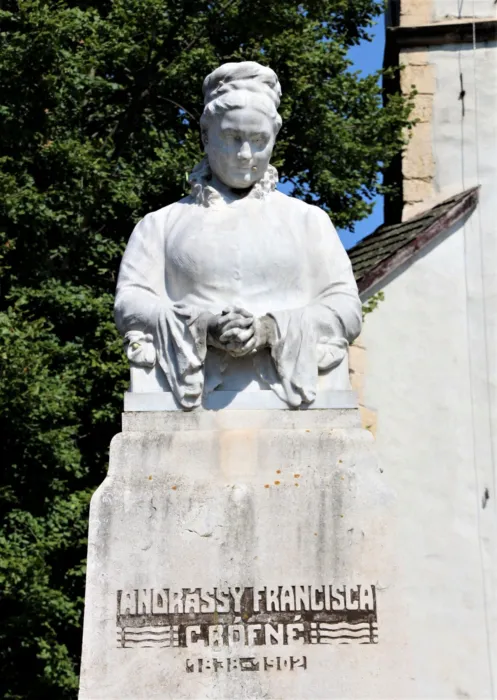
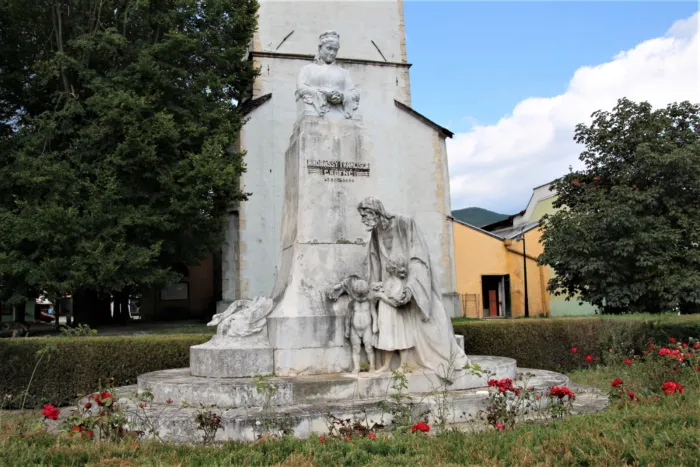
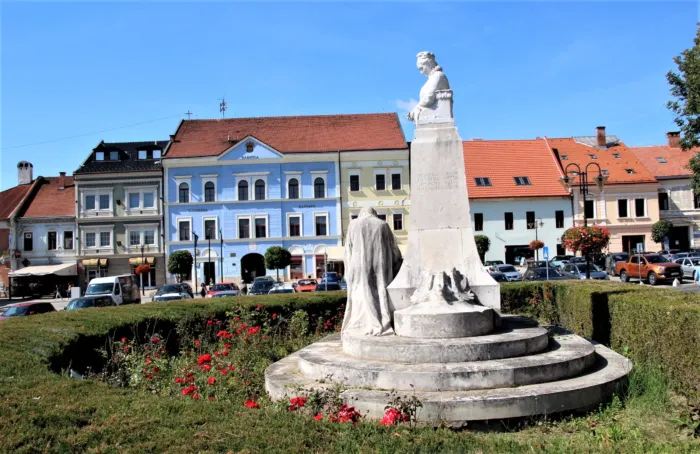
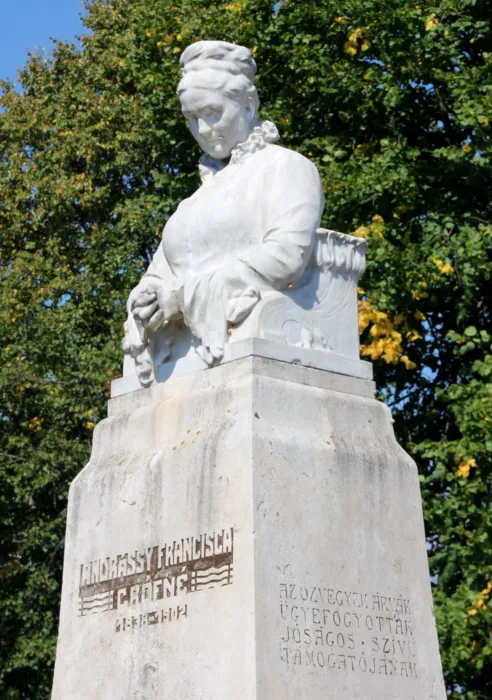
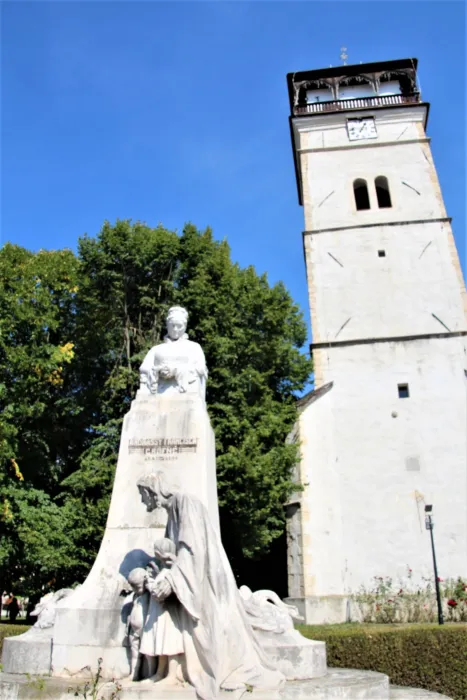
Statue of Countess Franciska Andrássy in Rozsny
Statue, monument, memorial plaque
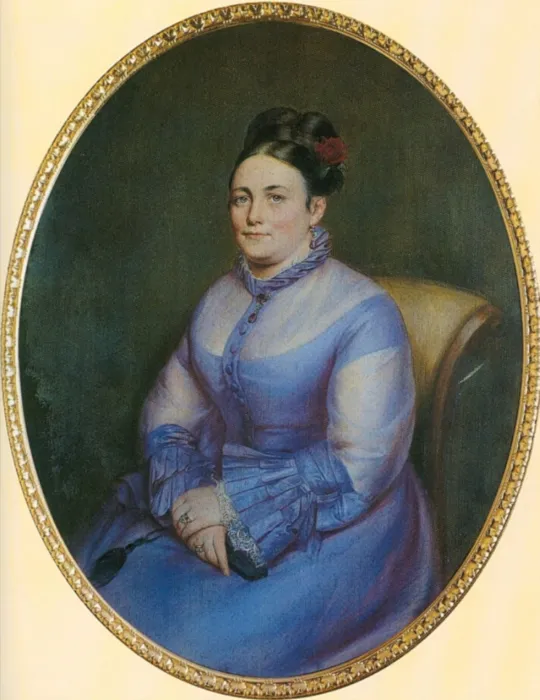
Franziska Seraphica Hablawetz (Vienna, October 4, 1838 – Munich, October 26, 1902) was a Viennese bourgeois, wife of Count Dénes Andrássy, patron of the arts. ; Born on October 4, 1838 in Vienna to Franz Hablawetz and Barbara Dossler, a bourgeois couple. She married Count Dénes Andrássy, the eldest son of Count György Andrássy and Countess Franciska of Königsegg-Aulendorf, on April 6, 1866 in Pisa, despite the protests of her parents. Due to the marriage concluded in a lower rank, her husband, as the heir of the Hoszőrét branch of the Andrássy family, had to renounce his birthright, which was inherited by her younger brother, György Andrássy (1846–1871), but due to his early death, the Andrássy estate reverted to Dénes. ; Hablawetz Franciska lived with her husband mostly in Vienna and Munich, was a well-known patron of the arts, supported charitable and cultural institutions. She died in Munich, on October 26, 1902, at the age of 64. She was buried there, and in 1904 her ashes were transferred to Krasznahorkaváralja, to the Andrássy Mausoleum founded by her husband. ; On September 15, 1903, the city of Rozsnyó announced a tender for a monument to Franciska Andrássy - a generous supporter of schools, kindergartens, hospitals and philanthropic organizations, the founder of the Institute for the Blind and Deaf-Mute - in memory of the daughter of the director of the Vienna Conservatory and from 1866 the wife of Count Dénes Andrássy. This is the theme of the statue and the original inscription on the 4th side of the pedestal refers to this: "The grateful public of the city of Rozsnyó raised it from public donations to the kind-hearted supporter of the widows, orphans, and the disabled, the generous patron of religious life - public education - art". ; The work of sculptors Ödön Szamovolszky and János Horvay was inaugurated on October 29, 1905. The statue bears the stylistic features of Art Nouveau. At the highest point of the sculpture group, on a pedestal, is the bust of the countess. With her hands clasped in prayer, she looks down at the male figure standing in front of the pedestal, who is protectively holding a little girl and a naked little boy. According to the 1905/45 issue of the Vasárnapi Újság, the male figure is depicted by Jesus, but there is also a widespread assumption that he is also a symbol of the poor helped by the countess, like the two little children. The statue of Franciska Andrássy is made of white marble, while the three other figures are made of plaster. ; The statue was removed from the square during the communist era. In its place, a statue depicting a partisan was erected in 1973. It was restored in 1993, then returned to its original place in front of the Fire Tower on the main square.