
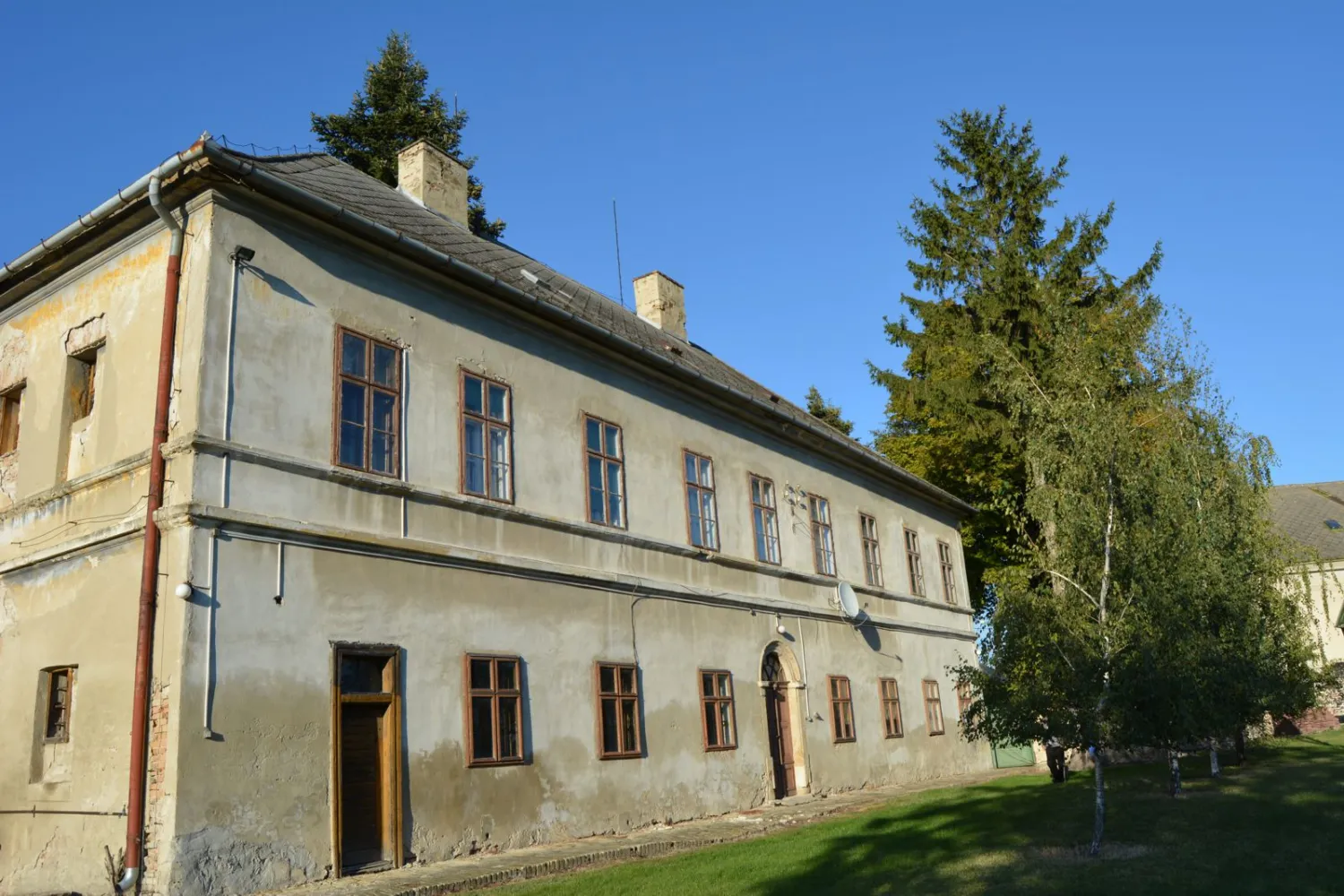
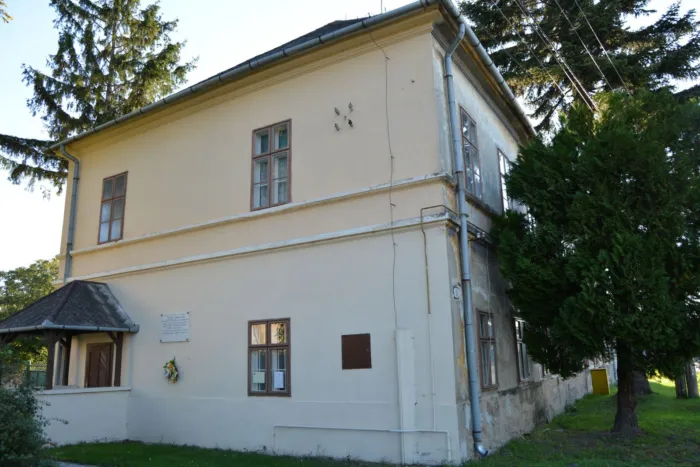
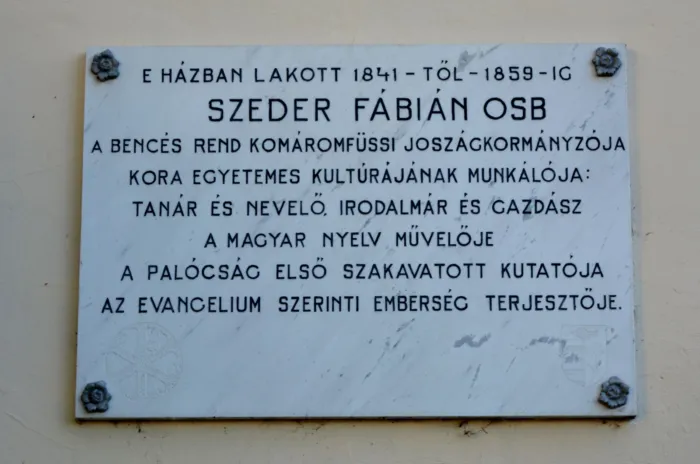
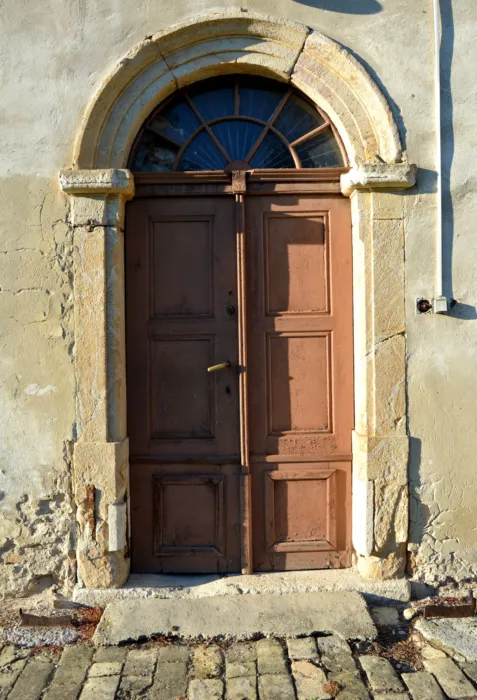
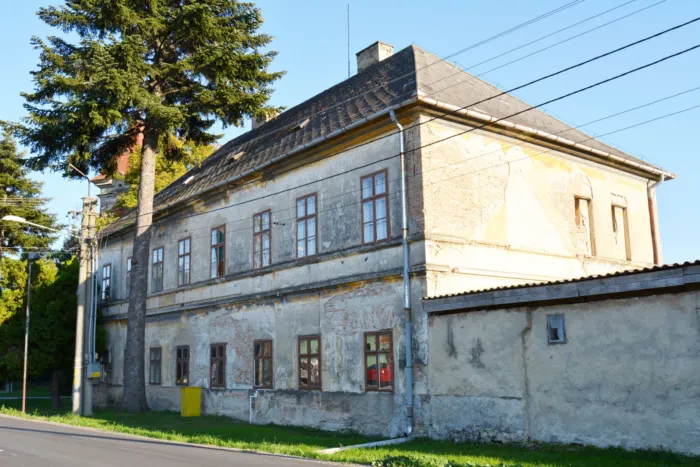
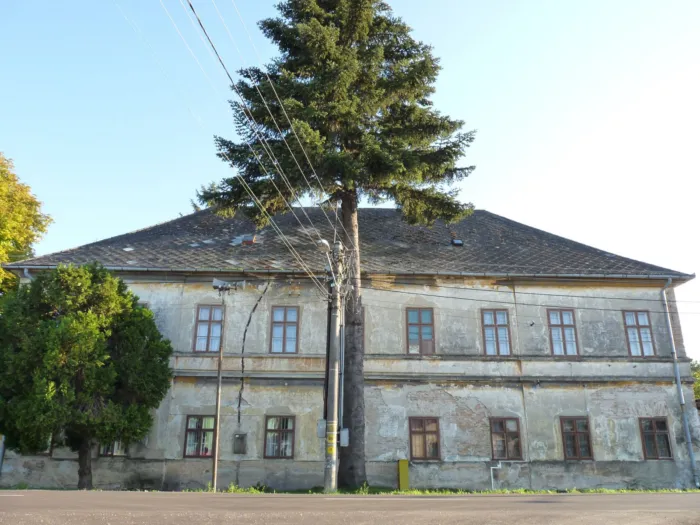
The building of the former Benedictine monastery and the memorial plaque of Fábián Szeder in Komáromfüss
Building, structure
János Fábián Szeder (June 24, 1784, Csáb - December 13, 1859, Füss), Benedictine priest, teacher, the most significant personality who was active in Füss. From 1793 he studied in Ersekújvár and then in Komárom. From 1797 he studied literature with Miklós Révay, from 1798 he studied oratory with István Kulcsár. From 1800 he was a student of philosophy at the Bratislava Academy. In 1802 he held the position of clerk in Esztergom, in 1803 he held the position of economic officer in Nagyszombat. On November 5, 1803 he entered the Benedictine order. He completed his theological studies in Győr and Pannonhalma, and was ordained on August 23, 1808. Between 1808 and 1811, he taught oratory as a high school teacher in Esztergom, literature in Győr in 1811 and 1812, director of the high school in Győr in 1812 and 1813, director of the high school in Sopron in 1813 and 1816, preacher in Dömölk in 1816 and 1817, headmaster and director of the high school in Győr in 1817 and 1819, and held the same position in Nagyszombat in 1819 and 1824, in Komárom in 1824 and 1826, and in Esztergom in 1826 and 1830. Between 1830 and 1832 he was a teacher in Pannonhalma and taught education, aesthetics, documentary studies, and methodology in the 3rd year of philosophy. He also organized the collection of coins, minerals, and antiquities. On February 17, 1831, he was elected a corresponding member of the Hungarian Academy of Sciences. He resigned from his position in 1837. In 1832, he was appointed archivist of the archabbey, and in 1838, librarian. Earlier, in 1823, he had been admitted to the Roman Arcadian society, among whom he bore the name of Ilissia Amintas. He received well-deserved recognition for the arrangement of the garden under the archabbey building. He paid special attention to the cultivation of blackberries, for which the governor honored him. In 1841 he became the governor of the Füss estate and remained in this position until his death. At first he did not want to come to Füss (he replaced Mór Czinár, who refused this position), but in the end he liked it here and was able to devote his time to tree cultivation in peace. The years spent in Füss were among the most productive periods of his work. He examined the quality of the land and experimented with what plant species were most advantageous to grow here. The yields of his fruit trees were famous, he took care of the saplings himself and enjoyed walking among his flowers. He made notes, many famous personalities visited here. He was respectful and fair to people. He was not a follower of the ideals of the Hungarian War of Independence of 1848/49, the old order suited him better. He managed the large estate without any particular problems even after 1850, when it was divided. Initially, he maintained good relations with the archabbey, but in his older years he traveled less. He is buried in the local cemetery. His memorial plaque, which was placed on the parish building, was inaugurated in 1995 in a ceremonial setting. ; His work is noteworthy. He wrote many articles, studies, tales, comedies, poems, which were published between 1819 and 1841 in the following journals: Aurora, Szépliteraturai azánd, Koszorú, Hasznos Mulatságok, Kedveskedő, Uránia, Felsőmagyarországi Minerva, Regélő, Egyházi Tár és Tudományos Gyűjtemény. He was occupied with heraldry, pomology, ethnography, librarianship and other scientific fields. Szeder Fábián can be considered the first Hungarian ethnographer: he published his treatise entitled A’ palóczokról in the prestigious forums of the time. In his work, he described the culture, origin, language, life, and treasures of his people, the Palócoks, which he learned about in Csáb. His work is so extensive that we will only present the most significant ones here. Published in print: ; 1. Song of joy, which was presented to Mr. Ft. György Fehér, when he began the administration of schools and sciences in the Győr royal scientific district, by the Győr royal gymnásium Sz. István hav. 1818. Győr. ; 2. Ode dicata a gymnásio r. Jauriensi ord. S. Benedecti. Győr, 1818. ; 3. The teaching of the Catholics with regard to Protestantism. " Translation from German, Nagyszombat, 1820. ; 4. Selected pieces, which were taken from some distinguished Hungarian works, for the youth who like Hungarian reading. yőr, 1821. ; 5. The death of Azael, or the rapture of Dina. After J. P. Dugát. Pest 1826. ; 6. A small greeting pocket book for the youth. Esztergom, 1827. Second edition. Esztergom, 1827. ; 7. Devotion to Saint John of Nepomuk. Pest, 1829. ; 8. The joy that His Eminence presented to Mr. Sándor Rudnay of Divekujfalus and Rudnay, when, after receiving the insignia of the Cardinalate of the Holy Roman Mother Church from Vienna in January 1829. Fortunately in Esztergom I would arrive. Esztergom, 1829. ; 9. A poem of joy, which he praised. And to Mr. Tamás Kováts, the abbot of the main monastery of St. Martin on the mountain of Pannonia, when he was installed in his splendid chair on Feb. 14. MDCCCXXX. I would be installed with a festive ceremony, in his honor, prepared by Fábián Szeder, a member of the same St. Benedict order. Esztergom, 1830. Several of his manuscript works are placed in the library of the main abbey. Between 1828 and 1833 he edited the Uránia national almanac in Esztergom as a New Year's gift.