
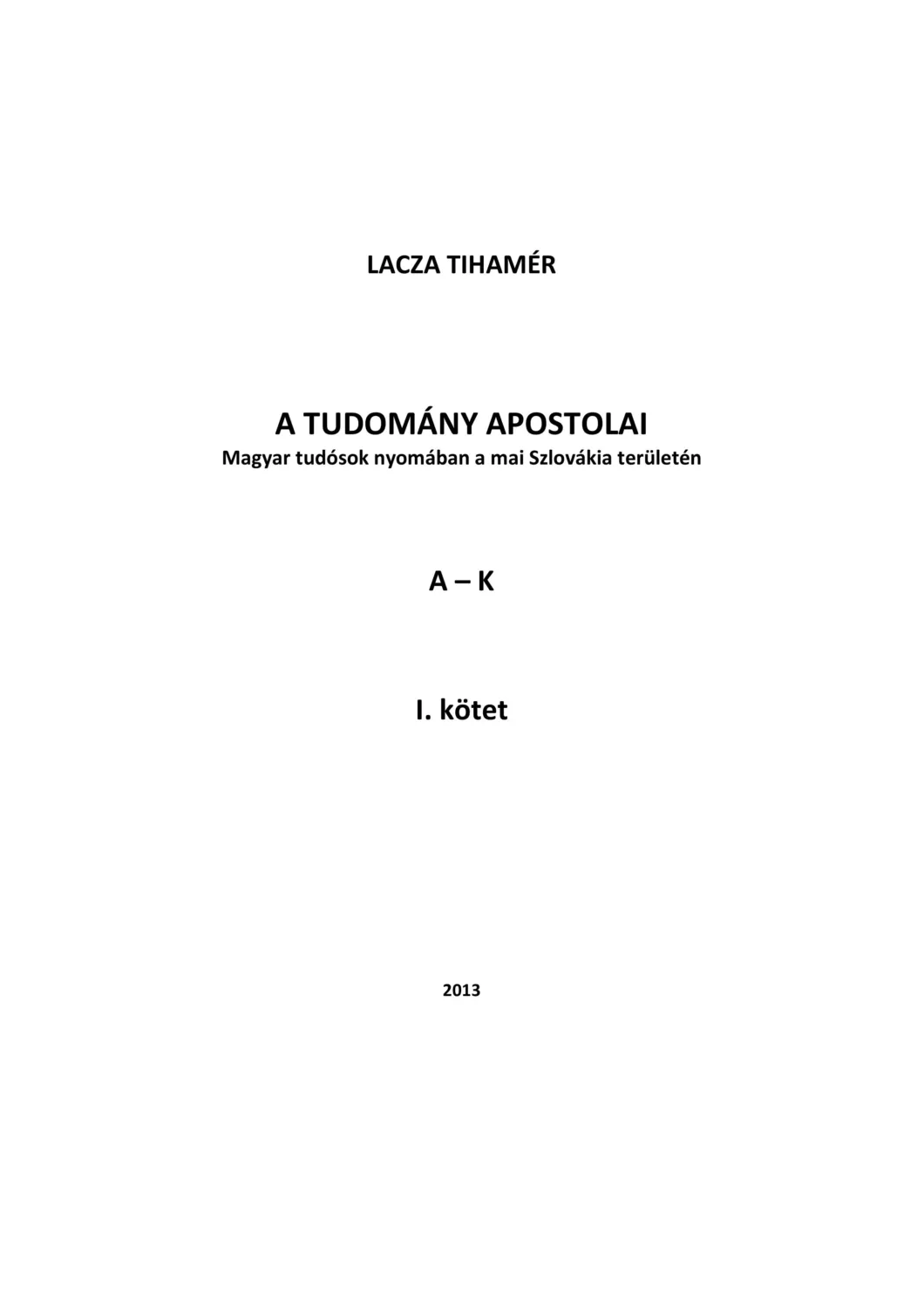
Apostles of Science Part I-II
Book
During my wanderings in the history of science and culture, I often came across the question of what role the homeland, the intellectual environment that launched him towards the sciences and gave him the impetus for his creative work, could play in the life of a scientist. If we take a closer look at the intellectual map of historical Hungary, we will find many settlements in the former Lower and Upper Hungary, that is, in the territory of today's Slovakia, which were the birthplaces or places of operation of numerous Hungarian scientists, technical specialists, teachers who also dealt with science, priests, doctors, and public figures. Quite a few of them got their names on the news, while others worked quietly, almost unnoticed, in the field they had chosen or that was assigned to them. In this region, for more than 1100 years, members of many peoples have lived together, for better or worse, so it is not surprising that they consciously strive to map out their own role in the progress of universal culture and civilization. Even in the most difficult historical periods, educational institutions, intellectual and scientific workshops that were torchbearers of human thought operated here, and they still do today, of course, because despite the various historical eras and empires, men of the spirit continue to do their work to serve the good of humanity. In the following, I invite readers to a special excursion into the history of science and culture, offering a kind of travel guide to briefly present the work of scientists who once lived and worked in the territory of present-day Slovakia, and to place them in space and time on a virtual map, on which they can follow their footsteps in alphabetical order by settlement.
While collecting material, I was surprised myself by how many of them started from secluded small villages, from places that had become completely Slovakized over time, or from places outside the Hungarian-speaking area. Following the career of a scientist or specialist writer seems an exciting task in itself, but this time I have undertaken – without striving for completeness – to at least briefly provide news about all those who have fallen under the spell of science in the former Highlands, now called Slovakia, from the beginning of Hungarian statehood to the present day. On the pages of the volume, Hungarian or
Hungarian-origin, or perhaps Hungarian-born, natural scientists, doctors, engineers, historians, archivists,
archaeologists, priests, economists, literary scholars, i.e. practitioners and representatives of the real and human sciences,
are “paraded”, thus emphasizing the fact that the realm of culture and science is
large enough to have room for everyone1
.
Finally, I would like to thank my friend, co-author, the excellent medical historian, Dr. László Kiss, who helped me with useful advice and observations during the writing of the book.
Tihamér Lacza
While collecting material, I was surprised myself by how many of them started from secluded small villages, from places that had become completely Slovakized over time, or from places outside the Hungarian-speaking area. Following the career of a scientist or specialist writer seems an exciting task in itself, but this time I have undertaken – without striving for completeness – to at least briefly provide news about all those who have fallen under the spell of science in the former Highlands, now called Slovakia, from the beginning of Hungarian statehood to the present day. On the pages of the volume, Hungarian or
Hungarian-origin, or perhaps Hungarian-born, natural scientists, doctors, engineers, historians, archivists,
archaeologists, priests, economists, literary scholars, i.e. practitioners and representatives of the real and human sciences,
are “paraded”, thus emphasizing the fact that the realm of culture and science is
large enough to have room for everyone1
.
Finally, I would like to thank my friend, co-author, the excellent medical historian, Dr. László Kiss, who helped me with useful advice and observations during the writing of the book.
Tihamér Lacza