
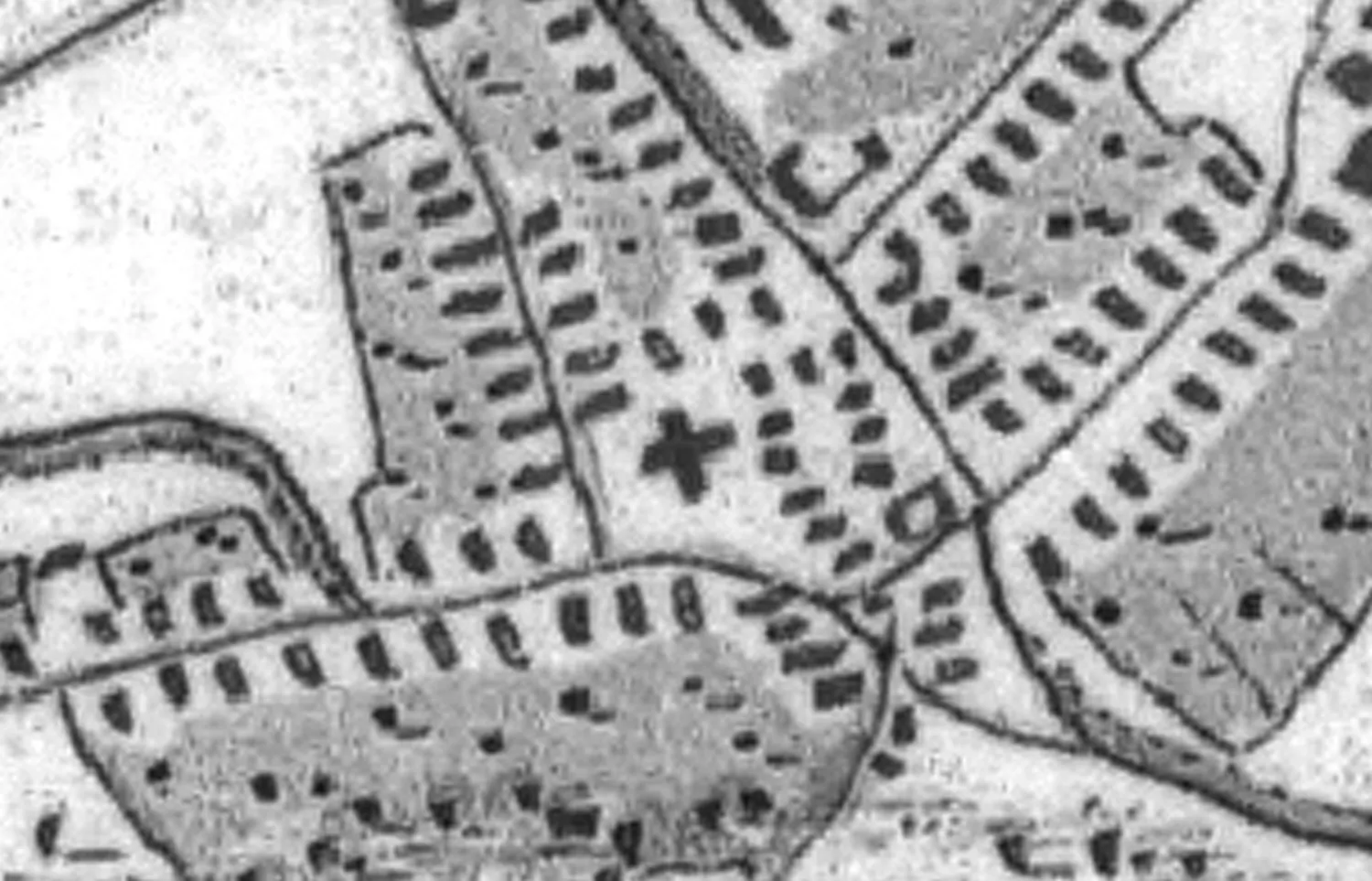
The Szentfundus – the “Szerdahely Castle” – the “old cemetery”
Cemeteries, tombstones, graves
In the former (Danube) Szerdahely, changing the early pagan customs, but certainly from the time of King Saint Ladislaus, the ancestors were buried around the church. The oldest Christian cemetery in the settlement was this cemetery surrounding the Church of Saint George. Documents from the early 1400s confirm that the high stone wall surrounding the church and the cemetery clearly stood, the area delimited by which was then preserved in the popular memory as Szentfundus (Sacere, according to its name: holy, i.e. inviolable plot, area), as the “Szerdahely castle” (still “alive” until the beginning of the 19th century). According to tradition, the settlement was then built next to this wall, “castle”, and as the name suggests, it served as protection for those who fled here on many occasions. ; The cemetery was more than a grave yard at that time, as meetings of the Palatine and the Spanish were held here, for example, but essentially around the church, in the immediate vicinity of the “old cemetery”, was the market place from which Dunaszerdahely essentially got its name. ; We do not know exactly where the stone wall went, but it probably included a large part of the space around the present-day church: perhaps it extended right along the current rows of shops, all the way to the parking lot. We know how it stood when the church was expanded with a side aisle in 1518, but also in 1742–43, when the church was rebuilt and raised. The description of the stone wall can be found in the notes to the map of the first military survey made between 1780–84, and we can read about it in Batthyány's church visitation record of 1781, where it is also mentioned that the Chapel of Our Lord's Passion still stood within the wall (not far from the church). The visitation also reports that the last burial in this oldest cemetery in Szerdahely was in 1780. ; Along with the changes in the settlement, the Church Square naturally took shape over the centuries: at the very beginning of the 19th century, the brick wall surrounding the church and cemetery was removed, and in 1801 the former mortuary chapel was demolished. ; It is interesting that not only the Szentfundus, but also the memory of the cemetery itself was so forgotten after the heart of Szerdahely, i.e. the old town, was incorporated, that for example, in an article published in 1928 in the Csallóközi Lapok, the following was written as a special curiosity: “Traces of a medieval cemetery were found in Dunaszerdahely. During the demolition of the Breuer Salamon house in the vicinity of the Dunaszerdahely Roman Catholic church, traces of a medieval cemetery were found. So far, countless skeletons have been excavated and, alongside the bones, various objects dating from the 12th–13th centuries have been found.” ; The several hundred-year-old parish once stood next to the Szentfundus, which was also demolished during the socialist era due to “urban planning”.