
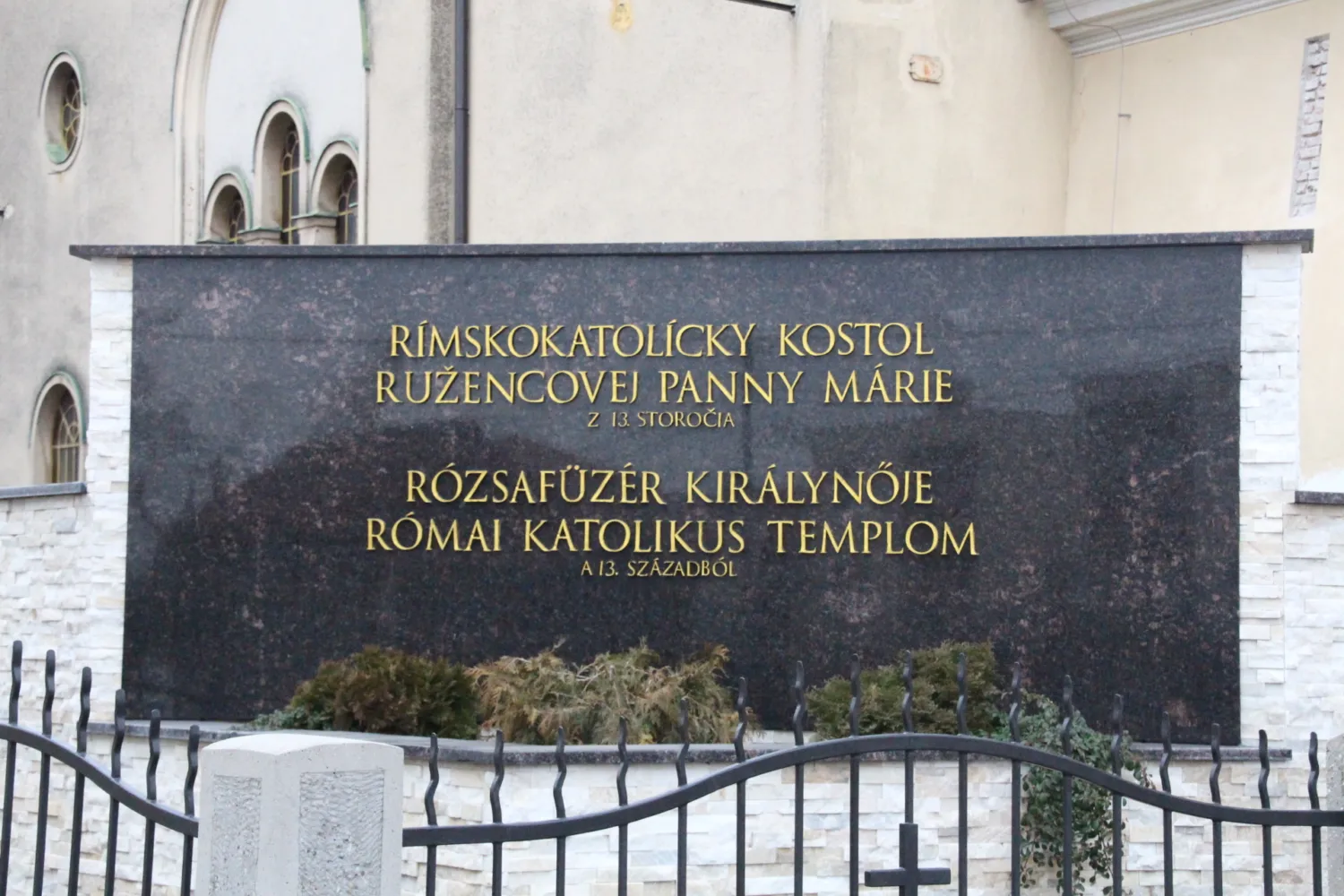
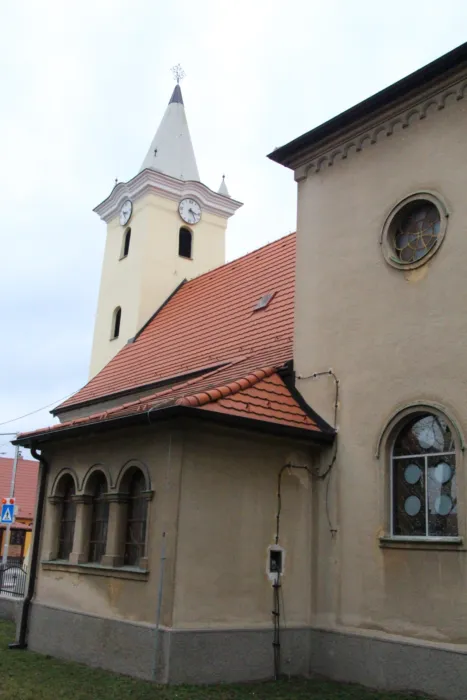
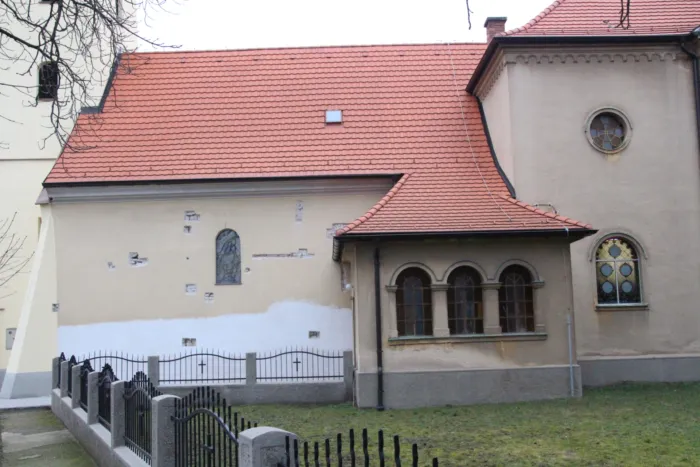
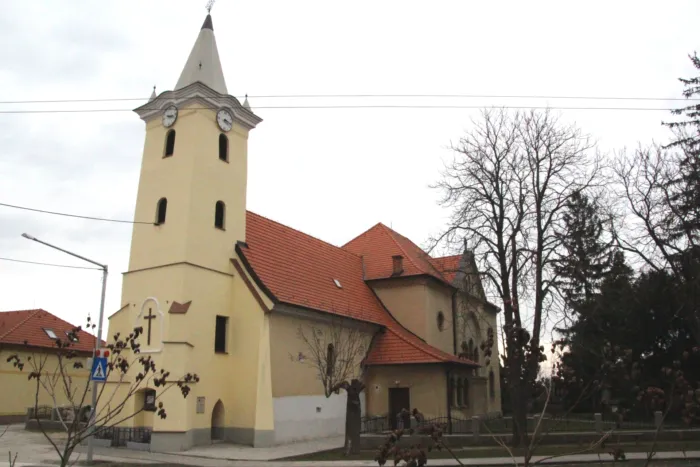
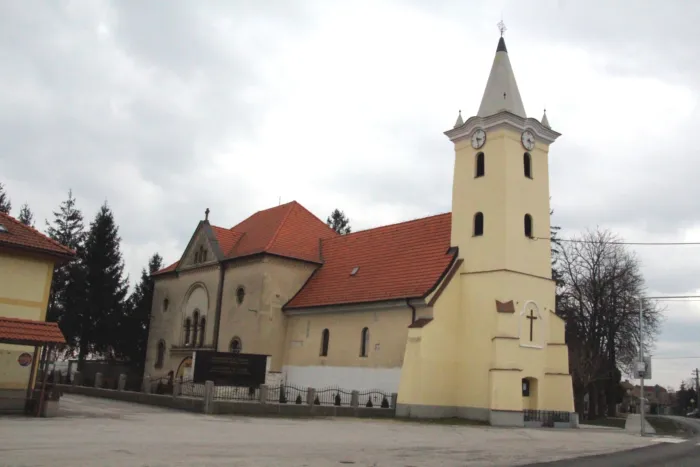
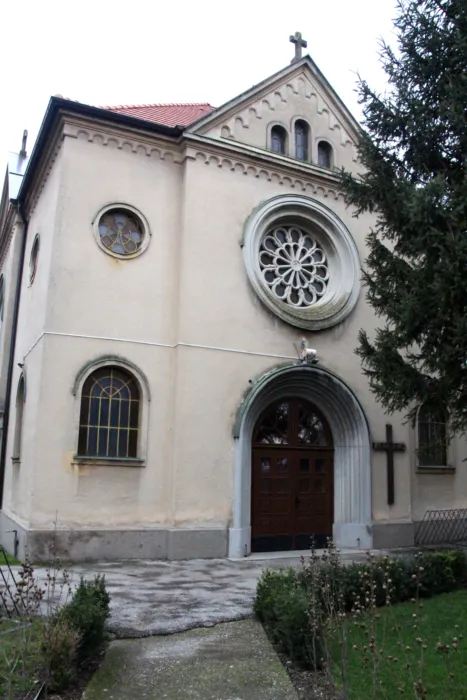
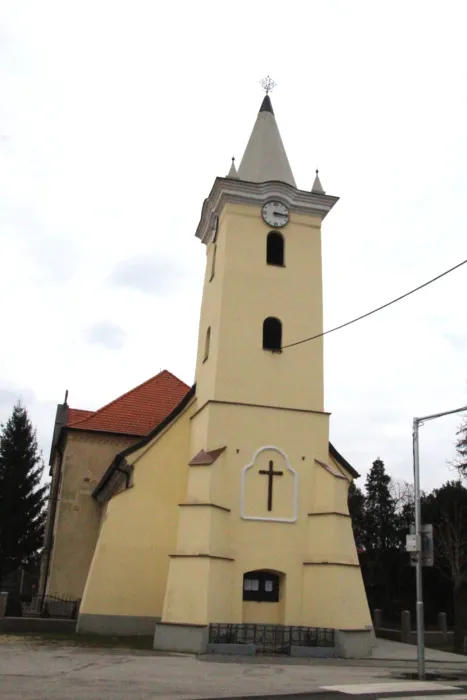
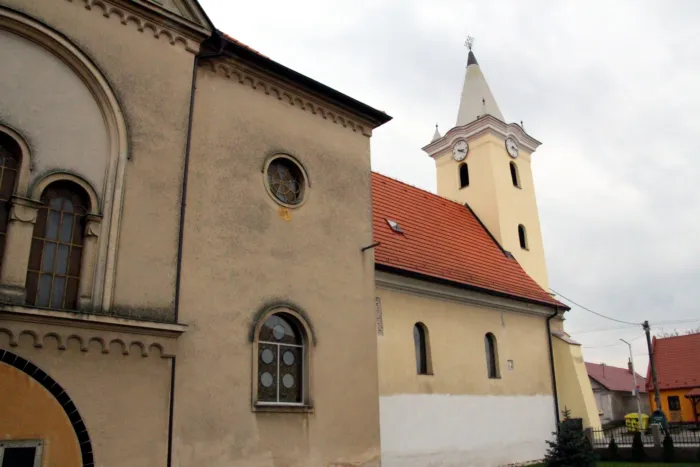
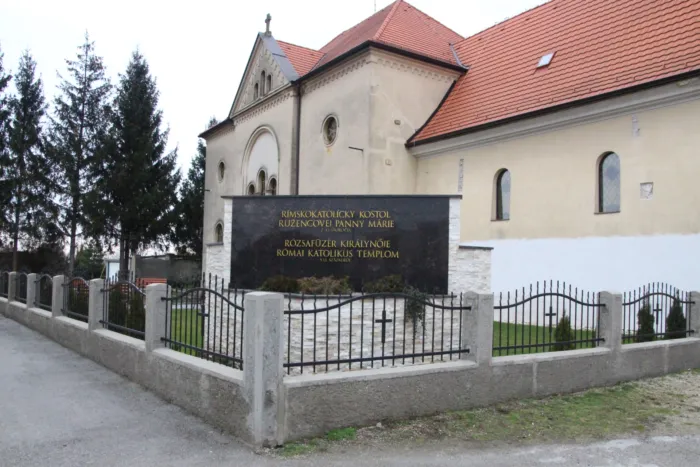
Roman Catholic church dedicated to the Queen of the Rosary
Building, structure
The first church was built in the first half of the 13th century from flat, red bricks laid in hot lime mortar. Its square nave was connected to the east by a semicircular sanctuary, and the fact that its western tower was also built by the beginning of the 1300s is proven by the late Romanesque doorway at the foot of its southern side. The tall, Gothic-proportioned bell tower with stepped transepts at the corners is a relic of the 14th century reconstruction (the exterior of its two upper floors and its late Baroque bell cornice are a legacy of the 1800s). The style of the 1300s is illustrated by the corner pillars of the old nave and two “accidentally” remaining pointed-arched stone door frames, one for the southern entrance to the nave, the other for the medieval sacristy. They can now be seen in their secondary locations. ; The building was completely transformed from its original form in 1933: the Romanesque sanctuary and the upper part of the nave were demolished, and a huge neo-Romanesque “nave” was added to the eastern side of the church. The interior was covered with a coffered flat ceiling, the walls were decorated in neo-Baroque, and the old patronage of Saint Andrew was changed to the Queen of the Rosary. ; The parish is listed as Sancti Andrea in the papal tithe registers between 1332 and 1337, and in 1490 “possessio Eghazfalva alio nomine Zenthandras” can be read in the deed of donation of Mátyás Hunyadi. The king gave the estate of Illyés Szentandrásúri to the Vízközi family, and a few years later Mihály Szüllő (Zyllew) also received a share of the land. In 1507, the widow of Fábián Egyházy, noblewoman Erzsébet, handed over her manor and property to the provost of Bratislava (these were bought back by Péter Olgyay in 1591), in 1533 the sons of Gergely Csorba and Pál shared the lands of Egyházfa. In 1540, the part of the infertile János Csorba was acquired by Tamás Illésházy, the vice-governor of Bratislava. In 1647, the Martonfalva family was among the landlords of the village, and from the middle of the 17th century until the First World War, the Pálffy counts were the largest landowners in the area. ; The inhabitants of Egyházfa converted to the Reformed faith in 1643, but they did not practice the new religion for long. In 1674 they were re-Catholicized by the “persuasion” of Count János Pálffy, from then on the hereditary lords of Bratislava County were the lords of Egyházfa. ; ; Egyházfa (Kostolná pri Dunaji) is located 25 kilometers west of Bratislava, between the Black Water (Cierna voda) and the Small Danube. Its name first appears in writing in 1308 in the form “Egyhazfalu, alias Szent Andrasur”, from which we can learn three things: the ending -fa, as is often the case in Transdanubia, is a shortened form of the village, the patron saint of the medieval parish was the apostle Andrew, the old Hungarians venerated their patron, even the Holy Cross, out of respect.