
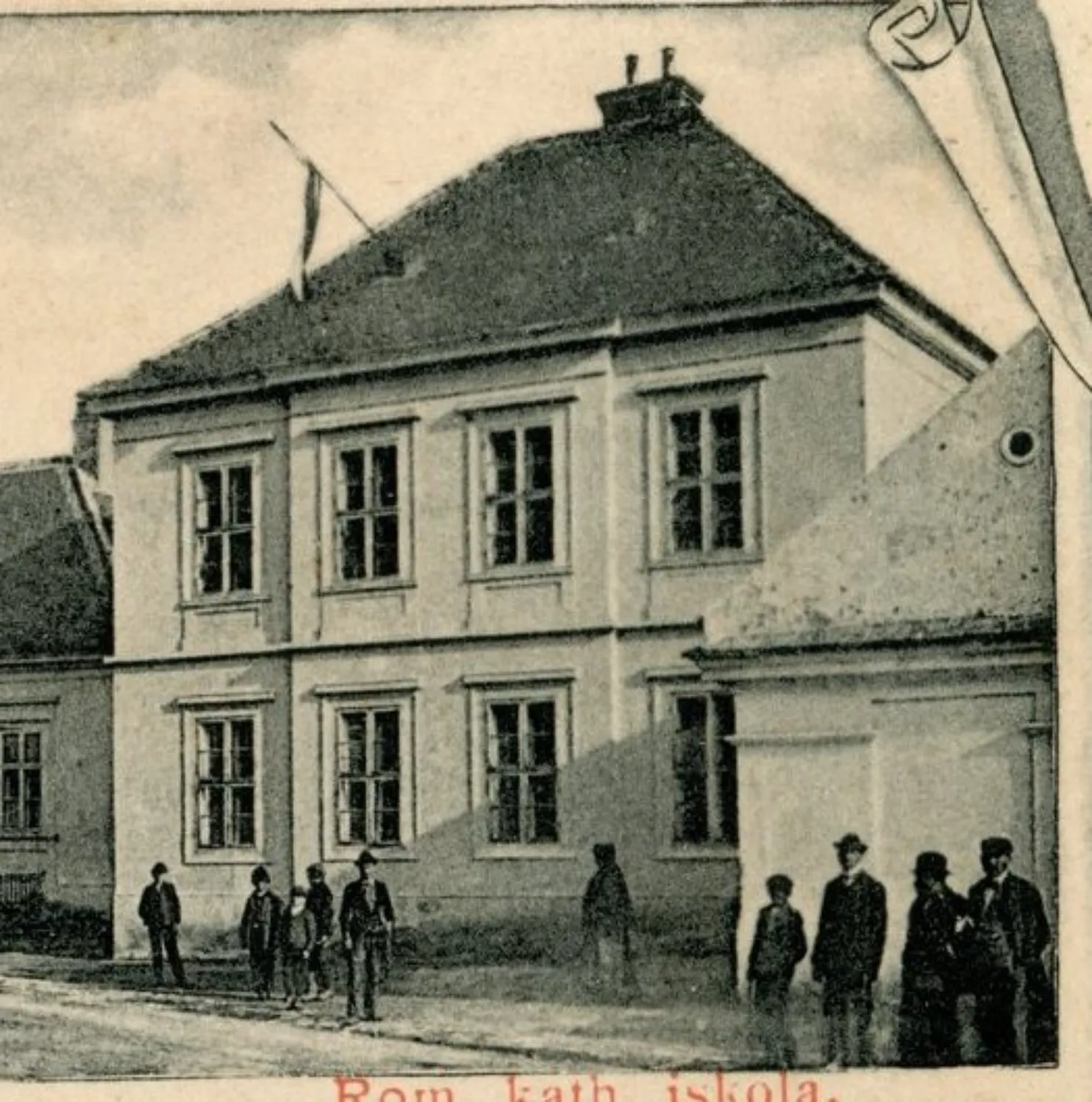
The old Catholic school
Building, structure
We find written evidence of the oldest school in the city as early as 1332 - at that time we also know its teacher (Iwan). Over time, the school's site was expanded by the Pálffy family, who had their small building rebuilt several times (it burned down, etc.), in the simple way that was common at the time: with walls made of adobe and roofed with reeds (and later with wooden shingles). The building also served as the residence of the cantor teacher under the supervision of the parish priest over the centuries. We should imagine a "schoolroom" and a living room as the scene of education in the 16th century, which included a kitchen and a small pantry, and in wealthier places, an outbuilding and a stable. ; The year 1862 marked another milestone for the Catholic parish: namely, the rebuilding of the Catholic school next to the church, at the instigation of the Piarist scholar Benedek Csaplár, born in Dunaszerdahely. In 1861, Csaplár spoke with fiery words at a public meeting in Szerdahely on a holiday about saving the school, which was already quite dilapidated at the time, and at the end of his speech, he donated two hundred forints to the institution. Following him, several representatives outbid each other and thus decided to rebuild the school. On June 10, 1862, the foundation stone was laid on the site of the old, small school with a shingle roof, in which coins were placed in a copper box soldered for posterity, and a writing in which the ancestors established an eternal and immortal memory for the builders of the (re)builders of the Catholic stone school in Dunaszerdahely. The school building was financially supported by the Archbishop of Esztergom, Prince-Primate János Scitovszki, but also by Count Ferenc Zichy (beneficiary of Rény-puszta) and Count Fidel Pálffy. "The schoolhouse is in the shape of the letter "F", with a north-facing facade, from foundation to roof, made of solid material, and built on one floor in the immediate vicinity of the parish. On the first floor are the cantor's 2 rooms and 1 kitchen, facing the street, below the first floor is one classroom in the courtyard, separated from the first classroom by a wider corridor, in the ground-floor building is the second classroom, after which a small corridor from the courtyard led to the assistant teacher's room. Directly after the assistant teacher's room is the cantor's chamber, with a cellar underneath. In the end wing of the building there was a stable and outhouses." - writes Komlóssy about it in his school history. He also notes that the students of the branch communities also attended the newly built school – that is, the students of Balázsfa, Csenkeszfa, Hegybene- and Töböréthe, Kis- and Nagyudvarnok, Léder- and Ollétejed, Pódafa and Sikabony, and the plains of Enyed and Rény. However, after the educational reform of 1868, many of these branches barely remained in contact with the Dunaszerdahely school. ; In 1932, the school was closed for health reasons, but in 1939 the students moved in again when their new school was offered to the gymnasium. After 1945, with the cessation of denominational education, the building was used by several types of schools until its demolition in 1972.