
:
:
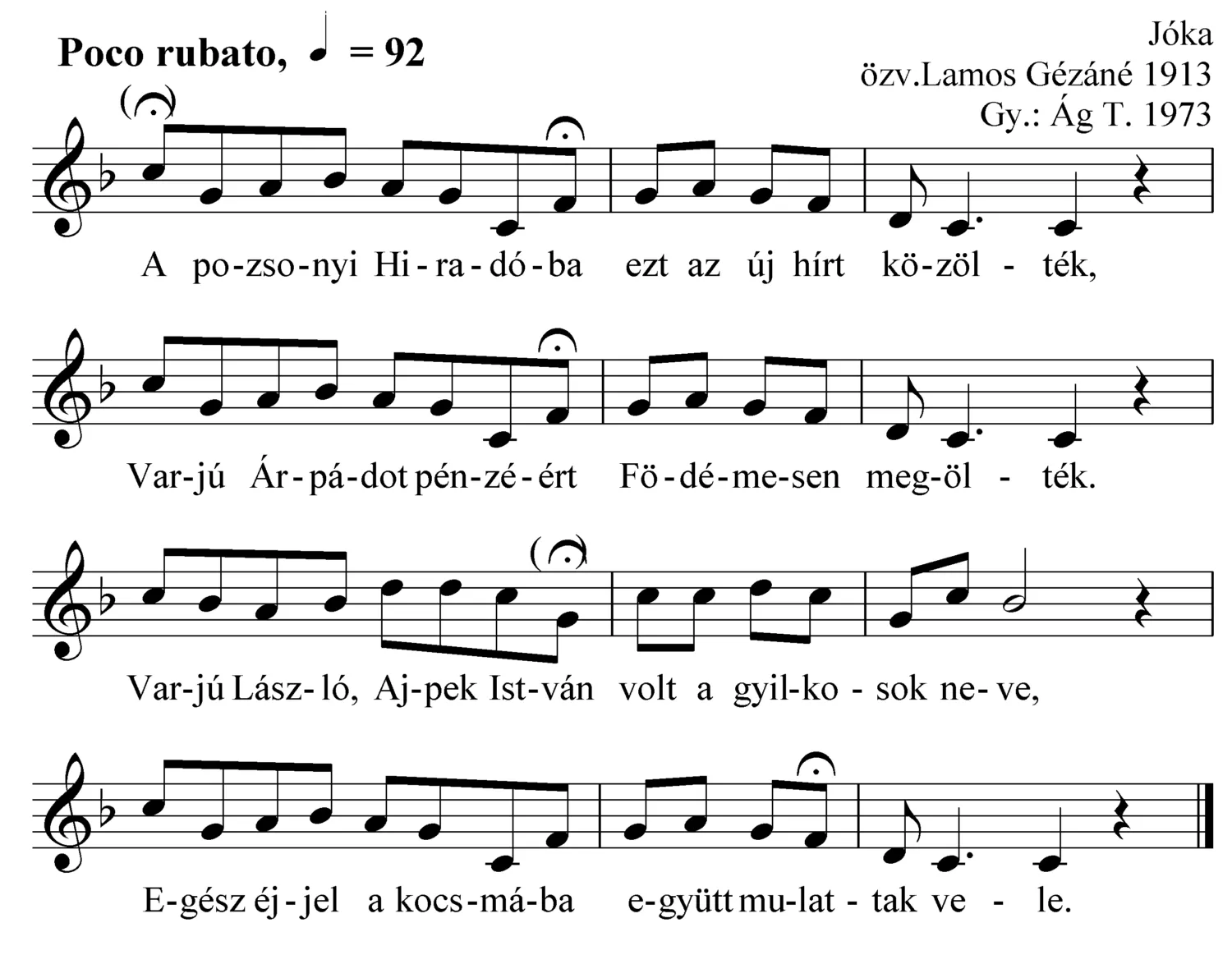
To the Bratislava news station (Árpád Varjú)
Song
1. This new news was announced in the Bratislava News, ; Árpád Varjú was killed in Födémes for money. ; László Varjú, István Ajpek were the names of the murderers, ; They partied with him in the pub all night. ; ; 2. Around midnight, what came to the murderers' minds, ; To trick Árpád into going to Nagyfödémes. ; Both of them held a revolver in their hands, ; They shot three live bullets into Árpád Varjú's heart. ; ; 3. When this murder was committed very quickly, ; That it would not be discovered, they calmly believed. ; But the village night watchman watched them from afar, ; He quickly reported it to relatives and gendarmes. ; ; 4. Árpád Varjú's bloody body was taken to Diószeg, ; He was quietly laid down in the arms of his faithful wife. ; – Alas, who killed my dear partner, that he fell on her while crying, ; In grief and fear, he was silenced by her words. ; ; An additional stanza was sung by 60-year-old Etel Oros Szilveszterné Ázsó in Hegysúr in 1970. ; ; 5. László Varjú sighs: I can't find peace, ; I know that the gendarmes are looking everywhere. ; The gendarmes found him at the Senj fair, ; He was escorted to the Bratislava prison with a sledgehammer. ; ; I wrote down five versions of this story in Jóka. In 1971, Mihályné Hakszer Matild Andrási, a 58-year-old resident of Jóka, added another stanza to the song, which acts as an instructive ending. ; ; 6. – We will never be free again in this world, ; Our crew will wither away in the Bratislava prison. ; – My God, we also know that our sin is very great, ; By rope, by rope our lives will be taken. ; ; This sung murder story was widely spread in the surrounding areas. The song was known not only in Hegysúr, but also in Béké. According to István Bódis, the judge at the time, Jókán, promised a reward to the first person to compose the event into a song. ; Mrs. Szilveszterné Oros from Hegysúr knew that a man named Lamos Lujzi from Jóka was the first to sing this story. This seems to be confirmed by the statement of the widow of Jóka, Mrs. Gézáné Lamos, who learned the song from Lamos Lujzi. ; ; Károly Mórocz, the Hungarian teacher at the Galanta high school, also aroused interest in collecting folklore traditions in his students. The result of this consistent collection work was first published in the school's newspaper "Alkotó Ifjúság". In 1979, the Slovak Pedagogical Publishing House published Károly Mórocz's complete collection of Mátyusföld folklore. In it (p. 9) the eight-verse story of the Jóka murder was published. The informant of this was Alajos Lamos, who was probably the first person to sing the story. ;
; Jóka, ; 1967 ; Sung by: Lamos Alajos ; Collected by: Mórocz K.,Varga L.
; Árpád Varjú ; ; 1. The Bratislava News reported this news: ; Árpád Varjú was killed by the pízijér Födémes. ; László Varjú, István Ajpek: these are the names of the murderers, ; They partied with him all evening in the tavern. ; ; 2. Around midnight, a wicked desire arose in their hearts: ; They escorted Árpád Varjú to the end of the village. ; Both of them held a revolver in their hands, ; They shot three live bullets into Árpád Varjú's heart. ; ; 3. When they committed this murder in secret, ; They thought among themselves that it would not be discovered. ; But the village night watchman watched this from afar, ; He quickly reported it to his relatives and the gendarmerie. ; ; 4. Árpád Varjú's bloody body was taken to Diószęg, ; He was laid quietly in his wife's arms. ; - My dear husband, who murdered me? - she fell on him with great weeping, ; In grief and fear, she fell silent between her words. ; ; 5. László Varjú sighs: - I can't find peace, ; I know very well that the gendarmes are looking everywhere. ; The gendarmes found him in the great market of Szent, ; He was escorted, beaten in irons, to the great prison of Bratislava. ; ; 6. On both sides of the great prison of Bratislava, but yellow, ; The murderers of Árpád Varjú are locked up there. ; The court should question them strictly there, ; So that they confess, so that they tell of all their evil deeds. ; ; 7. (That) I can no longer go to you, little angel, ; I will not hug you, I will not kiss your red lips, your tiny mouth. ; The great heavy iron rattles on my two hands and feet, ; If you have a true heart for me, my little angel, weep now! ; ; 8. We will never be free in this big world, ; Our youth withers away in the prison of Ilava. ; My God, I know well that our sin is indeed great, ; Our lives may be lost on a gallows, by a rope.