
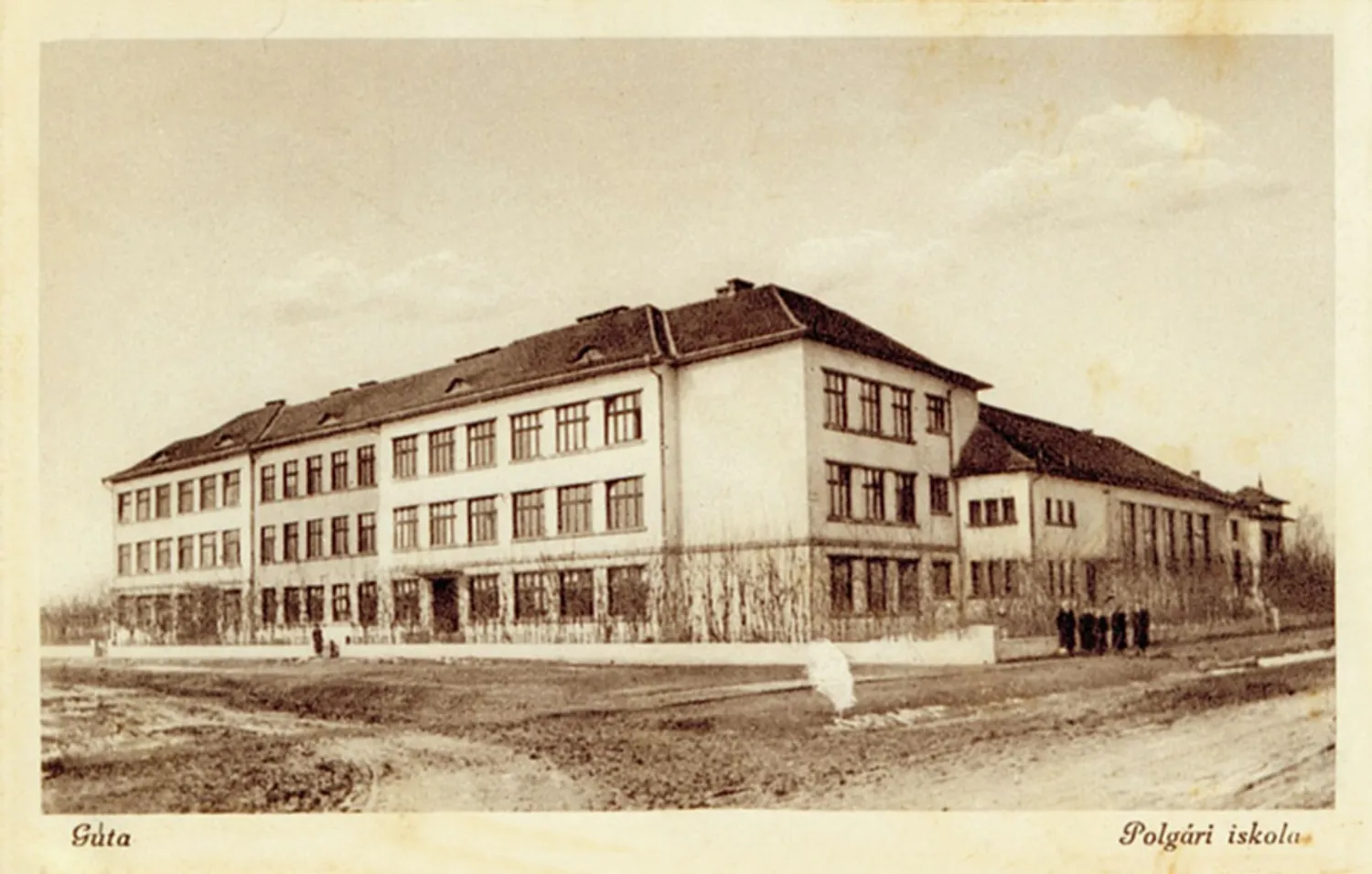
The "old" school in Gúta
Building, structure
At the beginning of the 20th century, Gúta had more than a thousand school-age residents, but despite this, education was provided in only 16 classes in the village until 1918. The 1921 law on compulsory eight-year schooling, the high population growth rate, and the condition of the boys' and girls' schools built in the 19th century made it necessary to develop the school system in Gúta. The local government had already applied for the construction of a new civic school in 1923, but - due to the lack of financial resources - the plans were only approved in 1925. The main supporter of the decision was Viktor Palkovich, parish priest and chairman of the school board. The plans for the two-story modern school building and the accompanying service apartments were prepared by architect J. Novotný. The village assumed the entire cost of the construction, which was covered by a 3 million crown loan. The contractor, the Leindörfer company from Párkány, undertook the construction work for a sum of 2.4 million crowns. The construction and the repayment of the loan did not go smoothly either. The local government was only able to pay the repayment installments by raising additional taxes on the population of the village and taking out new loans. ; The civil school education moved into the new building in the 1930/31 school year. The first director of the institution was János Molnár. The curriculum included Hungarian language, literature, history, geography, ethnography, religious studies, and later national defense knowledge. Teaching was suspended during the war. The civil school building functioned as a military hospital. After the war, only a Slovak school was opened in Gúta in September 1945. The Hungarian teachers were dismissed without financial compensation and the Slovak language became mandatory in the schools. In April of the 1949/50 school year, classes with Hungarian as the language of instruction were established again. In the 1950s, approximately 500-550 children studied at the institution. From the 1961 school year, a new school was built on Május 1. Street (now Iskola Street), so the “old” Nine-Year Elementary School on Pionír Street opened up space for the children of the school on Köztársaság Street (now Mester Street). The first director of the independent institution was Lajos Földi. The year 1965 will remain memorable for all residents of Gúta. The school was one of the few buildings that survived the flood, but teaching was suspended for a year anyway. In the early 1970s, education was suspended for another year due to the modernization of the classrooms. After that, due to the closure of small schools in the area, the number of visitors to the institution continued to grow. In the eighties and nineties, the school operated with 16-17 classes. On May 24, 2003, a three-day celebration commemorated the 75th anniversary of the school's operation. At that time, the institution took the name II. Rákóczi Ferenc Elementary School. Today, the school strives to keep up with the challenges of the 21st century and to continue the educational work of its great predecessors in the spirit of tradition.