
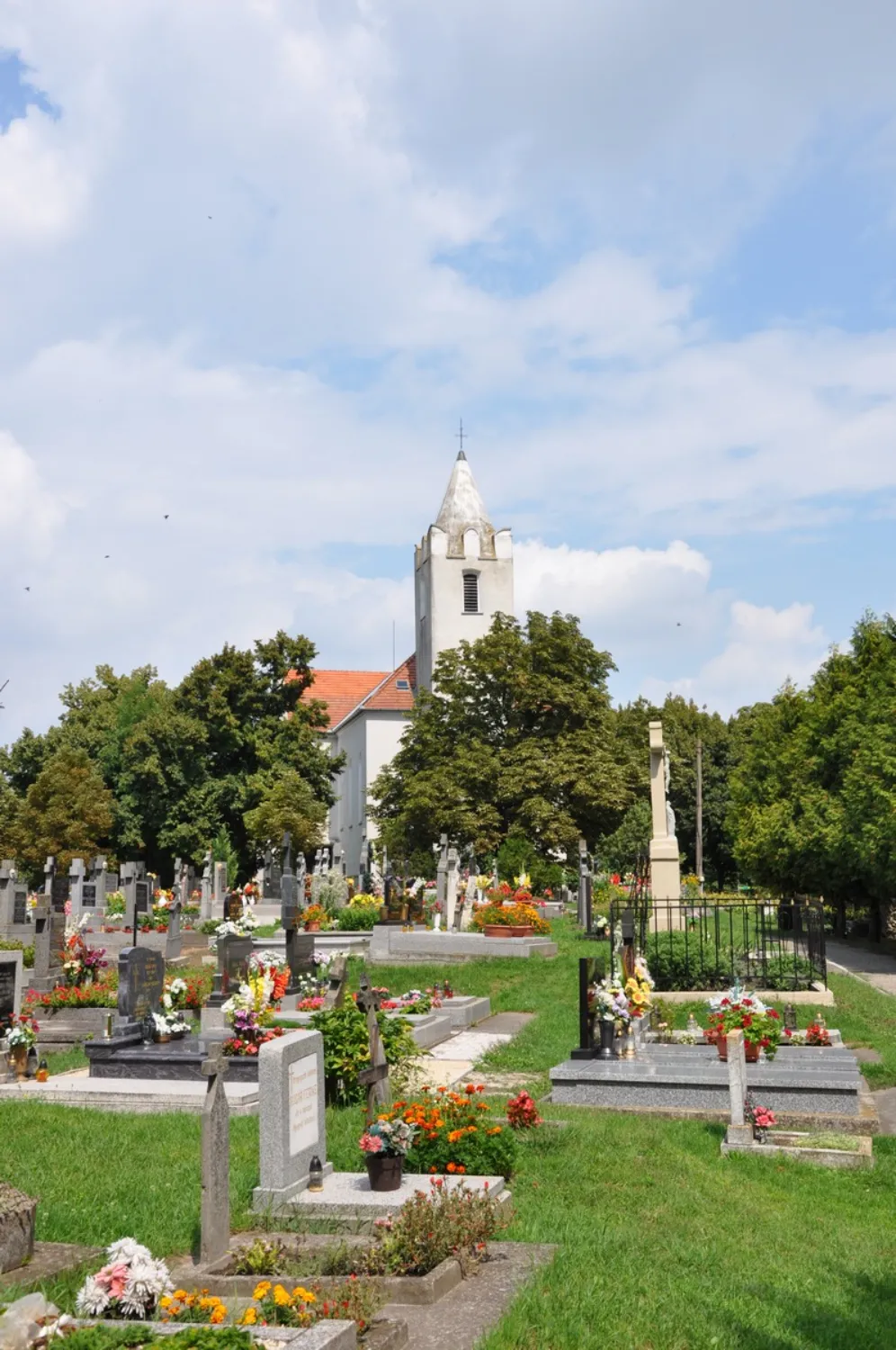
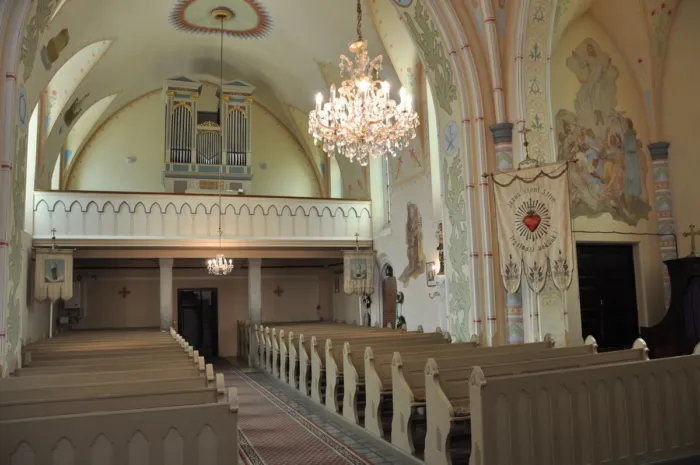
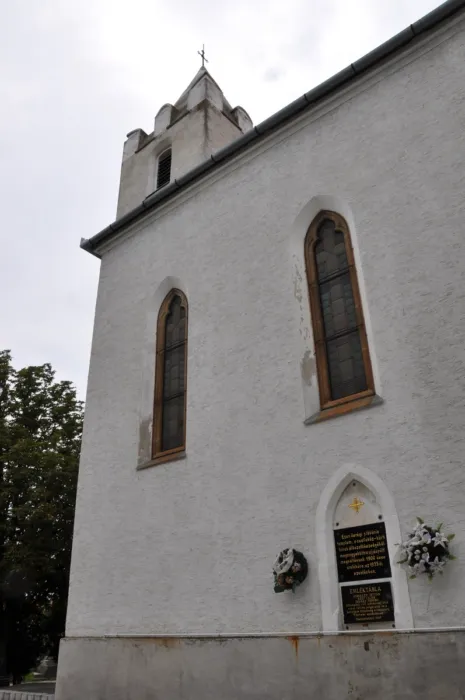
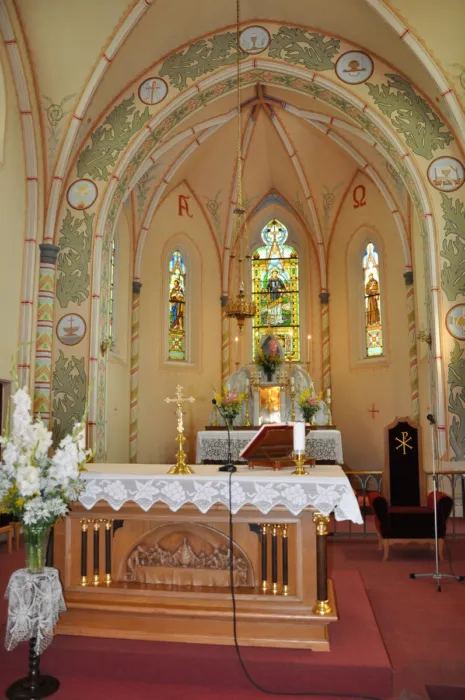
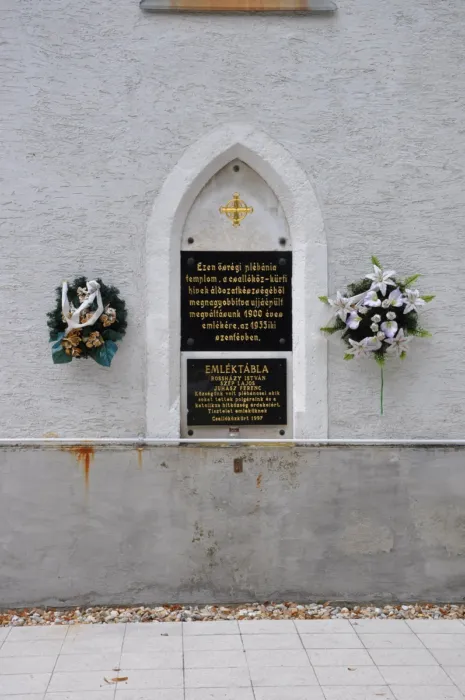
The Church of St. Stephen the Martyr in Csallóközkürt
Building, structure
The ancient church in Kürt probably existed in the Árpád era, from the 13th century, although we do not know with complete certainty about its exact origin. ; In 1276 we meet the priest of the church in Kürt, János, addressed to Saint Stephen in a document, and in 1346 we meet the mention of Egyházaskürt. In 1425, the church (and its tower and cemetery) dedicated to the martyr Saint Stephen of Felsőkürt (Egyházaskürt), which had 18 serf plots, is mentioned, with the remark that the parish priest lives here. In 1482, the great bell, which is still in use today, was placed in the church tower. The text written on the bell in Gothic letters reads: “O rex glorie veni cum pace. O Maria pia sis nobiscum in via Amen. MCCCCLXXXII Magister thoma” (King of glory, come with peace. Oh, pious Mary, accompany me on the way. Amen. 1482 Magister Thomas). This Master Thomas is assumed to be the same as Count Tamás Szentgyörgyi, who probably not only donated the bell, but may also have had the late Gothic church itself built (more precisely, rebuilt or renovated). ; In 1561, the church came into the hands of the Calvinists. In 1634, according to Péter Pázmány’s canonica visitatio (church visitation record), “the extraordinarily beautiful church was condemned to destruction. The faithful had apostatized from their faith and church. The Croatian priest moved to Vásárút.” Or: “the school site is abandoned.” According to the descriptions in the memorial books of the Vásárút parish, – writes Arnod Ipolyi – the Kürt church was one of the most beautiful churches in the region. He continues: “Even the pastors of the last century (1700s – editor’s note) describe the former artistic beauty and richness of this church with real enthusiasm, who saw it only in ruins. Accordingly, the richly ridged pointed arch vault rose on slender column bases, which is now replaced by a rough, flat roof or floor, the walls are covered with magnificent fresco paintings, the altar shone with marble and gold.” ; In 1694, the church was returned to the Catholics, but by this time the building surrounded by the cemetery was almost “just a ruin”. By the beginning of the 1700s, the sacral place, which was in rather dilapidated condition, was renovated. In 1798, the wall paintings were still visible, which were later whitewashed and plastered. The former late Gothic style and beautifully painted church is now only a shadow of itself. ; In 1872, János Simor, the prince-primate of Esztergom, reinstated the parish that had not been filled since 1705, and the Kürt branch became a mother church again. The new parish priest was István Rozsházy, the former parish priest of Kóspallag. A new one was built to replace the unusable school and teachers' apartment. ; In 1888, Cardinal Simor supported the renovation of the church with 400 forints. On this occasion, the people of Kürth send him a letter of thanks, “by which we, the faithful of Csallóköz-Kürth, acknowledge that the construction or repair costs that have arisen and will arise in the future around the church and parish buildings of Csallóköz-Kürth, are in no way the responsibility of the archdiocese treasury, but exclusively ourselves. (...) With regard to the maintenance of our church building, let us fall on our knees for the mercy and grace of His Eminence in the future as well, and cry out: For the love of God, the merits of the Immaculate Virgin and the salvation of our souls, embrace us, protect, guide, support and save us, our Lord, because otherwise we will perish! We cannot live without a local church and parish!” – they wrote. ; 1901: After the death of István Rozsházy, Endre Polcsák became the administrator for a few months, and then in the same year Lajos Szép, the chaplain of the Budapest castle parish, became the parish priest of Kürtre. ; In 1916, Lajos Szép established a credit cooperative in the village, and for his exemplary management, he received the Cross of the Order of Franz Joseph in 1916. In the same year, a decree was issued on the requisition of bells for military purposes. The parish priest managed to get the church authorities to prevent the old large bell from being taken away. On September 13, the military authorities took over the 82-kilo smaller bell, made in 1759. ; 1925: Parish priest Lajos Szép and his sister have a new altar made for the church: Alajos Rigele, a sculptor from Bratislava, created a new marble altar for the sanctuary, on which he made the angels from Carrara marble that came to his workshop from the exploded stumps of the equestrian statue of Maria Theresa in Bratislava, created by sculptor János Fadrusz. ; In 1933, the church, which had already fallen into disrepair by the 1920s, was completely rebuilt almost from the ground up, based on the plans of architect Károly Mahr. “so – except for the tower – the entire church building was completely new from the ground up. The first arch above the sanctuary was completed by the parish priest on July 6th with the installation of the closing brick (...)” – writes Father Ferenc Juhász, who completed the work started by the parish priest Lajos Szép, in the parish chronicle. ; He also describes what was preserved (apart from the tower) from the old Gothic building: ; “A stone frame built into the outer wall of the church framed the inner entrance door of the old church under the tower, which, however, had been bricked up for quite some time – it seems, since the reconstruction carried out after the Reformation riots. The only way to enter and exit the old church was through the door that stood in the place of the aforementioned stone frame, and the same stone frame of which door is now bricked up in the inner side of the back wall of the church nave. In the same wall and opposite it, we can also see stone columns built in, which were the buttresses of the arches of the original old church. The two stone consoles placed in the two corners under the choir are also from the old church. The other two are new,” writes parish priest Juhász in the same place. Sixteen stained glass windows were also made at this time – the main window with the patron saint of the church was donated by the faithful, the ones next to it were donated to the church by János Gaál and his wife, Rozália, and Lajos Házi and his wife. ; The pulpit was made by the altar builder from Galgóc, József Seilnacht, who also renovated the organ. The Lourdes grotto was also moved from the old church, which was also expanded. The blessing of the church was performed on November 19 by the papal prelate Dr. Imre Mayer, abbot and parish priest of Komárom, on behalf of the apostolic administrator – the clergy of the area were represented in large numbers at the ceremony, and several thousand believers were curious about the event. ; In 1934, the Sacred Heart side altar and the Lourdes side altar were replaced. ; In the 1970s, the cemetery chapel was built in an antique style reminiscent of the past, and then the church building was renovated in 1996.